
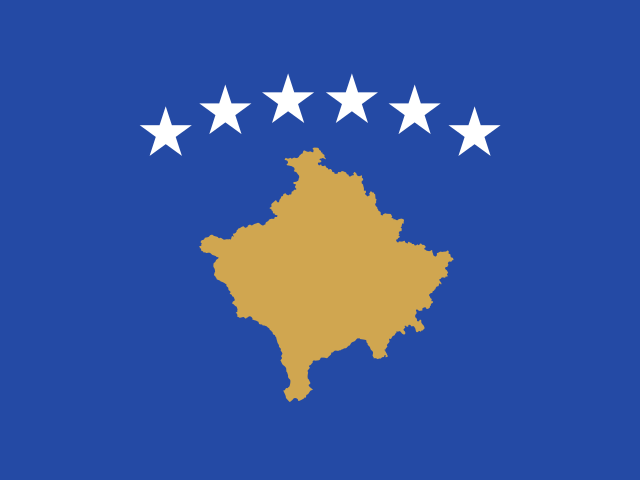
Kosovo
Kosovo is a small Balkan territory characterised by mountain ranges surrounding broad interior plains and valleys. The Šar Mountains dominate the south, while the Accursed Mountains (Bjeshkët e Nemuna) rise along the western border, with rugged peaks, alpine meadows, forests and deep valleys. Lower areas include agricultural land, river valleys and several reservoirs. Forests cover a substantial part of the territory, ranging from oak woodland at lower elevations to beech and conifer forests in the mountains. The climate is predominantly continental, with warm summers and cold, snowy winters, while elevation creates cooler alpine conditions in the highest ranges.
Overview
Kosovo is primarily interesting for Balkan mountain and forest birds. The Šar Mountains and Accursed Mountains support Golden Eagle, Rock Partridge, Alpine Chough and Ring Ouzel, while mature forests provide habitat for Black Woodpecker, Grey-headed Woodpecker and various owls. Lower farmland and open hillsides add European Bee-eater, Red-backed Shrike and raptors, while reservoirs and wetlands attract migrating waterbirds. Birding tourism remains relatively undeveloped, with few dedicated birding facilities, but mountain tourism provides trails and accommodation in several areas. Local guidance can be valuable for remote sites and changing access conditions. Kosovo is best suited to birders interested in quiet Balkan mountain landscapes and southeastern European species, rather than unique endemic targets.
Top 10 target species
| Species | Annual frequency | January | February | March | April | May | June | July | August | September | October | November | December |
|---|---|---|---|---|---|---|---|---|---|---|---|---|---|
| Eurasian Magpie Pica pica | 58.9% | 50.0% | 65.7% | 67.1% | 57.8% | 57.6% | 50.5% | 54.2% | 48.2% | 54.9% | 69.3% | 77.1% | 54.0% |
| Rock Pigeon Columba livia | 52.7% | 47.8% | 58.1% | 62.5% | 62.9% | 49.6% | 45.1% | 51.3% | 60.2% | 53.3% | 50.7% | 47.0% | 43.9% |
| Eurasian Tree Sparrow Passer montanus | 42.1% | 49.2% | 42.5% | 44.5% | 41.8% | 41.4% | 43.3% | 47.1% | 30.1% | 29.2% | 39.6% | 49.3% | 47.4% |
| Mallard Anas platyrhynchos | 41.1% | 22.2% | 30.9% | 48.8% | 54.0% | 47.8% | 42.7% | 57.2% | 50.6% | 29.2% | 41.1% | 42.2% | 26.8% |
| Common Raven Corvus corax | 39.7% | 54.5% | 51.9% | 48.1% | 48.6% | 31.6% | 24.9% | 29.3% | 27.8% | 41.8% | 40.5% | 42.5% | 35.2% |
| Great Tit Parus major | 39.0% | 77.2% | 59.9% | 44.2% | 37.5% | 18.4% | 23.0% | 22.9% | 19.8% | 23.9% | 23.3% | 49.4% | 68.5% |
| Hooded Crow Corvus cornix | 37.9% | 44.2% | 54.1% | 53.0% | 58.4% | 39.7% | 37.0% | 36.5% | 25.7% | 18.0% | 38.4% | 24.0% | 26.0% |
| Common Buzzard Buteo buteo | 37.9% | 37.3% | 46.4% | 49.1% | 40.8% | 17.9% | 20.7% | 24.9% | 41.1% | 44.9% | 31.8% | 52.2% | 47.4% |
| Gray Heron Ardea cinerea | 36.3% | 16.3% | 31.7% | 39.4% | 45.5% | 39.7% | 42.7% | 53.2% | 50.9% | 42.7% | 31.2% | 32.6% | 9.8% |
| European Starling Sturnus vulgaris | 34.4% | 1.5% | 18.3% | 41.1% | 39.6% | 37.7% | 51.6% | 50.5% | 41.6% | 49.4% | 48.3% | 32.3% | 1.2% |