
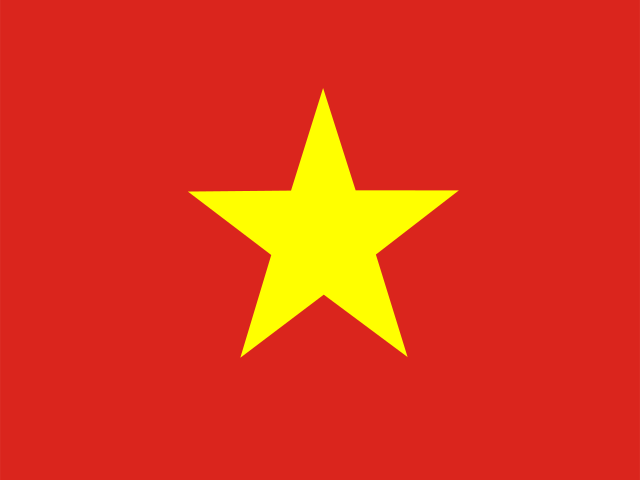
Vietnam
Vietnam stretches along the eastern edge of mainland Southeast Asia, with a long coastline connecting the Red River Delta in the north to the Mekong Delta in the south. Much of the interior is mountainous, including the Annamite Range, whose forests form an important ecological boundary with Laos and Cambodia. Northern Vietnam includes high mountains around Fansipan, subtropical forests and limestone karst, while the central highlands support extensive evergreen and montane forests. Southern Vietnam becomes increasingly tropical, with lowland forests, wetlands and the vast waterways of the Mekong Delta. The climate is strongly monsoonal but varies considerably from the cooler, seasonal north to the tropical south.
Overview
Vietnam is one of Southeast Asia's most important destinations for endemics and restricted-range forest birds. The Dalat Plateau is particularly famous, with specialties including Collared Laughingthrush, Vietnamese Greenfinch and Dalat Shrike-Babbler. Cat Tien National Park offers accessible lowland forest birding for Green Peafowl, pittas, hornbills and broadbills, while Bach Ma and Cuc Phuong add rich montane and northern forest communities. The Annamites contain some exceptionally rare species, including Crested Argus and several recently discovered or highly localised birds. Vietnam has an established specialist birding-tour industry and local guides, while roads and domestic flights make the main regions relatively accessible. However, seeing the country's full endemic complement requires considerable travel between widely separated sites.
Top 10 target species
| Species | Annual frequency | January | February | March | April | May | June | July | August | September | October | November | December |
|---|---|---|---|---|---|---|---|---|---|---|---|---|---|
| Eurasian Tree Sparrow Passer montanus | 24.4% | 19.1% | 19.6% | 19.5% | 23.5% | 24.8% | 33.9% | 32.4% | 31.7% | 27.0% | 20.3% | 22.0% | 18.8% |
| White-nest Swiftlet Aerodramus fuciphagus | 21.7% | 24.7% | 22.5% | 20.4% | 18.2% | 20.5% | 21.2% | 26.4% | 26.0% | 21.0% | 15.9% | 21.9% | 21.1% |
| Greater Coucal Centropus sinensis | 20.3% | 18.5% | 21.5% | 23.7% | 23.2% | 27.4% | 25.8% | 24.8% | 22.0% | 16.2% | 11.2% | 14.3% | 15.0% |
| Spotted Dove Spilopelia chinensis | 18.2% | 19.0% | 20.1% | 17.8% | 16.0% | 18.6% | 20.5% | 21.1% | 22.9% | 15.8% | 13.7% | 16.6% | 16.6% |
| Common Tailorbird Orthotomus sutorius | 17.6% | 16.3% | 16.7% | 16.2% | 15.9% | 17.9% | 20.3% | 17.9% | 19.8% | 22.1% | 16.0% | 15.7% | 15.9% |
| Chinese Pond-Heron Ardeola bacchus | 17.0% | 24.2% | 22.5% | 21.7% | 20.6% | 12.4% | 5.4% | 4.3% | 6.8% | 18.1% | 19.3% | 24.1% | 24.4% |
| Sooty-headed Bulbul Pycnonotus aurigaster | 15.7% | 14.8% | 16.1% | 14.9% | 14.7% | 16.2% | 20.1% | 18.9% | 14.0% | 16.0% | 12.5% | 14.8% | 15.5% |
| White-throated Kingfisher Halcyon smyrnensis | 15.5% | 15.3% | 16.0% | 16.2% | 11.9% | 14.7% | 16.3% | 20.1% | 17.2% | 17.2% | 14.3% | 13.1% | 14.0% |
| Zebra Dove Geopelia striata | 15.5% | 16.1% | 15.7% | 13.2% | 11.0% | 13.4% | 17.0% | 19.7% | 21.3% | 18.7% | 13.1% | 13.3% | 13.3% |
| Ashy Drongo Dicrurus leucophaeus | 15.1% | 20.2% | 21.7% | 21.2% | 14.2% | 13.0% | 9.5% | 8.2% | 6.3% | 12.3% | 16.1% | 17.3% | 21.1% |