
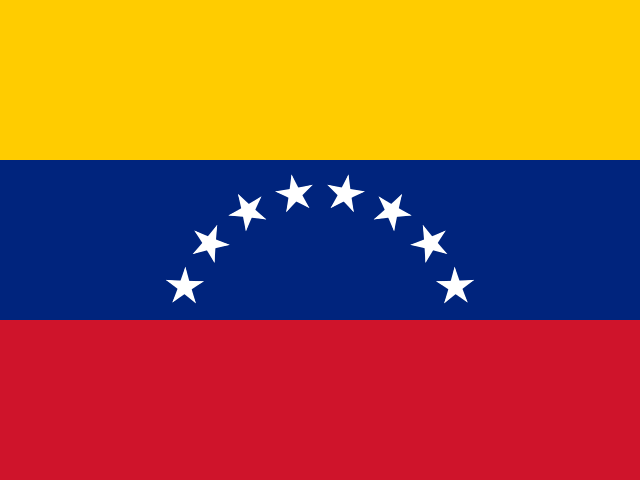
Venezuela
Venezuela contains an unusually broad range of landscapes, from the Andes and Caribbean coast to the vast Llanos, Orinoco lowlands, Amazonian forests and Guiana Highlands. The southeast is dominated by the spectacular tepuis, isolated sandstone plateaus that rise above surrounding savannas and forests. Canaima National Park combines these formations with extensive rivers, waterfalls and gallery forests, including the 979-metre Kerepakupai Vená (Angel Falls). The northern Andes and coastal ranges create cooler mountain environments, while the Llanos form an enormous seasonal wetland and grassland system. The country also includes dry forests, mangroves and Caribbean islands, giving Venezuela remarkable ecological variety. The tepuis are especially distinctive because their isolated summits function as ecological islands, supporting plants and animals found nowhere else.
Overview
Venezuela is exceptionally valuable for endemics and specialised regional birds, with particularly rich communities in the Andes, coastal mountains and tepuis. The Henri Pittier National Park is a major northern site, combining cloud forest with an important migration corridor and numerous endemic or range-restricted species. The Venezuelan Andes are notable for species such as White-bearded Helmetcrest, Mérida Sunangel and Venezuelan Sylph, while the tepuis support specialised Pantepui birds, including Tepui Tinamou. Other major birding regions include the Llanos and Amazonian south. Venezuela would be a major destination for an endemic-focused birder, but current travel conditions and limited flight availability make independent birding difficult; official travel advice currently recommends against non-essential travel.
Top 10 target species
| Species | Annual frequency | January | February | March | April | May | June | July | August | September | October | November | December |
|---|---|---|---|---|---|---|---|---|---|---|---|---|---|
| Blue-gray Tanager Thraupis episcopus | 40.6% | 38.2% | 39.3% | 43.2% | 49.2% | 46.1% | 47.9% | 42.8% | 38.0% | 39.1% | 35.8% | 34.6% | 32.4% |
| Tropical Kingbird Tyrannus melancholicus | 36.5% | 34.4% | 33.2% | 34.6% | 38.5% | 37.7% | 41.7% | 40.0% | 39.9% | 39.9% | 33.6% | 32.5% | 31.6% |
| Black Vulture Coragyps atratus | 35.1% | 35.4% | 35.1% | 36.3% | 36.5% | 32.5% | 35.5% | 35.6% | 37.9% | 37.6% | 33.7% | 33.3% | 31.7% |
| Southern House Wren Troglodytes musculus | 31.5% | 30.0% | 27.9% | 30.9% | 37.5% | 34.1% | 36.4% | 34.0% | 31.1% | 29.9% | 27.9% | 30.0% | 28.4% |
| Great Kiskadee Pitangus sulphuratus | 29.4% | 29.4% | 29.0% | 31.2% | 33.9% | 30.2% | 32.6% | 29.4% | 27.7% | 29.7% | 27.5% | 26.8% | 26.0% |
| Bananaquit Coereba flaveola | 24.7% | 25.7% | 26.5% | 27.3% | 30.3% | 25.6% | 25.9% | 24.0% | 23.2% | 25.2% | 21.2% | 20.7% | 20.3% |
| Tropical Mockingbird Mimus gilvus | 23.3% | 23.2% | 22.2% | 23.3% | 24.3% | 21.9% | 21.8% | 22.0% | 24.8% | 26.8% | 25.4% | 22.3% | 21.5% |
| Saffron Finch Sicalis flaveola | 23.1% | 19.9% | 18.5% | 19.5% | 22.3% | 22.5% | 27.2% | 27.2% | 29.1% | 28.5% | 24.1% | 20.6% | 17.5% |
| Red-crowned Woodpecker Melanerpes rubricapillus | 21.3% | 21.0% | 22.0% | 24.0% | 26.7% | 23.4% | 24.1% | 22.2% | 20.3% | 21.1% | 17.6% | 16.2% | 16.7% |
| Chestnut-fronted Macaw Ara severus | 17.9% | 18.4% | 17.3% | 18.3% | 19.5% | 17.4% | 18.9% | 17.6% | 17.3% | 19.2% | 16.5% | 17.5% | 16.5% |