
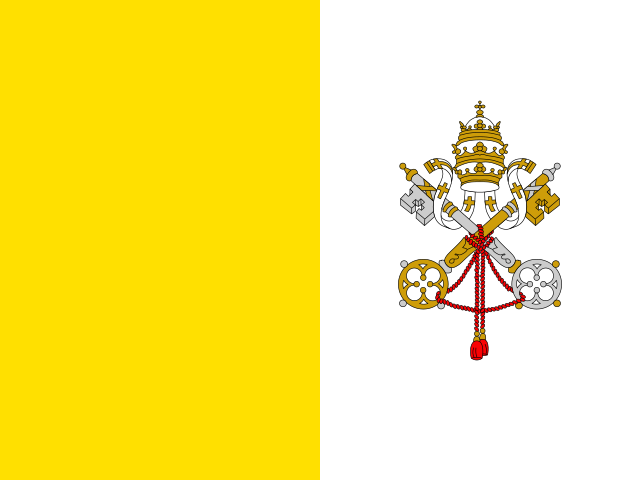
Vatican City
Vatican City is the world's smallest independent state, occupying just 0.44 km² within Rome. Almost the entire territory consists of buildings, courtyards and landscaped grounds associated with the Holy See, including St Peter's Basilica, the Apostolic Palace and the Vatican Gardens. The gardens cover a substantial part of the state and contain mature trees, lawns, fountains and ornamental plantings, providing its main green space. The climate is Mediterranean, with hot, dry summers and mild, wetter winters, essentially identical to that of surrounding Rome.
Overview
Vatican City has no distinctive endemic birdlife, but the Vatican Gardens provide habitat for common urban and woodland birds within central Rome. Typical species include European Robin, Eurasian Blackbird, Italian Sparrow, European Serin and Eurasian Blackcap, while Common Swifts are conspicuous over the city in summer. Migrants may also stop in the gardens during spring and autumn. Birding access is limited because much of Vatican City is not freely open to the public, and the gardens generally require an organised visit. For birders, Vatican City is mainly a novelty listing destination, easily combined with the much broader birding opportunities around Rome and central Italy.
Top 10 target species
| Species | Annual frequency | January | February | March | April | May | June | July | August | September | October | November | December |
|---|---|---|---|---|---|---|---|---|---|---|---|---|---|
| Yellow-legged Gull Larus michahellis | 85.8% | 93.8% | 90.0% | 90.8% | 91.1% | 79.6% | 90.1% | 76.4% | 79.4% | 75.8% | 89.5% | 82.0% | 91.3% |
| Rock Pigeon Columba livia | 82.0% | 79.3% | 77.5% | 80.2% | 86.2% | 84.7% | 80.6% | 78.3% | 84.1% | 76.7% | 81.0% | 81.4% | 93.9% |
| Hooded Crow Corvus cornix | 63.5% | 63.1% | 72.5% | 57.1% | 61.4% | 62.8% | 51.9% | 62.7% | 58.3% | 52.2% | 76.6% | 77.0% | 66.2% |
| Italian Sparrow Passer italiae | 51.0% | 51.4% | 55.0% | 61.3% | 52.0% | 52.0% | 49.9% | 51.9% | 39.0% | 44.1% | 43.7% | 44.3% | 67.7% |
| Rose-ringed Parakeet Psittacula krameri | 35.7% | 40.6% | 42.5% | 46.3% | 38.4% | 24.3% | 17.3% | 20.4% | 27.1% | 37.3% | 29.4% | 51.0% | 53.5% |
| Common Swift Apus apus | 24.9% | 0.0% | 0.0% | 3.0% | 49.9% | 62.5% | 72.4% | 52.5% | 32.5% | 17.9% | 8.5% | 0.0% | 0.0% |
| Monk Parakeet Myiopsitta monachus | 18.2% | 18.5% | 20.0% | 31.4% | 9.5% | 12.9% | 7.4% | 12.6% | 14.9% | 21.2% | 18.1% | 19.8% | 31.9% |
| European Starling Sturnus vulgaris | 17.3% | 7.7% | 15.0% | 23.5% | 18.6% | 26.7% | 12.5% | 12.2% | 4.8% | 12.5% | 22.3% | 27.3% | 24.5% |
| White Wagtail Motacilla alba | 15.1% | 16.8% | 22.5% | 21.6% | 7.6% | 8.4% | 7.1% | 10.1% | 2.7% | 8.9% | 15.9% | 26.4% | 33.7% |
| Eurasian Blackbird Turdus merula | 14.7% | 7.7% | 20.0% | 30.5% | 22.4% | 26.4% | 11.8% | 13.6% | 7.7% | 7.1% | 5.7% | 9.1% | 14.8% |