
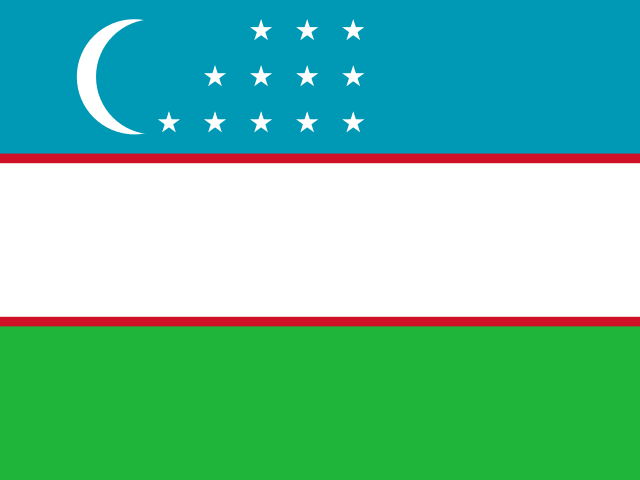
Uzbekistan
Uzbekistan lies at the heart of Central Asia, dominated by arid plains, deserts and irrigated river valleys. Much of the west is occupied by the Kyzylkum Desert, while the east rises into foothills and mountains connected to the western Tien Shan and Pamir-Alay systems. The Amu Darya and Syr Darya have historically supported fertile agricultural regions and the great Silk Road cities of Samarkand, Bukhara and Khiva. In the northwest, the dramatically diminished Aral Sea has left extensive salt flats and the new Aralkum Desert. Uzbekistan has a strongly continental, predominantly dry climate, with hot summers and cold winters.
Overview
Uzbekistan offers a distinctive combination of Central Asian desert, steppe and mountain birds. The country's signature species is Pander's Ground Jay, a highly specialised resident of the Kyzylkum Desert and a major target for visiting birders. Desert and semi-desert habitats also support Macqueen's Bustard, sandgrouse, larks and wheatears. The mountains east of Tashkent, particularly around Chimgan and Ugam-Chatkal, add raptors and high-altitude species such as Himalayan Griffon, Lammergeier and White-winged Grosbeak. Wetlands and reservoirs provide important migration stopovers in an otherwise arid landscape. Specialist birding tours are available, and the country's established cultural-tourism infrastructure makes it relatively easy to combine birding with Samarkand, Bukhara and other Silk Road sites. Long drives are often necessary to reach the best desert habitats, but the major birding regions are reasonably accessible.
Top 10 target species
| Species | Annual frequency | January | February | March | April | May | June | July | August | September | October | November | December |
|---|---|---|---|---|---|---|---|---|---|---|---|---|---|
| Common Myna Acridotheres tristis | 54.9% | 46.4% | 45.1% | 43.6% | 40.9% | 55.5% | 66.9% | 79.9% | 57.7% | 53.6% | 54.9% | 60.4% | 53.8% |
| Eurasian Magpie Pica pica | 48.7% | 61.9% | 58.1% | 35.1% | 24.2% | 41.1% | 48.2% | 53.9% | 35.1% | 53.7% | 58.2% | 68.0% | 47.4% |
| Rock Pigeon Columba livia | 40.0% | 40.5% | 38.5% | 38.3% | 27.9% | 30.5% | 40.1% | 50.0% | 45.0% | 44.1% | 38.0% | 47.0% | 40.1% |
| Eurasian Collared-Dove Streptopelia decaocto | 27.1% | 16.3% | 23.4% | 18.0% | 15.9% | 24.8% | 32.8% | 42.7% | 30.8% | 35.0% | 25.9% | 35.0% | 24.6% |
| Rook Corvus frugilegus | 24.9% | 49.1% | 47.8% | 22.7% | 9.2% | 11.3% | 8.7% | 6.7% | 6.6% | 9.0% | 38.8% | 56.8% | 32.4% |
| White Wagtail Motacilla alba | 24.4% | 9.0% | 19.1% | 48.8% | 38.7% | 25.7% | 32.8% | 29.0% | 21.0% | 27.6% | 17.7% | 13.0% | 10.3% |
| Crested Lark Galerida cristata | 24.4% | 21.7% | 11.8% | 42.2% | 49.7% | 27.4% | 28.6% | 16.7% | 18.8% | 24.1% | 18.9% | 13.8% | 18.9% |
| Carrion Crow Corvus corone | 24.4% | 37.7% | 31.6% | 9.4% | 11.9% | 23.3% | 22.9% | 12.2% | 22.1% | 21.5% | 26.5% | 45.9% | 27.2% |
| Laughing Dove Spilopelia senegalensis | 24.1% | 16.8% | 14.2% | 20.9% | 16.1% | 20.6% | 34.3% | 44.5% | 27.9% | 31.9% | 21.8% | 24.9% | 16.0% |
| Barn Swallow Hirundo rustica | 23.4% | 0.0% | 0.0% | 8.9% | 43.8% | 41.6% | 51.3% | 50.6% | 40.9% | 36.0% | 7.3% | 0.0% | 0.0% |