
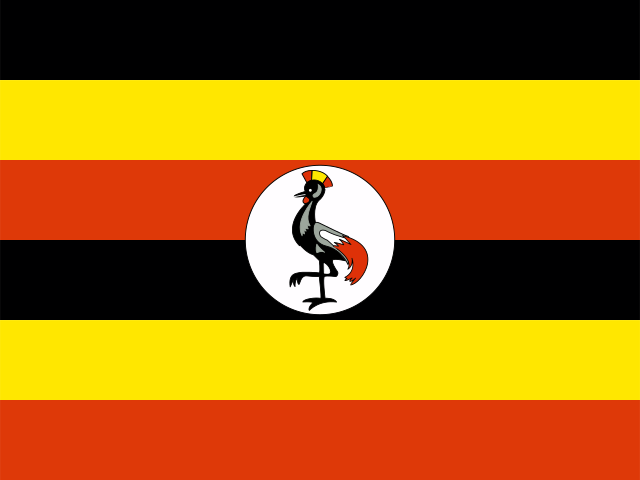
Uganda
Uganda lies in the heart of the African Great Lakes region, combining tropical forests, savannas, wetlands and some of Africa's highest mountains. Much of the country forms a high plateau surrounding Lake Victoria, while the western border follows the Great Rift Valley with lakes, escarpments and the Rwenzori Mountains, whose peaks exceed 5,000 metres. Dense equatorial forests survive in the southwest and west, contrasting with extensive savannas and the drier landscapes of the northeast. The White Nile flows northward from Lake Victoria, and wetlands are widespread throughout the country.
Overview
Uganda is one of Africa's premier birding destinations, with more than 1,000 recorded species packed into a relatively small area. Its most famous target is the extraordinary Shoebill, readily sought in wetlands such as Mabamba Swamp. Bwindi Impenetrable Forest and the Albertine Rift mountains hold numerous restricted-range species, including African Green Broadbill, Grauer's Broadbill and Shelley’s Crimsonwing. Queen Elizabeth and Murchison Falls National Parks combine excellent savanna and wetland birding with major mammals, while Kibale Forest offers rich forest avifauna. Uganda has a well-developed network of specialist bird guides and established birding circuits, often combined with gorilla and chimpanzee trekking. Some remote sites require long drives or difficult forest hikes, but overall the country offers an unusually accessible combination of East African, Central African and Albertine Rift birds.
Top 10 target species
| Species | Annual frequency | January | February | March | April | May | June | July | August | September | October | November | December |
|---|---|---|---|---|---|---|---|---|---|---|---|---|---|
| Common Bulbul Pycnonotus barbatus | 39.2% | 45.0% | 42.8% | 29.7% | 23.6% | 35.2% | 37.2% | 39.6% | 41.6% | 37.8% | 46.1% | 45.5% | 45.8% |
| Hadada Ibis Bostrychia hagedash | 25.6% | 28.6% | 27.4% | 20.2% | 16.9% | 24.4% | 22.4% | 24.1% | 27.0% | 23.9% | 33.6% | 30.1% | 29.0% |
| Speckled Mousebird Colius striatus | 25.4% | 29.5% | 27.9% | 18.0% | 14.0% | 24.0% | 25.2% | 26.9% | 27.4% | 23.7% | 30.7% | 29.3% | 27.8% |
| Red-eyed Dove Streptopelia semitorquata | 23.8% | 28.2% | 26.4% | 15.7% | 13.6% | 22.7% | 23.5% | 24.0% | 24.0% | 18.8% | 28.8% | 29.1% | 30.8% |
| Green-backed Camaroptera Camaroptera brachyura | 23.1% | 20.9% | 21.8% | 21.5% | 25.0% | 29.6% | 20.6% | 18.3% | 19.2% | 23.2% | 26.2% | 26.5% | 24.4% |
| Rüppell's Starling Lamprotornis purpuroptera | 22.3% | 23.5% | 23.7% | 18.7% | 17.7% | 21.1% | 20.8% | 22.6% | 21.4% | 21.8% | 25.6% | 26.7% | 23.9% |
| Black Kite Milvus migrans | 19.2% | 26.8% | 25.8% | 20.9% | 13.5% | 16.3% | 12.1% | 12.7% | 14.8% | 13.2% | 23.8% | 23.9% | 26.1% |
| Northern Gray-headed Sparrow Passer griseus | 19.0% | 22.7% | 20.1% | 12.8% | 9.6% | 18.8% | 18.4% | 18.7% | 19.7% | 16.1% | 24.8% | 22.3% | 24.3% |
| African Thrush Turdus pelios | 18.0% | 20.2% | 20.3% | 15.3% | 13.0% | 19.5% | 14.8% | 14.0% | 17.3% | 15.7% | 25.1% | 21.4% | 19.8% |
| Eastern Plantain-eater Crinifer zonurus | 18.0% | 21.2% | 19.9% | 14.2% | 12.3% | 18.8% | 15.2% | 14.6% | 17.4% | 15.4% | 23.7% | 22.4% | 20.4% |