
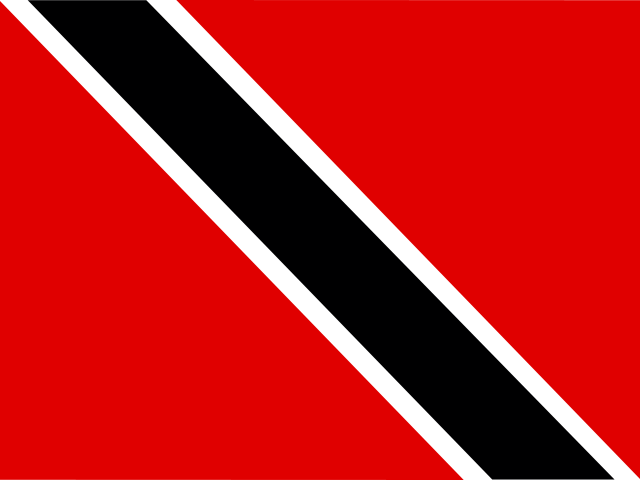
Trinidad and Tobago
Trinidad and Tobago are two contrasting Caribbean islands just off the northeastern coast of Venezuela. Trinidad is the larger and more varied island, with the Northern Range rising to almost 1,000 metres and covered in humid forest, while the south and central areas include lowland forest, wetlands, savanna and agricultural landscapes. Tobago is smaller, more isolated and dominated by forested hills, beaches and coral-fringed coastal areas. The islands have a tropical climate, with a pronounced wetter season and a relatively drier period. Their proximity to mainland South America gives them a stronger continental influence than many eastern Caribbean islands, while their separation has also produced distinct island ecosystems.
Overview
Trinidad and Tobago are especially attractive for mainland South American birds in an accessible Caribbean setting. Trinidad's Northern Range is the main focus, with Asa Wright Nature Centre particularly famous for hummingbirds, tanagers, trogons and forest species. The island is also one of the best places to see Oilbird, with caves at Asa Wright and Dunston Cave supporting colonies. The Caroni Swamp is renowned for evening concentrations of Scarlet Ibis, while coastal wetlands and mudflats add waterbirds and migrants. Tobago has a smaller but distinctive bird community and is particularly good for forest birds and Caribbean species. Trinidad has a long-established birding-tourism infrastructure, with specialist guides and lodges, making it one of the easier Caribbean destinations for serious birders. The combination of tropical diversity, accessibility and proximity to South America makes it particularly useful for birders seeking species that are otherwise associated with the mainland.
Top 10 target species
| Species | Annual frequency | January | February | March | April | May | June | July | August | September | October | November | December |
|---|---|---|---|---|---|---|---|---|---|---|---|---|---|
| Bananaquit Coereba flaveola | 44.9% | 46.8% | 50.1% | 47.5% | 45.4% | 45.2% | 43.1% | 42.2% | 38.9% | 39.1% | 41.9% | 47.0% | 51.8% |
| Palm Tanager Thraupis palmarum | 43.0% | 37.6% | 41.0% | 42.3% | 43.5% | 51.1% | 49.2% | 45.0% | 41.7% | 42.2% | 41.9% | 39.9% | 40.1% |
| Tropical Mockingbird Mimus gilvus | 41.5% | 39.9% | 43.2% | 41.1% | 37.8% | 43.1% | 42.3% | 37.7% | 39.9% | 44.2% | 43.5% | 42.1% | 43.0% |
| Great Kiskadee Pitangus sulphuratus | 39.5% | 34.2% | 36.7% | 33.9% | 37.8% | 45.8% | 39.4% | 44.0% | 43.5% | 43.2% | 41.9% | 37.2% | 36.3% |
| Blue-gray Tanager Thraupis episcopus | 38.5% | 36.7% | 39.8% | 41.1% | 41.7% | 46.3% | 43.0% | 37.1% | 34.8% | 33.7% | 34.4% | 36.5% | 37.3% |
| Tropical Kingbird Tyrannus melancholicus | 35.4% | 37.5% | 37.2% | 34.8% | 31.8% | 35.5% | 34.7% | 35.1% | 33.4% | 33.5% | 36.1% | 38.0% | 37.0% |
| Ruddy Ground Dove Columbina talpacoti | 33.6% | 29.9% | 30.4% | 29.4% | 28.5% | 34.6% | 34.6% | 34.6% | 36.6% | 40.0% | 40.0% | 33.8% | 30.5% |
| Orange-winged Amazon Amazona amazonica | 33.4% | 34.6% | 35.7% | 35.1% | 37.0% | 39.2% | 33.7% | 28.6% | 30.3% | 26.5% | 30.2% | 33.1% | 36.2% |
| Black Vulture Coragyps atratus | 31.6% | 29.9% | 31.1% | 29.7% | 32.4% | 35.3% | 29.6% | 33.4% | 33.3% | 32.5% | 33.0% | 28.5% | 31.1% |
| Copper-rumped Hummingbird Saucerottia tobaci | 31.1% | 31.3% | 32.3% | 30.7% | 29.4% | 29.4% | 29.6% | 28.0% | 26.5% | 26.0% | 32.0% | 38.1% | 39.9% |