
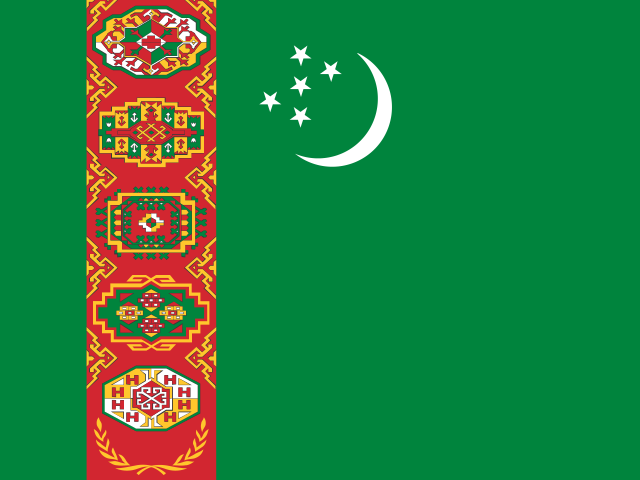
Turkmenistan
Turkmenistan is one of Central Asia's most arid countries, with the Karakum Desert covering most of its territory. Vast sand dunes, gravel plains and salt depressions dominate the interior, while the Kopet Dag Mountains form a rugged natural border with Iran in the south. The Amu Darya and irrigated oases support agriculture and settlements in an otherwise extremely dry landscape, and the western edge meets the Caspian Sea, with coastal wetlands, lagoons and desert shores. The climate is strongly continental and exceptionally dry, with very hot summers and cold winters. Population is concentrated around oases, river valleys and cities such as Ashgabat, leaving much of the desert sparsely inhabited.
Overview
Turkmenistan offers distinctive Central Asian desert, mountain and Caspian birding. The Karakum supports Pander's Ground Jay, Macqueen's Bustard, sandgrouse, larks and wheatears, while the Kopet Dag adds mountain species with strong Iranian and Central Asian affinities. The Caspian coast, particularly around Turkmenbashi Bay, is internationally important for migrating and wintering waterbirds, including large concentrations of ducks, geese, shorebirds and flamingos. Desert reserves such as Repetek protect characteristic Karakum habitats. Turkmenistan receives relatively few international birders, and independent travel can be complicated by visa requirements, permits and restrictions on travel to certain areas. Specialist organised tours are therefore the most practical approach. Its appeal lies in combining remote desert specialties with major Caspian migration sites in a little-visited part of Central Asia.
Top 10 target species
| Species | Annual frequency | January | February | March | April | May | June | July | August | September | October | November | December |
|---|---|---|---|---|---|---|---|---|---|---|---|---|---|
| Common Myna Acridotheres tristis | 22.6% | 25.6% | 14.6% | 8.9% | 44.1% | 52.1% | 22.4% | 19.1% | 6.3% | 27.7% | 8.4% | 33.9% | 8.4% |
| Rock Pigeon Columba livia | 18.1% | 23.3% | 16.7% | 0.0% | 33.0% | 27.0% | 20.2% | 16.4% | 9.1% | 35.9% | 5.0% | 7.7% | 22.9% |
| Crested Lark Galerida cristata | 17.6% | 3.1% | 0.0% | 10.8% | 18.4% | 38.5% | 22.6% | 9.1% | 45.9% | 25.2% | 15.0% | 7.1% | 15.6% |
| White Wagtail Motacilla alba | 17.1% | 24.7% | 20.8% | 10.8% | 30.3% | 24.3% | 15.5% | 7.3% | 9.1% | 19.1% | 21.7% | 8.9% | 12.5% |
| Barn Swallow Hirundo rustica | 15.1% | 0.0% | 0.0% | 8.8% | 34.6% | 43.3% | 20.3% | 11.8% | 49.3% | 13.0% | 0.0% | 0.0% | 0.0% |
| Hooded Crow Corvus cornix | 14.5% | 20.2% | 16.7% | 3.9% | 12.8% | 16.5% | 20.3% | 9.5% | 0.1% | 27.2% | 0.1% | 32.7% | 14.6% |
| Eurasian Kestrel Falco tinnunculus | 12.6% | 16.2% | 8.3% | 8.8% | 22.7% | 16.8% | 6.3% | 6.8% | 2.8% | 15.7% | 22.2% | 13.7% | 10.4% |
| House Sparrow Passer domesticus | 12.0% | 7.7% | 0.0% | 8.8% | 22.9% | 32.9% | 21.1% | 4.5% | 31.3% | 6.3% | 5.0% | 3.6% | 0.0% |
| Eurasian Magpie Pica pica | 11.5% | 14.8% | 8.3% | 0.1% | 20.8% | 28.2% | 8.3% | 2.3% | 6.3% | 11.7% | 21.7% | 8.9% | 6.3% |
| Eurasian Collared-Dove Streptopelia decaocto | 10.5% | 9.9% | 0.0% | 2.9% | 27.8% | 28.4% | 16.1% | 6.8% | 0.1% | 18.7% | 0.1% | 7.7% | 7.3% |