
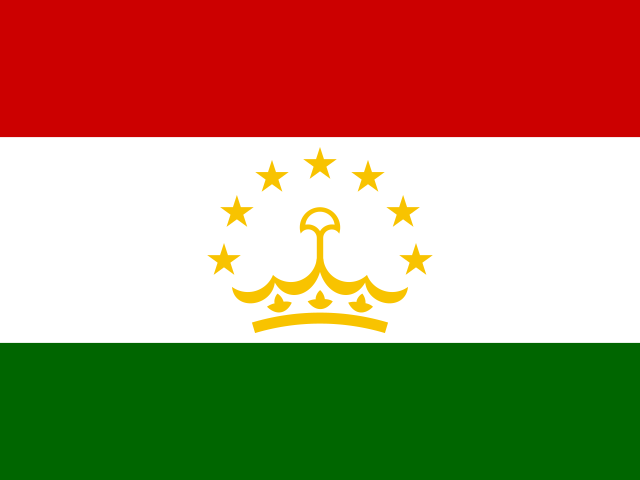
Tajikistan
Tajikistan is the most mountainous country in Central Asia, with around 90% of its territory covered by mountains. The Pamir Mountains dominate the east, forming a vast high-altitude landscape of barren plateaus, glaciers, deep valleys and peaks exceeding 7,000 metres. Western Tajikistan is characterised by the Pamir-Alay ranges, fertile river valleys and considerably lower, drier foothills. The country has a strongly continental climate, ranging from hot, arid lowlands to severe alpine conditions in the high Pamirs. Rivers fed by mountain snow and glaciers are among Tajikistan's most important natural resources. Outside the main valleys and Dushanbe, settlements are sparse and transport through the mountains can be slow and highly seasonal.
Overview
Tajikistan is a specialist destination for Central Asian mountain and high-altitude birds. The Pamirs offer species such as Tibetan Snowcock, Himalayan Snowcock, Ibisbill, Güldenstädt's Redstart and White-winged Grosbeak, alongside Lammergeier, Himalayan Griffon and Golden Eagle. Lower western mountains and valleys add a different assemblage of buntings, warblers, wheatears and other dry-country species. The Pamir Highway provides access to spectacular high-altitude habitats and makes it possible to combine birding with one of Central Asia's great overland journeys. Birding tourism remains limited, however, and remote sites require experienced guides, suitable vehicles and careful logistical planning. Altitude, rough roads and long distances are important considerations. Tajikistan is therefore most rewarding for adventurous birders seeking high-mountain specialties in exceptionally dramatic and sparsely populated landscapes.
Top 10 target species
| Species | Annual frequency | January | February | March | April | May | June | July | August | September | October | November | December |
|---|---|---|---|---|---|---|---|---|---|---|---|---|---|
| Common Myna Acridotheres tristis | 69.3% | 70.8% | 80.2% | 77.3% | 67.3% | 60.7% | 55.7% | 55.2% | 74.8% | 60.4% | 69.3% | 77.9% | 81.9% |
| Rock Pigeon Columba livia | 48.0% | 42.8% | 45.1% | 50.6% | 45.8% | 39.4% | 46.4% | 42.8% | 56.2% | 45.2% | 50.9% | 59.9% | 50.4% |
| Laughing Dove Spilopelia senegalensis | 45.2% | 37.9% | 38.6% | 35.9% | 40.3% | 39.3% | 39.6% | 40.9% | 60.1% | 50.0% | 51.9% | 56.7% | 50.9% |
| Eurasian Tree Sparrow Passer montanus | 42.2% | 42.0% | 42.4% | 33.3% | 32.4% | 35.8% | 42.0% | 37.5% | 55.9% | 33.6% | 46.1% | 52.2% | 53.6% |
| Eurasian Magpie Pica pica | 40.8% | 47.7% | 53.3% | 41.1% | 34.2% | 33.5% | 31.3% | 23.8% | 27.2% | 38.9% | 48.0% | 51.9% | 58.7% |
| Eurasian Blackbird Turdus merula | 36.8% | 51.5% | 58.0% | 50.2% | 44.5% | 34.0% | 29.9% | 18.2% | 15.0% | 16.6% | 25.9% | 41.2% | 57.1% |
| Common Wood-Pigeon Columba palumbus | 22.0% | 18.8% | 29.8% | 25.9% | 20.9% | 18.2% | 14.6% | 15.7% | 21.4% | 15.6% | 23.7% | 29.3% | 29.6% |
| Rook Corvus frugilegus | 21.3% | 46.0% | 44.4% | 10.7% | 2.4% | 0.3% | 0.5% | 0.4% | 0.7% | 1.6% | 33.0% | 56.6% | 59.6% |
| Carrion Crow Corvus corone | 21.0% | 25.6% | 21.8% | 29.7% | 22.3% | 13.6% | 20.7% | 22.7% | 17.1% | 22.7% | 21.2% | 19.7% | 15.5% |
| White Wagtail Motacilla alba | 18.7% | 16.1% | 14.2% | 32.8% | 25.2% | 19.0% | 17.5% | 20.4% | 21.7% | 24.6% | 14.3% | 8.4% | 9.7% |