
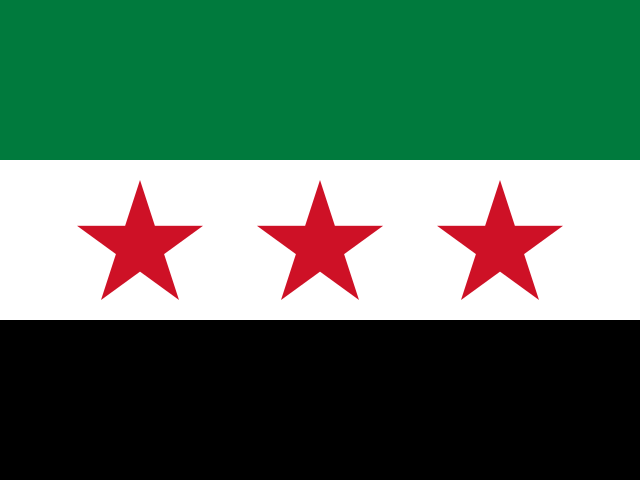
Syria
Syria lies between the Mediterranean coast and the deserts of the Middle East, with landscapes becoming progressively drier toward the east. A narrow coastal plain and the Syrian Coastal Mountains receive relatively high rainfall and support Mediterranean woodland, while the interior includes agricultural plains, dry steppe and extensive semi-desert. The Euphrates River crosses eastern Syria and historically supported important floodplain and wetland habitats. Mountains along the Lebanese border provide the country's highest elevations. The climate is Mediterranean in the west and increasingly continental and arid inland.
Overview
Syria occupies an important position on migration routes between Europe, western Asia and Africa, with wetlands, steppes and deserts supporting a diverse Middle Eastern avifauna. Its most famous ornithological story is the discovery near Palmyra in 2002 of a tiny surviving breeding colony of the Northern Bald Ibis, previously thought extinct in the region; the colony subsequently disappeared during the years of conflict. Steppe and desert habitats can support bustards, sandgrouse, larks and wheatears, while the Euphrates valley has historically been important for waterbirds and migrants. Syria currently presents severe security and access challenges, with many governments advising against travel. Birding tourism and monitoring have been heavily disrupted by years of conflict, and access conditions can change rapidly.
Top 10 target species
| Species | Annual frequency | January | February | March | April | May | June | July | August | September | October | November | December |
|---|---|---|---|---|---|---|---|---|---|---|---|---|---|
| House Sparrow Passer domesticus | 34.8% | 0.1% | 16.7% | 35.4% | 45.0% | 66.3% | 24.6% | 57.5% | 0.0% | 45.0% | 26.5% | 50.0% | 50.0% |
| Crested Lark Galerida cristata | 32.7% | 25.0% | 45.8% | 25.0% | 31.3% | 55.0% | 27.5% | 30.1% | 50.0% | 45.8% | 23.8% | 33.4% | 0.0% |
| Rock Pigeon Columba livia | 27.0% | 0.1% | 2.8% | 27.1% | 19.5% | 13.2% | 36.3% | 51.2% | 50.0% | 17.5% | 14.2% | 66.7% | 25.0% |
| Laughing Dove Spilopelia senegalensis | 25.3% | 0.1% | 11.1% | 25.0% | 27.7% | 51.9% | 22.1% | 28.8% | 0.1% | 18.4% | 18.4% | 75.0% | 25.0% |
| Hooded Crow Corvus cornix | 25.0% | 0.0% | 26.4% | 39.6% | 37.3% | 46.3% | 9.6% | 28.8% | 0.0% | 20.9% | 15.7% | 25.0% | 50.0% |
| Eurasian Kestrel Falco tinnunculus | 19.9% | 25.0% | 12.6% | 27.1% | 18.5% | 18.8% | 31.3% | 5.0% | 37.5% | 36.7% | 26.5% | 0.0% | 0.0% |
| Barn Swallow Hirundo rustica | 18.5% | 0.0% | 2.8% | 14.6% | 36.3% | 46.9% | 38.7% | 33.8% | 12.5% | 31.7% | 5.1% | 0.0% | 0.0% |
| Common Swift Apus apus | 17.4% | 0.0% | 5.6% | 8.3% | 30.7% | 31.3% | 29.2% | 48.8% | 50.0% | 0.0% | 5.0% | 0.0% | 0.0% |
| Eurasian Collared-Dove Streptopelia decaocto | 15.4% | 0.0% | 0.1% | 18.8% | 13.9% | 25.7% | 21.3% | 11.3% | 25.0% | 14.2% | 21.5% | 8.3% | 25.0% |
| Eurasian Blackbird Turdus merula | 15.0% | 0.0% | 13.9% | 8.3% | 20.4% | 28.1% | 4.6% | 25.0% | 0.0% | 0.0% | 17.3% | 37.5% | 25.0% |