
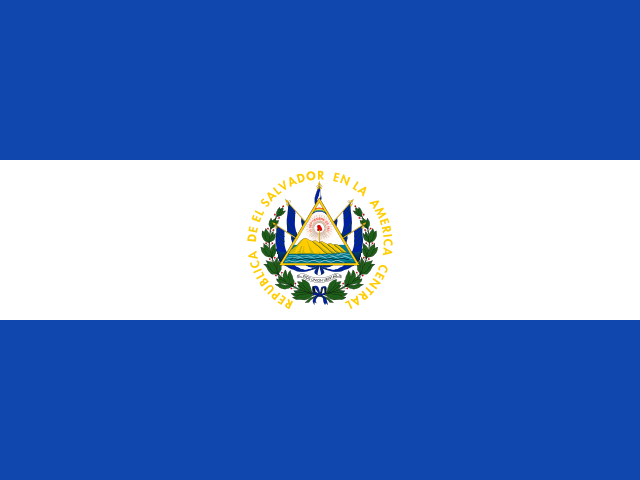
El Salvador
El Salvador is the smallest mainland country in Central America and is shaped by a chain of volcanic mountains, a central plateau and a narrow Pacific coastal plain. Much of the interior is mountainous, with cooler conditions in the northern and western highlands, while the Pacific lowlands are hot and tropical. The country is strongly volcanic in character, with prominent peaks including Santa Ana, San Salvador and San Miguel. The coastline combines sandy beaches, rocky shores, estuaries and mangroves, while inland valleys, coffee-growing landscapes and remnants of forest add further variation. The Lempa River, Central America's largest river by volume, crosses much of the country and forms an important drainage system. El Salvador has a pronounced dry season from November to April and a rainy season from May to October, with elevation creating significant local differences in climate.
Overview
El Salvador is somewhat overlooked internationally, but its compact size makes it possible to explore Pacific lowlands, cloud forest, volcanic habitats and wetlands within relatively short distances. The Apaneca–Ilamatepec range is particularly good for hummingbirds and highland forest birds, while Montecristo National Park protects important cloud forest in the tri-border highlands and supports species such as Resplendent Quetzal and Highland Guan. Coastal wetlands and mangroves add herons, shorebirds and other waterbirds, while the country's position on a major North American migration route brings substantial seasonal movements. Sites around Cerrón Grande Reservoir and other inland wetlands complement the mountain forests. El Salvador's improving birding infrastructure, local guides and compact geography make it an interesting alternative to the better-known Central American destinations, particularly for birders looking to explore a less-visited part of the region.
Top 10 target species
| Species | Annual frequency | January | February | March | April | May | June | July | August | September | October | November | December |
|---|---|---|---|---|---|---|---|---|---|---|---|---|---|
| White-winged Dove Zenaida asiatica | 57.2% | 60.6% | 60.4% | 62.9% | 63.5% | 64.7% | 65.3% | 59.2% | 47.2% | 45.1% | 47.2% | 53.7% | 56.2% |
| Great-tailed Grackle Quiscalus mexicanus | 51.4% | 51.2% | 52.5% | 54.6% | 55.9% | 55.4% | 55.5% | 51.7% | 48.5% | 47.1% | 46.5% | 49.7% | 48.5% |
| Clay-colored Thrush Turdus grayi | 45.7% | 40.0% | 40.0% | 46.1% | 56.3% | 63.1% | 63.0% | 51.0% | 39.8% | 36.9% | 35.6% | 39.3% | 36.8% |
| Tropical Kingbird Tyrannus melancholicus | 36.9% | 35.9% | 35.4% | 33.8% | 34.2% | 37.1% | 38.8% | 38.5% | 37.1% | 40.5% | 38.0% | 38.2% | 35.7% |
| Golden-fronted Woodpecker Melanerpes aurifrons | 34.9% | 34.3% | 36.3% | 40.1% | 40.7% | 42.8% | 38.4% | 33.1% | 31.8% | 31.8% | 30.1% | 28.6% | 30.8% |
| Melodious Blackbird Dives dives | 34.7% | 30.3% | 31.3% | 35.3% | 37.9% | 42.2% | 41.6% | 39.6% | 34.6% | 31.1% | 30.5% | 31.2% | 30.3% |
| Social Flycatcher Myiozetetes similis | 33.5% | 33.2% | 32.4% | 34.0% | 34.1% | 36.9% | 36.5% | 30.3% | 30.3% | 35.4% | 33.3% | 32.3% | 32.7% |
| Rufous-backed Wren Campylorhynchus capistratus | 33.4% | 28.5% | 28.3% | 33.1% | 36.7% | 37.8% | 35.7% | 37.5% | 41.2% | 36.8% | 29.7% | 28.5% | 27.4% |
| Ruddy Ground Dove Columbina talpacoti | 33.2% | 28.8% | 29.1% | 30.5% | 30.6% | 32.1% | 37.9% | 40.2% | 40.1% | 38.9% | 32.4% | 30.2% | 27.8% |
| Turkey Vulture Cathartes aura | 32.6% | 41.0% | 41.0% | 39.6% | 31.6% | 26.2% | 22.6% | 24.7% | 27.0% | 26.0% | 34.4% | 37.9% | 39.6% |