
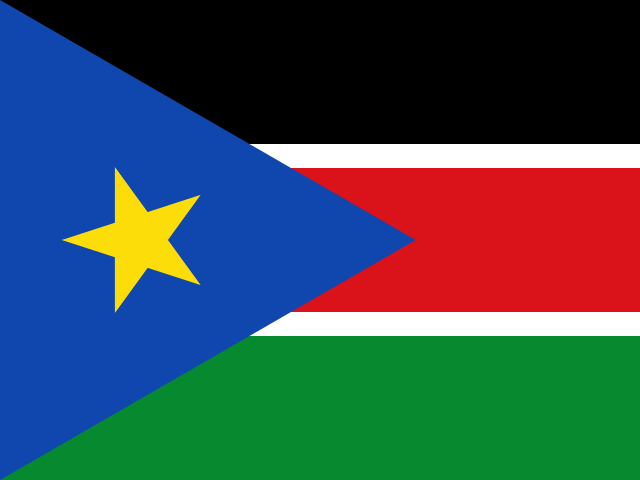
South Sudan
South Sudan is dominated by broad savannas, floodplains and wetlands associated with the White Nile and its tributaries. Its most remarkable landscape is the Sudd, one of the world's largest tropical wetlands, forming a vast mosaic of papyrus swamps, seasonally flooded grasslands and channels. Drier woodland and savanna extend across much of the country, while the far south and southeast rise into hills and mountains along the borders with Uganda, Kenya and Ethiopia. Seasonal rainfall drives dramatic changes in water levels and vegetation, with extensive areas becoming flooded during the wet season.
Overview
South Sudan has enormous but still poorly explored ornithological potential. The Sudd and surrounding floodplains support vast numbers of waterbirds, including Shoebill, Black Crowned Crane, pelicans, storks and herons, while savannas hold bustards, hornbills, raptors and vultures. The Boma–Badingilo landscape, famous for one of the world's largest mammal migrations, also protects extensive grassland and woodland bird communities. Southeastern mountains and forests contain species associated with the poorly surveyed borderlands of East Africa. Birding tourism remains extremely limited, however. Armed conflict, intercommunal violence, poor infrastructure, flooding and unexploded ordnance make travel difficult or dangerous in many areas, and numerous governments advise against travel to South Sudan. Any visit requires current security information and highly experienced local logistical support.
Top 10 target species
| Species | Annual frequency | January | February | March | April | May | June | July | August | September | October | November | December |
|---|---|---|---|---|---|---|---|---|---|---|---|---|---|
| Black Kite Milvus migrans | 38.6% | 56.9% | 64.7% | 81.9% | 38.0% | 58.8% | 48.1% | 11.9% | 0.0% | 4.2% | 17.6% | 39.3% | 42.4% |
| Common Bulbul Pycnonotus barbatus | 30.1% | 30.8% | 38.2% | 59.7% | 25.1% | 34.7% | 22.9% | 26.6% | 18.8% | 41.3% | 20.2% | 21.6% | 21.5% |
| Pied Crow Corvus albus | 28.9% | 24.6% | 34.9% | 32.5% | 28.4% | 46.0% | 41.8% | 14.0% | 27.5% | 31.5% | 38.3% | 19.7% | 7.3% |
| Red-cheeked Cordonbleu Uraeginthus bengalus | 26.6% | 40.8% | 31.0% | 37.5% | 15.5% | 26.1% | 20.5% | 28.1% | 17.5% | 38.5% | 28.6% | 15.6% | 20.1% |
| Speckled Pigeon Columba guinea | 20.1% | 28.9% | 16.9% | 28.5% | 21.8% | 13.1% | 26.6% | 7.8% | 18.1% | 28.6% | 32.2% | 16.9% | 2.3% |
| Hooded Vulture Necrosyrtes monachus | 19.7% | 22.6% | 21.1% | 35.3% | 22.3% | 23.1% | 23.9% | 23.8% | 5.1% | 5.6% | 24.4% | 14.5% | 14.8% |
| Rüppell's Starling Lamprotornis purpuroptera | 19.2% | 24.0% | 14.5% | 25.3% | 15.8% | 17.1% | 27.9% | 20.9% | 20.6% | 18.3% | 13.3% | 15.9% | 17.3% |
| African Sacred Ibis Threskiornis aethiopicus | 18.8% | 26.6% | 32.9% | 22.9% | 25.5% | 20.8% | 24.0% | 21.1% | 8.2% | 13.3% | 14.9% | 5.9% | 10.1% |
| Western Cattle-Egret Ardea ibis | 16.7% | 11.7% | 23.7% | 7.0% | 14.7% | 30.8% | 24.0% | 18.8% | 15.0% | 7.0% | 12.7% | 25.0% | 10.4% |
| African Openbill Anastomus lamelligerus | 16.3% | 15.8% | 19.0% | 17.5% | 15.9% | 27.1% | 25.2% | 16.8% | 8.8% | 17.5% | 12.8% | 16.7% | 2.9% |