
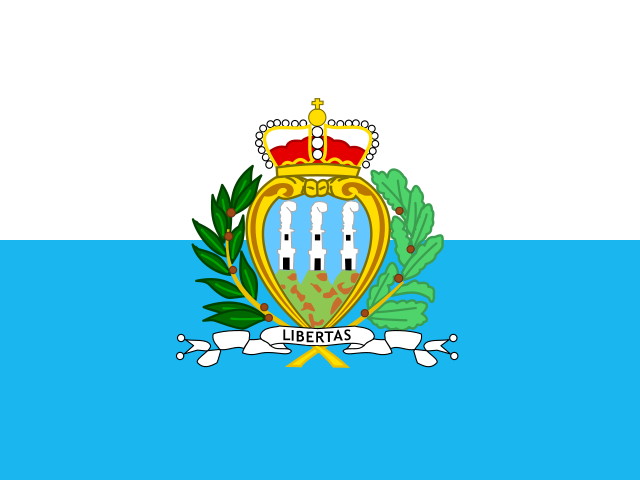
San Marino
San Marino is a tiny republic surrounded by northeastern Italy, centred on the steep limestone ridge of Monte Titano. Despite its small area, the landscape ranges from rocky slopes and wooded hills to agricultural land, small valleys and densely settled areas. Elevation rises to 739 metres on Monte Titano, creating cooler conditions than the nearby Adriatic lowlands. Vegetation combines deciduous woodland, scrub, grassland and cultivated countryside. The climate is transitional between Mediterranean and continental influences, with warm summers and cool winters.
Overview
San Marino has no endemic birds, but its wooded hills and rocky slopes support a typical mixture of Italian woodland, farmland and cliff species. Monte Titano and surrounding countryside can produce Peregrine Falcon, Common Kestrel, European Green Woodpecker, Eurasian Nuthatch and various warblers, while open areas attract finches and other farmland birds. Migrating raptors and passerines may pass through during spring and autumn. Dedicated birding tourism is virtually nonexistent, but the country's tiny size, extensive walking trails and easy access from Italy make casual exploration straightforward. For birders, San Marino is primarily a novelty country-listing stop, readily combined with more productive habitats in the nearby Apennines and Adriatic region.
Top 10 target species
| Species | Annual frequency | January | February | March | April | May | June | July | August | September | October | November | December |
|---|---|---|---|---|---|---|---|---|---|---|---|---|---|
| Rock Pigeon Columba livia | 58.4% | 57.5% | 46.3% | 50.8% | 75.0% | 59.9% | 73.9% | 56.3% | 37.5% | 68.3% | 65.0% | 10.7% | 100.0% |
| Eurasian Blackbird Turdus merula | 44.0% | 27.5% | 52.5% | 54.3% | 67.4% | 65.8% | 75.4% | 45.8% | 28.1% | 47.5% | 35.8% | 7.1% | 20.8% |
| Eurasian Blue Tit Cyanistes caeruleus | 37.6% | 37.5% | 30.0% | 64.3% | 41.5% | 55.6% | 40.2% | 6.3% | 12.5% | 30.8% | 37.5% | 3.6% | 91.7% |
| Eurasian Jackdaw Coloeus monedula | 33.3% | 45.0% | 28.7% | 59.3% | 45.5% | 45.8% | 69.4% | 3.6% | 15.6% | 13.3% | 29.2% | 10.7% | 33.3% |
| Eurasian Blackcap Sylvia atricapilla | 29.9% | 37.5% | 35.0% | 50.8% | 45.5% | 63.0% | 63.2% | 32.9% | 6.3% | 8.3% | 12.5% | 3.6% | 0.0% |
| Great Tit Parus major | 29.6% | 32.5% | 30.0% | 45.7% | 58.0% | 45.5% | 32.6% | 11.5% | 6.3% | 26.7% | 33.3% | 0.0% | 33.3% |
| European Serin Serinus serinus | 28.0% | 25.0% | 0.0% | 45.7% | 67.9% | 51.7% | 67.4% | 42.4% | 18.8% | 13.3% | 4.2% | 0.0% | 0.0% |
| Common Chaffinch Fringilla coelebs | 27.8% | 57.5% | 5.0% | 38.6% | 35.7% | 19.7% | 37.3% | 29.8% | 6.3% | 0.0% | 20.8% | 0.0% | 83.3% |
| Eurasian Collared-Dove Streptopelia decaocto | 26.1% | 45.0% | 12.5% | 42.2% | 41.5% | 21.6% | 40.6% | 25.0% | 21.9% | 33.4% | 5.1% | 0.0% | 25.0% |
| European Robin Erithacus rubecula | 25.6% | 20.0% | 33.8% | 30.1% | 37.9% | 42.4% | 25.6% | 5.8% | 0.0% | 20.0% | 31.7% | 14.3% | 45.8% |