
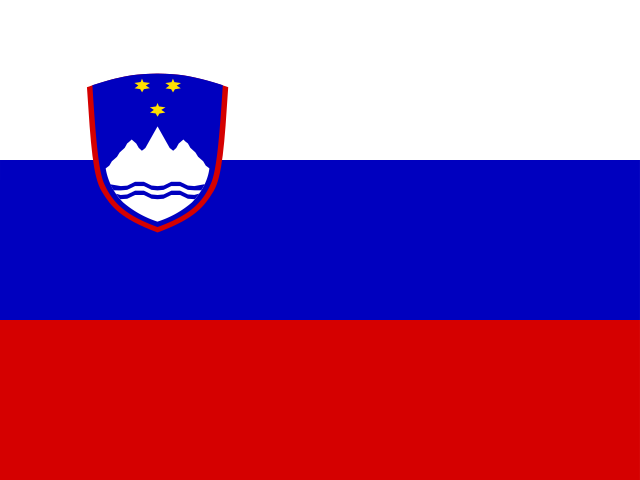
Slovenia
Slovenia lies where the Alps, Mediterranean, Pannonian Plain and Dinaric Mountains meet, creating exceptional landscape diversity within a small area. The northwest is dominated by the Julian Alps, with high peaks, glacial valleys and alpine lakes, while extensive forests and limestone karst cover much of the south. The east opens into gentler agricultural landscapes and wetlands, and a short Adriatic coastline adds Mediterranean habitats. More than half the country is forested, including large, relatively intact woodland complexes that support rich wildlife. Climate varies from alpine in the mountains to continental inland and Mediterranean near the coast.
Overview
Slovenia combines Alpine, forest, karst and wetland birding within remarkably short distances. The Julian Alps support Golden Eagle, Rock Ptarmigan, Alpine Accentor and Wallcreeper, while extensive southern forests hold Ural Owl, Eurasian Pygmy Owl, Three-toed Woodpecker and White-backed Woodpecker. Lake Cerknica, an unusual intermittent karst lake, is especially important for waterbirds, raptors and migrants, while the Škocjanski Zatok wetlands provide excellent coastal birding. Karst grasslands add species such as Short-toed Snake Eagle and European Bee-eater. Slovenia's compact size, good roads, hiking infrastructure and extensive protected areas make independent birding straightforward. Its particular appeal is the ability to combine high-quality Alpine and southeastern European forest birding in a relatively small and accessible country.
Top 10 target species
| Species | Annual frequency | January | February | March | April | May | June | July | August | September | October | November | December |
|---|---|---|---|---|---|---|---|---|---|---|---|---|---|
| Great Tit Parus major | 52.4% | 55.2% | 58.4% | 63.3% | 60.1% | 48.9% | 38.7% | 36.6% | 38.1% | 52.2% | 58.7% | 59.2% | 59.7% |
| Hooded Crow Corvus cornix | 51.7% | 56.5% | 54.0% | 60.6% | 58.0% | 50.0% | 43.3% | 38.4% | 35.2% | 44.8% | 55.1% | 62.8% | 61.3% |
| Eurasian Blackbird Turdus merula | 50.2% | 40.1% | 40.8% | 61.3% | 65.3% | 66.6% | 61.1% | 47.3% | 35.4% | 40.8% | 52.3% | 47.1% | 44.2% |
| Common Chaffinch Fringilla coelebs | 46.0% | 47.9% | 43.2% | 54.8% | 54.1% | 49.4% | 50.4% | 35.5% | 29.1% | 34.0% | 51.7% | 51.6% | 50.3% |
| European Robin Erithacus rubecula | 39.7% | 41.0% | 36.2% | 53.1% | 40.7% | 26.6% | 26.9% | 24.2% | 24.9% | 36.4% | 61.4% | 57.6% | 47.4% |
| Mallard Anas platyrhynchos | 39.2% | 43.4% | 42.7% | 42.8% | 46.4% | 36.4% | 25.9% | 27.1% | 35.8% | 35.2% | 38.6% | 45.7% | 50.1% |
| House Sparrow Passer domesticus | 34.4% | 26.7% | 25.6% | 37.4% | 38.9% | 41.3% | 39.5% | 40.4% | 33.3% | 32.2% | 37.8% | 33.1% | 26.5% |
| Common Buzzard Buteo buteo | 34.0% | 33.1% | 36.3% | 39.1% | 38.4% | 29.7% | 27.8% | 29.4% | 31.7% | 34.8% | 36.3% | 37.1% | 34.7% |
| Eurasian Blue Tit Cyanistes caeruleus | 33.4% | 42.2% | 44.1% | 41.1% | 29.6% | 19.4% | 21.4% | 20.0% | 26.8% | 32.9% | 37.7% | 39.5% | 45.6% |
| Eurasian Magpie Pica pica | 31.3% | 35.0% | 31.5% | 37.5% | 34.9% | 27.2% | 23.4% | 20.7% | 23.4% | 27.8% | 36.4% | 41.2% | 36.8% |