
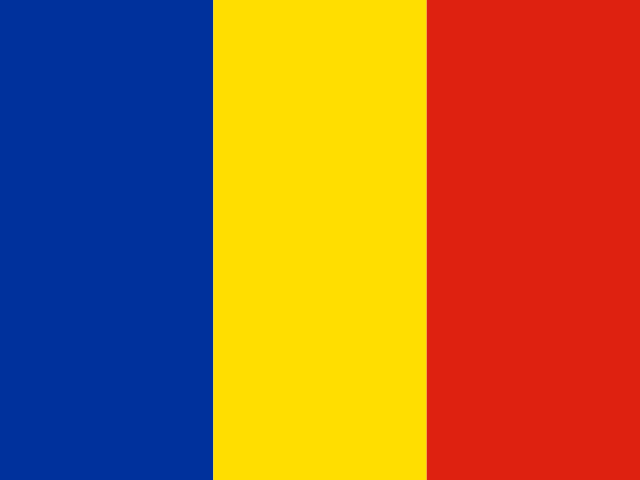
Romania
Romania has unusually varied landscapes centred on the great arc of the Carpathian Mountains, surrounded by rolling hills, forests and the agricultural plains of Transylvania, Wallachia and Moldavia. The Danube forms much of the southern border before reaching the Black Sea through its vast delta. The Carpathians retain extensive beech and conifer forests, while southeastern Romania includes dry steppe, coastal lagoons and wetlands. Climate is predominantly continental, with warm summers and cold winters, moderated by elevation and the Black Sea. Large areas of relatively intact forest and traditional farmland remain important features of the countryside.
Overview
Romania is one of Europe's outstanding destinations for wetlands, eastern specialties and forest birds. The Danube Delta is the premier site, with enormous reedbeds, lakes and channels supporting Great White and Dalmatian Pelicans, Pygmy Cormorants, herons and vast numbers of breeding and migrating waterbirds. Nearby Dobrogea adds steppe species such as Calandra Lark and Isabelline Wheatear, alongside important raptor migration. The Carpathians support Ural Owl, Three-toed and White-backed Woodpeckers, Golden Eagle and Hazel Grouse. Romania has an established birding-tourism sector, particularly in the delta, where boat trips and local guides are the best way to explore. Its combination of the Danube Delta, Carpathian forests and southeastern steppe makes it exceptionally diverse.
Top 10 target species
| Species | Annual frequency | January | February | March | April | May | June | July | August | September | October | November | December |
|---|---|---|---|---|---|---|---|---|---|---|---|---|---|
| Great Tit Parus major | 45.0% | 54.4% | 59.3% | 54.6% | 43.5% | 32.2% | 31.2% | 30.4% | 33.7% | 36.9% | 51.5% | 56.0% | 56.5% |
| Eurasian Magpie Pica pica | 43.3% | 48.2% | 49.7% | 49.6% | 41.2% | 37.3% | 38.3% | 34.5% | 34.3% | 38.6% | 45.6% | 49.5% | 52.7% |
| House Sparrow Passer domesticus | 34.3% | 27.4% | 35.5% | 35.6% | 37.0% | 38.3% | 41.3% | 40.8% | 34.2% | 27.8% | 29.5% | 32.7% | 31.2% |
| Eurasian Collared-Dove Streptopelia decaocto | 33.5% | 28.7% | 34.3% | 38.0% | 36.4% | 34.4% | 37.5% | 34.7% | 35.5% | 31.3% | 26.8% | 31.0% | 32.8% |
| Common Chaffinch Fringilla coelebs | 29.0% | 33.4% | 30.8% | 34.7% | 30.4% | 24.8% | 26.6% | 22.2% | 21.7% | 23.9% | 33.6% | 32.7% | 33.3% |
| Eurasian Blue Tit Cyanistes caeruleus | 28.2% | 39.9% | 38.4% | 32.7% | 16.5% | 12.6% | 16.6% | 17.3% | 22.6% | 24.1% | 33.0% | 40.4% | 43.8% |
| Rock Pigeon Columba livia | 28.1% | 26.4% | 29.4% | 29.1% | 29.4% | 23.7% | 25.7% | 28.7% | 29.5% | 28.5% | 27.4% | 32.8% | 26.3% |
| Hooded Crow Corvus cornix | 26.7% | 24.4% | 23.7% | 24.9% | 31.8% | 32.8% | 29.1% | 24.5% | 26.0% | 29.9% | 24.4% | 25.5% | 22.9% |
| Mallard Anas platyrhynchos | 26.4% | 30.4% | 22.3% | 27.1% | 29.0% | 27.5% | 22.8% | 18.5% | 25.1% | 30.5% | 26.3% | 27.8% | 29.9% |
| Eurasian Blackbird Turdus merula | 24.0% | 26.3% | 31.2% | 34.0% | 31.4% | 26.6% | 27.0% | 19.5% | 11.8% | 11.8% | 20.5% | 23.1% | 25.0% |