
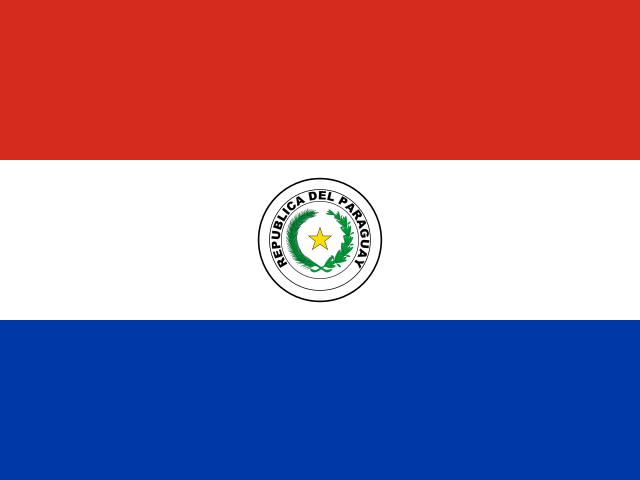
Paraguay
Paraguay lies at the centre of South America, with the Paraguay River dividing the country into two contrasting regions. The eastern half is more humid and densely settled, with rolling hills, subtropical forest and agricultural landscapes. To the west, the Gran Chaco is flatter, hotter and considerably drier, with thorny woodland, scrub and seasonal wetlands. The Pantanal reaches into the country's northern Chaco, creating a mosaic of rivers, lagoons and seasonally flooded habitats. Paraguay's geography is therefore less about dramatic elevation than about the transition between humid Atlantic forests and the dry Chaco. The country has a warm subtropical climate, with rainfall generally decreasing towards the west.
Overview
Paraguay is particularly interesting for Chaco and Atlantic Forest birds, as well as species associated with the country's extensive wetlands. The Chaco is the main attraction for specialised dry-country birds, including Quebracho Crested Tinamou, Black-legged Seriema and many Chaco woodland species. In the east, San Rafael and other remaining Atlantic Forest areas support a very different community, including toucans, parrots and forest specialists. Laguna Blanca is another notable site, combining forest, grassland and wetlands and attracting a broad range of species. Paraguay is less developed as a birding destination than neighbouring Brazil or Argentina, but specialist guides and established reserves make targeted trips possible. Its central location also makes it a useful addition to a wider South American itinerary, particularly for birders interested in species that are difficult to find elsewhere in the Chaco.
Top 10 target species
| Species | Annual frequency | January | February | March | April | May | June | July | August | September | October | November | December |
|---|---|---|---|---|---|---|---|---|---|---|---|---|---|
| Great Kiskadee Pitangus sulphuratus | 63.6% | 62.0% | 61.5% | 67.9% | 64.6% | 66.4% | 66.4% | 64.5% | 58.1% | 60.3% | 61.4% | 64.7% | 65.2% |
| Rufous Hornero Furnarius rufus | 49.6% | 48.8% | 50.1% | 56.3% | 50.7% | 54.7% | 50.2% | 47.0% | 43.1% | 42.5% | 48.2% | 50.9% | 52.9% |
| Sayaca Tanager Thraupis sayaca | 47.2% | 43.9% | 42.7% | 51.4% | 48.0% | 49.7% | 47.7% | 42.8% | 41.2% | 42.5% | 51.8% | 52.6% | 51.9% |
| White-tipped Dove Leptotila verreauxi | 43.4% | 44.0% | 43.0% | 43.4% | 36.3% | 41.1% | 44.9% | 44.3% | 42.0% | 42.5% | 45.1% | 47.2% | 47.3% |
| Monk Parakeet Myiopsitta monachus | 38.7% | 33.4% | 35.3% | 39.3% | 39.2% | 43.1% | 44.0% | 43.7% | 40.9% | 34.9% | 35.4% | 40.4% | 35.1% |
| Saffron Finch Sicalis flaveola | 37.5% | 46.9% | 43.4% | 36.9% | 28.3% | 32.1% | 34.8% | 32.4% | 30.5% | 34.2% | 39.3% | 46.4% | 44.8% |
| Southern Lapwing Vanellus chilensis | 36.7% | 34.6% | 29.7% | 31.3% | 31.9% | 38.1% | 40.8% | 40.6% | 39.5% | 44.9% | 38.4% | 36.4% | 34.4% |
| Bluish-gray Saltator Saltator coerulescens | 35.7% | 36.7% | 33.6% | 38.8% | 36.2% | 37.1% | 35.8% | 30.4% | 29.7% | 34.1% | 36.3% | 39.4% | 40.1% |
| Southern House Wren Troglodytes musculus | 31.1% | 29.1% | 25.1% | 25.8% | 30.2% | 32.4% | 32.3% | 32.0% | 33.8% | 33.2% | 33.4% | 33.2% | 32.7% |
| Tropical Kingbird Tyrannus melancholicus | 30.8% | 58.9% | 59.4% | 54.0% | 12.1% | 2.8% | 0.3% | 0.2% | 0.8% | 15.1% | 53.5% | 56.0% | 56.7% |