
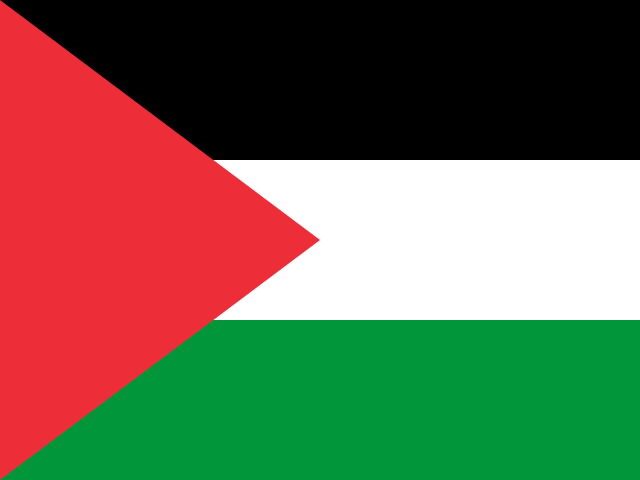
Palestine
Palestine comprises the West Bank and Gaza Strip, with landscapes ranging from Mediterranean hills to the deeply sunken Jordan Valley and Dead Sea margins. The central West Bank is dominated by limestone uplands, terraced slopes, olive groves and Mediterranean scrub, while conditions become increasingly arid toward the Jordan Valley and Judaean Desert. The Gaza Strip is a narrow Mediterranean coastal plain with sandy soils and formerly important wetlands and agricultural areas. Despite its small area, steep rainfall and elevation gradients create a transition from Mediterranean to desert environments.
Overview
Palestine lies on a major Eurasia–Africa migration corridor, bringing large movements of raptors, storks, pelicans and passerines through the region. The eastern West Bank and Jordan Valley are particularly interesting for desert and Middle Eastern birds, including Palestine Sunbird, Tristram's Starling, Blackstart, Sand Partridge and various wheatears, while Mediterranean uplands support woodland and scrub species. Jericho and the Dead Sea region provide access to particularly distinctive arid habitats. Birding opportunities are currently severely affected by the Israeli–Palestinian conflict, with checkpoints, closures, military operations and rapidly changing security conditions restricting or preventing access to many areas. The Gaza Strip in particular is not a practical birding destination under current conditions; official travel advice and local restrictions must take precedence.
Top 10 target species
| Species | Annual frequency | January | February | March | April | May | June | July | August | September | October | November | December |
|---|---|---|---|---|---|---|---|---|---|---|---|---|---|
| White-spectacled Bulbul Pycnonotus xanthopygos | 67.2% | 62.8% | 67.1% | 65.3% | 62.9% | 66.6% | 66.6% | 69.2% | 73.1% | 68.6% | 67.3% | 68.5% | 68.7% |
| Rock Pigeon Columba livia | 62.5% | 55.8% | 58.7% | 60.1% | 59.2% | 64.9% | 65.8% | 67.9% | 70.5% | 63.4% | 60.6% | 60.3% | 63.2% |
| House Sparrow Passer domesticus | 59.5% | 51.1% | 52.9% | 57.4% | 64.6% | 70.2% | 69.1% | 66.0% | 60.5% | 58.3% | 55.8% | 52.6% | 55.4% |
| Laughing Dove Spilopelia senegalensis | 59.0% | 52.3% | 56.7% | 54.6% | 58.6% | 64.0% | 63.0% | 65.1% | 68.6% | 61.1% | 54.9% | 55.4% | 54.1% |
| Hooded Crow Corvus cornix | 55.9% | 53.4% | 58.5% | 56.3% | 57.8% | 59.1% | 54.5% | 49.6% | 52.8% | 53.0% | 55.6% | 60.6% | 59.8% |
| Common Myna Acridotheres tristis | 50.2% | 41.9% | 45.0% | 49.3% | 50.3% | 53.9% | 57.4% | 56.9% | 58.3% | 52.8% | 45.6% | 46.8% | 44.0% |
| Graceful Prinia Prinia gracilis | 50.0% | 41.3% | 49.9% | 50.6% | 47.8% | 54.9% | 57.5% | 55.5% | 55.1% | 45.9% | 44.8% | 48.5% | 48.7% |
| Palestine Sunbird Cinnyris osea | 49.8% | 43.4% | 51.3% | 52.0% | 50.3% | 53.5% | 49.4% | 49.5% | 49.5% | 51.5% | 51.0% | 48.4% | 48.2% |
| Eurasian Collared-Dove Streptopelia decaocto | 48.1% | 33.5% | 45.4% | 45.7% | 46.1% | 57.1% | 57.6% | 57.3% | 55.8% | 47.8% | 40.9% | 47.4% | 43.1% |
| Eurasian Jay Garrulus glandarius | 44.4% | 41.6% | 42.8% | 41.0% | 38.5% | 44.8% | 40.6% | 39.1% | 43.6% | 46.0% | 52.3% | 52.9% | 50.0% |