
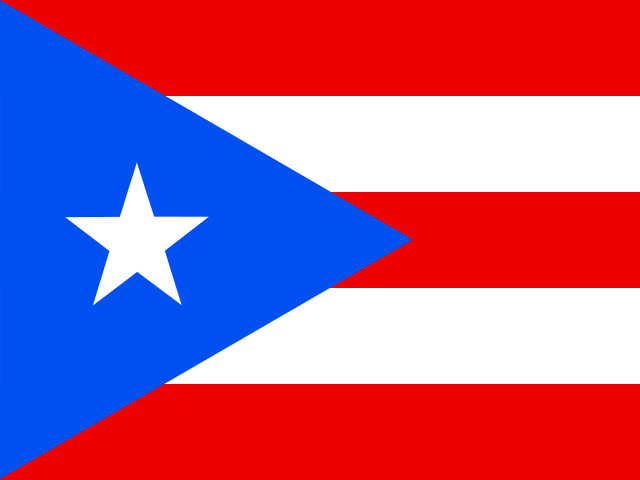
Puerto Rico
Puerto Rico is a mountainous Caribbean island with surprisingly strong contrasts over a relatively small area. The central Cordillera Central rises to more than 1,300 metres, while the north and east are humid and heavily forested. El Yunque contains Puerto Rico's only tropical rainforest, whereas the southwest around Guánica is much drier, with one of the Caribbean's best-developed tropical dry forests. Coastal mangroves, lagoons and limestone karst add further habitats, while smaller offshore islands and cays contribute their own environments. The island's tropical climate is strongly influenced by elevation and exposure, producing wetter conditions in the north and east and a pronounced dry zone in the southwest. Puerto Rico's combination of mountainous terrain, rainforest and dry forest makes it ecologically more varied than its relatively modest size suggests.
Overview
Puerto Rico is an excellent destination for Caribbean endemics, with 18 endemic bird species and more than 300 species recorded overall. El Yunque is the classic destination for rainforest birds, while Río Abajo State Forest is particularly important for the endangered Puerto Rican Parrot, which survives in several wild populations. Other endemic targets include Puerto Rican Tody, Puerto Rican Woodpecker, Puerto Rican Spindalis, Puerto Rican Screech-Owl and Puerto Rican Bullfinch. The dry southwest offers a contrasting community around Guánica, while Cabo Rojo is particularly useful for shorebirds and migrants. Puerto Rico has good roads, established reserves and numerous local birding guides, making it one of the more accessible Caribbean destinations for endemic-focused birding. El Yunque is also easily reached from San Juan.
Top 10 target species
| Species | Annual frequency | January | February | March | April | May | June | July | August | September | October | November | December |
|---|---|---|---|---|---|---|---|---|---|---|---|---|---|
| Bananaquit Coereba flaveola | 55.4% | 57.1% | 57.3% | 59.1% | 57.2% | 55.6% | 48.7% | 54.1% | 52.7% | 51.5% | 58.3% | 55.9% | 57.6% |
| Gray Kingbird Tyrannus dominicensis | 54.2% | 53.0% | 52.3% | 54.6% | 57.5% | 57.2% | 58.6% | 58.0% | 52.7% | 50.5% | 53.2% | 48.8% | 54.1% |
| Greater Antillean Grackle Quiscalus niger | 49.3% | 44.1% | 46.8% | 48.3% | 51.8% | 54.5% | 55.3% | 54.9% | 55.3% | 49.4% | 45.9% | 41.1% | 44.1% |
| White-winged Dove Zenaida asiatica | 43.4% | 41.7% | 45.6% | 50.6% | 52.6% | 52.9% | 50.6% | 46.5% | 41.6% | 38.2% | 36.2% | 29.0% | 35.6% |
| Zenaida Dove Zenaida aurita | 37.7% | 36.3% | 36.1% | 37.0% | 40.8% | 42.2% | 40.0% | 37.8% | 38.2% | 37.1% | 38.3% | 33.5% | 34.8% |
| Northern Mockingbird Mimus polyglottos | 30.0% | 30.9% | 29.1% | 30.2% | 31.8% | 31.1% | 30.8% | 25.1% | 23.0% | 30.0% | 36.5% | 30.0% | 31.9% |
| Puerto Rican Woodpecker Melanerpes portoricensis | 27.4% | 25.6% | 25.7% | 27.8% | 28.6% | 30.2% | 27.0% | 26.9% | 26.7% | 27.4% | 29.9% | 26.7% | 26.1% |
| Pearly-eyed Thrasher Margarops fuscatus | 27.1% | 22.5% | 26.2% | 29.7% | 34.3% | 36.5% | 36.7% | 29.4% | 20.9% | 19.9% | 26.0% | 21.7% | 21.4% |
| Black-faced Grassquit Melanospiza bicolor | 27.0% | 24.5% | 24.3% | 26.2% | 27.2% | 25.8% | 21.4% | 27.9% | 27.5% | 32.0% | 33.7% | 26.3% | 26.9% |
| Scaly-naped Pigeon Patagioenas squamosa | 26.9% | 23.7% | 25.1% | 28.7% | 31.7% | 33.7% | 34.3% | 31.6% | 24.1% | 20.9% | 22.5% | 23.4% | 23.8% |