
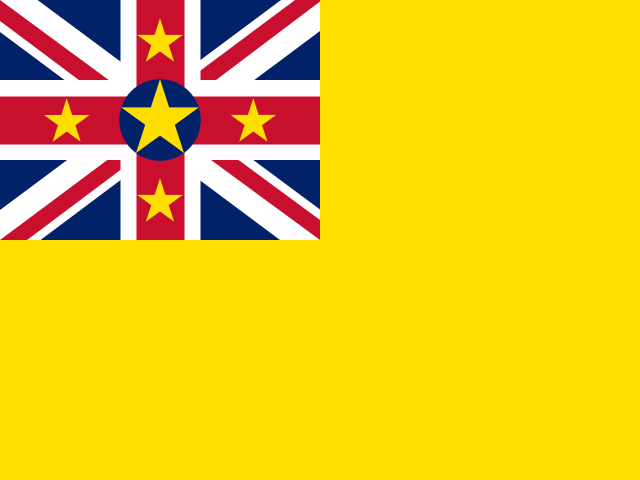
Niue
Niue is a small self-governing Polynesian island in free association with New Zealand and one of the world's largest raised coral islands. Unlike the volcanic islands common across Polynesia, it consists of a limestone plateau surrounded by steep coastal cliffs and a narrow fringing reef, with caves, chasms and natural pools forming distinctive features along the coast. Much of the interior is covered by secondary forest and agricultural land, while important areas of native forest survive in the Huvalu Forest Conservation Area. Niue has no rivers or permanent surface streams because rainfall rapidly drains through the porous limestone. The climate is tropical and maritime, with a wetter, cyclone-prone season from roughly November to April. The island is sparsely populated and can be explored easily by road.
Overview
Niue has a small but distinctive Polynesian bird community. The key specialty is the Polynesian Triller, represented on Niue by a distinctive endemic form, while Polynesian Starling, Pacific Imperial-Pigeon, Blue-crowned Lorikeet and Polynesian Wattled Honeyeater are characteristic forest birds. The Huvalu Forest Conservation Area protects some of the best remaining native forest and is the main focus for terrestrial birding. Coastal cliffs and surrounding waters add White-tailed Tropicbird, noddies, terns and other tropical seabirds, while Pacific shorebirds occur seasonally. There is little dedicated birding infrastructure, but Niue's compact size, road network and extensive forest make independent exploration relatively straightforward. For birders, Niue is best considered a quiet Polynesian birding stop with regional specialties and accessible forest rather than a destination built around numerous endemic species.
Top 10 target species
| Species | Annual frequency | January | February | March | April | May | June | July | August | September | October | November | December |
|---|---|---|---|---|---|---|---|---|---|---|---|---|---|
| Blue-billed White-Tern Gygis candida | 45.8% | 100.0% | 12.5% | 25.0% | 25.0% | 50.0% | 75.0% | 19.4% | 70.0% | 18.8% | 72.7% | 30.7% | 50.0% |
| White-tailed Tropicbird Phaethon lepturus | 45.2% | 82.5% | 25.0% | 25.0% | 50.0% | 50.0% | 75.0% | 34.7% | 76.4% | 37.5% | 33.3% | 11.3% | 41.7% |
| Polynesian Triller Lalage maculosa | 34.9% | 78.3% | 12.5% | 0.0% | 25.0% | 0.0% | 50.1% | 31.3% | 78.0% | 31.3% | 32.5% | 38.2% | 41.7% |
| Brown Noddy Anous stolidus | 27.6% | 70.8% | 0.0% | 12.5% | 0.0% | 25.0% | 50.0% | 18.5% | 57.5% | 12.5% | 28.3% | 22.5% | 33.3% |
| White-rumped Swiftlet Aerodramus spodiopygius | 24.7% | 65.8% | 12.5% | 0.0% | 25.0% | 0.0% | 50.1% | 22.5% | 57.3% | 0.1% | 16.4% | 5.0% | 41.7% |
| Polynesian Starling Aplonis tabuensis | 22.3% | 57.5% | 12.5% | 0.0% | 0.0% | 0.0% | 50.0% | 25.6% | 70.0% | 0.0% | 15.6% | 3.2% | 33.3% |
| Crimson-crowned Fruit-Dove Ptilinopus porphyraceus | 21.0% | 61.7% | 12.5% | 0.0% | 25.0% | 0.0% | 0.0% | 17.5% | 63.9% | 0.1% | 21.3% | 16.3% | 33.3% |
| Red Junglefowl Gallus gallus | 20.0% | 28.3% | 12.5% | 0.0% | 0.0% | 0.0% | 50.0% | 20.0% | 42.8% | 37.5% | 20.3% | 28.1% | 0.0% |
| Pacific Imperial-Pigeon Ducula pacifica | 19.6% | 65.0% | 12.5% | 0.0% | 0.0% | 0.0% | 25.0% | 15.3% | 57.4% | 12.5% | 13.1% | 9.4% | 25.0% |
| Pacific Reef-Heron Egretta sacra | 17.9% | 18.3% | 12.5% | 0.0% | 0.0% | 25.0% | 25.1% | 20.9% | 61.1% | 31.3% | 9.8% | 11.3% | 0.0% |