
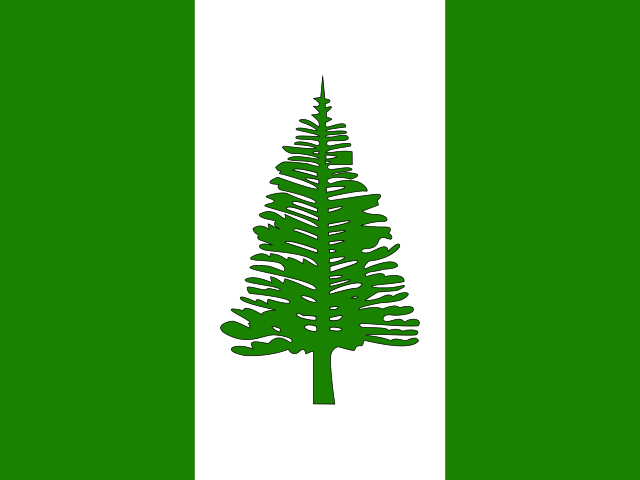
Norfolk Island
Norfolk Island is a small, isolated Australian territory in the southwestern Pacific, lying between Australia, New Zealand and New Caledonia. Its landscape combines rolling farmland and dramatic coastal cliffs with subtropical rainforest, especially around Mount Pitt and Mount Bates. The island is famous for its tall Norfolk Island Pines, which are a defining part of its landscape and occur naturally only here. Much of the remaining native habitat is protected within Norfolk Island National Park and Botanic Garden, which covers about one-sixth of the island. Its isolation has produced a distinctive endemic flora and fauna, although introduced predators and habitat clearance have had a major impact. The island is small and relatively easy to explore by road, with walking trails providing access to its remaining forest.
Overview
Norfolk Island is an excellent specialist birding destination for Pacific island endemics, with around 116 bird species recorded and several found nowhere else. The main target is the endangered Norfolk Island Green Parrot, now recovering from near extinction and concentrated particularly around the National Park and Botanic Gardens. Other key species include the Slender-billed White-eye, Norfolk Island Morepork, Norfolk Island Robin, Norfolk Island Golden Whistler and Norfolk Island Sacred Kingfisher. Coastal cliffs and nearby Phillip Island add Wedge-tailed Shearwater, White Tern, Red-tailed Tropicbird and other seabirds. Birding is unusually accessible for such a remote island, with good trails and specialist local guides; dedicated half-day bird tours are available.
Top 10 target species
| Species | Annual frequency | January | February | March | April | May | June | July | August | September | October | November | December |
|---|---|---|---|---|---|---|---|---|---|---|---|---|---|
| Blue-billed White-Tern Gygis candida | 56.2% | 75.2% | 77.1% | 66.2% | 65.1% | 56.0% | 37.1% | 22.7% | 38.6% | 48.8% | 59.3% | 61.9% | 66.8% |
| Eurasian Blackbird Turdus merula | 42.7% | 40.2% | 38.7% | 29.2% | 28.2% | 36.0% | 44.6% | 53.9% | 45.9% | 36.2% | 56.1% | 56.1% | 46.9% |
| Crimson Rosella Platycercus elegans | 41.9% | 33.4% | 40.9% | 31.8% | 33.4% | 39.2% | 40.3% | 50.0% | 50.2% | 47.6% | 53.0% | 46.8% | 36.4% |
| Norfolk Island Gerygone Gerygone modesta | 41.4% | 35.7% | 40.1% | 35.0% | 31.6% | 40.6% | 42.7% | 46.4% | 52.5% | 38.2% | 51.1% | 40.6% | 42.7% |
| European Starling Sturnus vulgaris | 40.8% | 33.4% | 41.8% | 36.0% | 32.7% | 38.5% | 45.5% | 48.5% | 33.8% | 39.4% | 50.8% | 49.9% | 39.5% |
| Welcome Swallow Hirundo neoxena | 37.8% | 28.6% | 35.6% | 30.2% | 33.0% | 37.2% | 41.9% | 44.3% | 39.4% | 35.5% | 49.7% | 42.1% | 36.1% |
| Sacred Kingfisher Todiramphus sanctus | 36.2% | 37.4% | 41.0% | 26.3% | 22.3% | 29.4% | 35.4% | 36.3% | 36.1% | 38.2% | 45.8% | 44.0% | 42.3% |
| Silvereye Zosterops lateralis | 35.5% | 40.4% | 37.9% | 29.7% | 26.0% | 36.2% | 34.2% | 49.1% | 29.7% | 21.9% | 36.5% | 43.8% | 40.8% |
| House Sparrow Passer domesticus | 35.2% | 36.0% | 38.7% | 25.9% | 24.8% | 28.0% | 33.0% | 45.9% | 32.2% | 30.8% | 45.3% | 41.9% | 40.0% |
| Gray Fantail Rhipidura albiscapa | 31.0% | 26.8% | 28.0% | 26.5% | 33.1% | 35.5% | 26.7% | 41.3% | 30.8% | 29.9% | 35.4% | 30.5% | 27.5% |