
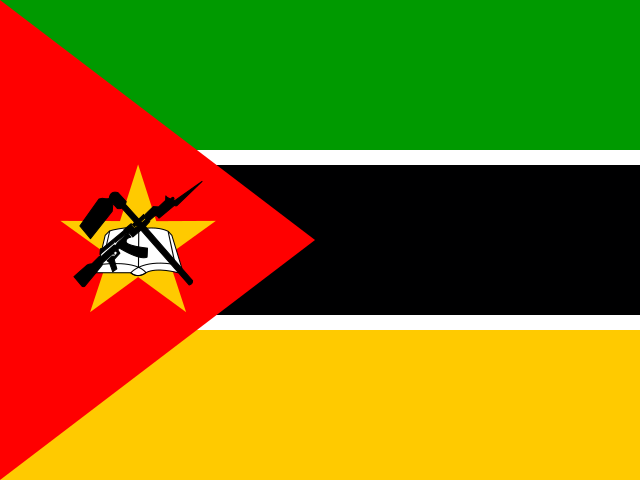
Mozambique
Mozambique stretches for more than 2,000 km along the Indian Ocean, with an extensive coastline of beaches, mangroves, estuaries and offshore islands. Much of the interior consists of low plains covered by miombo woodland and savanna, rising toward mountains along the borders with Zimbabwe and Malawi. Northern Mozambique includes isolated forested massifs, while major river systems such as the Zambezi create broad floodplains and wetlands. The climate is tropical, with a pronounced wet season and frequent exposure to powerful Indian Ocean cyclones.
Overview
Mozambique is particularly exciting for its combination of miombo specialists, coastal birds and highly localized mountain endemics. Mount Gorongosa and Gorongosa National Park combine rainforest, woodland, wetlands and savanna, supporting species such as Green-headed Oriole and a rich assemblage of raptors and waterbirds. Northern mountains are especially important: Mount Namuli holds the endemic Namuli Apalis, while other isolated massifs support rare and poorly known forest species. Extensive miombo offers Miombo Pied Barbet, White-breasted Cuckooshrike and various sunbirds, while coastal wetlands attract shorebirds and waterbirds. Mozambique has growing ecotourism infrastructure around major parks, but many specialist sites remain remote and require 4WD vehicles, local guides and substantial travel time. Security problems in parts of Cabo Delgado can restrict access to the far north.
Top 10 target species
| Species | Annual frequency | January | February | March | April | May | June | July | August | September | October | November | December |
|---|---|---|---|---|---|---|---|---|---|---|---|---|---|
| Common Bulbul Pycnonotus barbatus | 53.0% | 53.3% | 46.7% | 52.8% | 51.5% | 56.0% | 50.8% | 53.2% | 54.5% | 49.9% | 53.6% | 59.5% | 53.7% |
| Red-eyed Dove Streptopelia semitorquata | 29.5% | 29.1% | 25.9% | 33.4% | 32.4% | 30.6% | 27.9% | 30.8% | 30.4% | 28.2% | 29.1% | 30.4% | 26.0% |
| Pied Crow Corvus albus | 26.8% | 26.3% | 23.1% | 26.7% | 26.0% | 27.8% | 23.9% | 27.7% | 27.0% | 29.6% | 27.6% | 27.2% | 29.2% |
| Black-backed Puffback Dryoscopus cubla | 25.9% | 22.6% | 19.3% | 20.7% | 21.3% | 28.5% | 25.8% | 25.0% | 29.5% | 23.2% | 28.1% | 37.5% | 29.4% |
| Bronze Mannikin Spermestes cucullata | 25.0% | 32.5% | 22.3% | 31.1% | 29.6% | 29.5% | 21.6% | 22.6% | 22.0% | 22.9% | 21.1% | 18.7% | 25.9% |
| Tawny-flanked Prinia Prinia subflava | 24.6% | 28.4% | 30.0% | 31.2% | 23.4% | 22.6% | 20.3% | 21.9% | 25.5% | 20.4% | 21.3% | 26.3% | 23.4% |
| Emerald-spotted Wood-Dove Turtur chalcospilos | 23.5% | 17.7% | 18.7% | 23.3% | 24.4% | 20.7% | 20.9% | 24.7% | 28.6% | 23.1% | 27.2% | 29.1% | 24.3% |
| House Sparrow Passer domesticus | 21.2% | 23.3% | 23.1% | 23.0% | 22.4% | 22.6% | 17.8% | 19.4% | 15.5% | 22.0% | 22.9% | 19.8% | 22.2% |
| Gray Heron Ardea cinerea | 20.9% | 19.8% | 20.4% | 24.4% | 21.3% | 22.0% | 19.4% | 22.6% | 19.8% | 27.2% | 21.4% | 18.4% | 14.2% |
| Little Egret Egretta garzetta | 20.7% | 19.7% | 18.6% | 23.4% | 21.1% | 20.0% | 17.7% | 20.5% | 19.1% | 28.5% | 21.6% | 19.2% | 19.5% |