
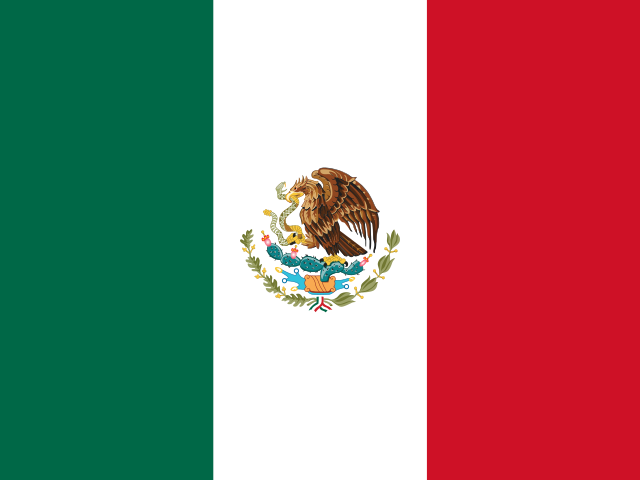
Mexico
Mexico forms a major transition between the Nearctic and Neotropical regions, with deserts, dry forests, tropical lowlands, mountains and extensive coastlines. The Sierra Madre ranges and central volcanic belt divide the country into strong climatic and ecological zones, while the Yucatán Peninsula is a contrasting flat limestone landscape with tropical forest, wetlands and cenotes. The north is predominantly arid or semi-arid, whereas southern Mexico becomes increasingly humid and mountainous. Baja California is geographically distinctive, combining desert landscapes with rugged mountains and a Pacific coastline. The Pacific, Gulf of Mexico and Caribbean coasts also create markedly different environments. Mexico's position between two major biogeographic regions is one of its defining geographical characteristics, producing exceptional habitat diversity over relatively short distances.
Overview
Mexico is one of the strongest countries for bird diversity and endemism in North America, with particularly distinctive avifaunas in the west and south. The Sierra Madre Occidental is important for species such as Tufted Jay, Eared Quetzal and Military Macaw, while southern highlands support a rich montane community. The Yucatán Peninsula is notable for endemics including Yucatan Jay, Ocellated Turkey and Yucatan Wren. Baja California adds desert specialists and Pacific seabirds, while the Pacific and Gulf coasts are major migration routes. Mexico's extensive road network and growing network of birding lodges and guides make many regions accessible, although some of the most interesting southern and western forests require more careful planning. Its combination of resident tropical birds, endemics and migrants makes Mexico particularly rewarding for repeated visits.
Top 10 target species
| Species | Annual frequency | January | February | March | April | May | June | July | August | September | October | November | December |
|---|---|---|---|---|---|---|---|---|---|---|---|---|---|
| Great-tailed Grackle Quiscalus mexicanus | 39.4% | 38.4% | 38.3% | 38.7% | 43.0% | 45.0% | 42.0% | 41.5% | 38.2% | 36.2% | 35.8% | 37.8% | 38.2% |
| White-winged Dove Zenaida asiatica | 28.1% | 27.8% | 30.0% | 30.6% | 33.3% | 32.4% | 31.0% | 28.9% | 25.2% | 23.8% | 24.8% | 24.3% | 25.4% |
| Turkey Vulture Cathartes aura | 27.1% | 35.3% | 33.9% | 32.3% | 25.4% | 21.3% | 18.9% | 18.6% | 19.5% | 21.7% | 29.9% | 33.1% | 34.6% |
| Great Kiskadee Pitangus sulphuratus | 24.4% | 26.0% | 25.6% | 25.0% | 25.4% | 24.7% | 22.2% | 22.7% | 23.3% | 23.7% | 23.1% | 25.5% | 25.7% |
| Inca Dove Columbina inca | 22.6% | 20.0% | 19.6% | 20.0% | 22.1% | 24.0% | 23.2% | 25.3% | 26.7% | 27.0% | 23.4% | 20.2% | 19.9% |
| House Finch Haemorhous mexicanus | 21.1% | 18.5% | 20.3% | 21.0% | 22.5% | 25.3% | 25.7% | 24.3% | 21.3% | 18.8% | 19.4% | 18.1% | 18.4% |
| Black Vulture Coragyps atratus | 21.0% | 25.3% | 24.7% | 24.4% | 22.2% | 19.5% | 16.2% | 16.2% | 16.9% | 18.6% | 20.7% | 22.9% | 24.1% |
| Social Flycatcher Myiozetetes similis | 20.6% | 21.2% | 20.4% | 21.1% | 21.7% | 21.9% | 19.9% | 19.5% | 19.0% | 20.6% | 20.1% | 20.9% | 20.4% |
| Golden-fronted Woodpecker Melanerpes aurifrons | 20.0% | 16.2% | 17.3% | 18.4% | 22.3% | 24.8% | 22.3% | 21.8% | 21.4% | 22.2% | 19.4% | 17.3% | 16.3% |
| House Sparrow Passer domesticus | 19.3% | 16.8% | 18.0% | 18.3% | 21.1% | 24.1% | 24.2% | 23.5% | 19.3% | 17.2% | 17.6% | 16.1% | 15.6% |