
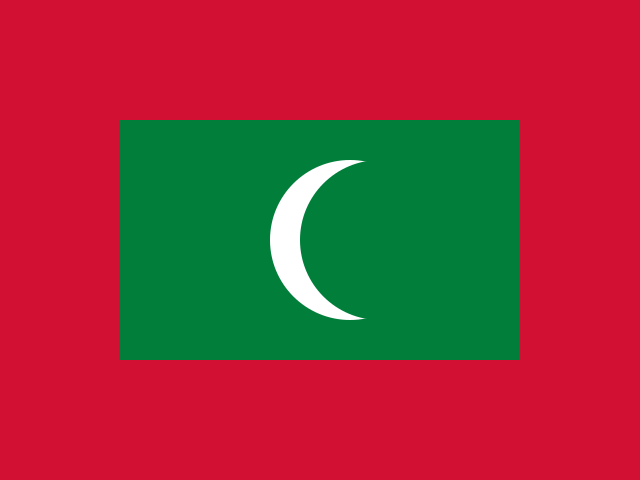
Maldives
The Maldives consists of 26 coral atolls and more than 1,000 islands scattered across the tropical Indian Ocean. Almost all land lies only a few metres above sea level, making it one of the world's lowest countries. Natural habitats are dominated by coral reefs, lagoons, sandy shores, coastal vegetation and small areas of tropical woodland, with no mountains or major freshwater ecosystems. The climate is warm and humid year-round, with rainfall and sea conditions strongly influenced by the monsoons.
Overview
The Maldives has relatively limited terrestrial bird diversity, but its remote oceanic setting makes it interesting for seabirds and migrants. Offshore waters and isolated islands support or attract tropicbirds, terns, noddies, frigatebirds and shearwaters, while shorebirds use beaches, reefs and lagoons during migration and winter. The southern atolls can receive species arriving from both the Indian subcontinent and farther across the Indian Ocean. There are few major birding sites or dedicated birding services, and most visitors come for marine tourism rather than birds. Reaching productive seabird areas may require boat trips between islands, making birding highly dependent on local transport and sea conditions.
Top 10 target species
| Species | Annual frequency | January | February | March | April | May | June | July | August | September | October | November | December |
|---|---|---|---|---|---|---|---|---|---|---|---|---|---|
| House Crow Corvus splendens | 57.4% | 67.6% | 47.3% | 59.4% | 57.0% | 43.7% | 51.1% | 66.9% | 60.9% | 50.1% | 58.8% | 68.2% | 57.3% |
| Asian Koel Eudynamys scolopaceus | 53.7% | 55.5% | 47.8% | 52.6% | 53.8% | 58.2% | 31.3% | 59.8% | 52.3% | 57.4% | 63.2% | 57.2% | 54.9% |
| Gray Heron Ardea cinerea | 52.2% | 52.0% | 51.3% | 53.3% | 55.8% | 55.3% | 30.1% | 48.6% | 59.1% | 49.9% | 54.1% | 61.0% | 55.8% |
| Black-naped Tern Sterna sumatrana | 34.3% | 41.3% | 25.7% | 21.4% | 24.1% | 28.0% | 32.0% | 33.6% | 32.5% | 34.3% | 44.2% | 53.3% | 41.8% |
| White-breasted Waterhen Amaurornis phoenicurus | 33.1% | 36.1% | 25.1% | 32.8% | 35.9% | 36.8% | 34.6% | 26.8% | 27.2% | 32.7% | 44.0% | 34.6% | 31.2% |
| Little Heron Butorides atricapilla | 27.6% | 30.5% | 25.9% | 28.8% | 27.2% | 28.8% | 26.1% | 20.1% | 17.7% | 42.5% | 30.3% | 30.6% | 22.2% |
| Common Sandpiper Actitis hypoleucos | 25.3% | 32.7% | 36.6% | 35.5% | 28.0% | 0.7% | 0.8% | 4.5% | 18.7% | 40.2% | 40.8% | 34.3% | 30.7% |
| Rock Pigeon Columba livia | 12.6% | 14.2% | 9.0% | 13.9% | 18.1% | 12.5% | 4.2% | 26.0% | 11.3% | 10.5% | 13.9% | 6.2% | 11.5% |
| Common Myna Acridotheres tristis | 10.2% | 11.9% | 8.9% | 13.1% | 7.7% | 11.6% | 5.7% | 16.5% | 14.3% | 6.6% | 11.9% | 5.8% | 8.8% |
| Brown Noddy Anous stolidus | 8.9% | 5.7% | 7.9% | 7.4% | 6.5% | 16.5% | 13.1% | 10.2% | 6.0% | 9.8% | 7.5% | 5.7% | 10.6% |