
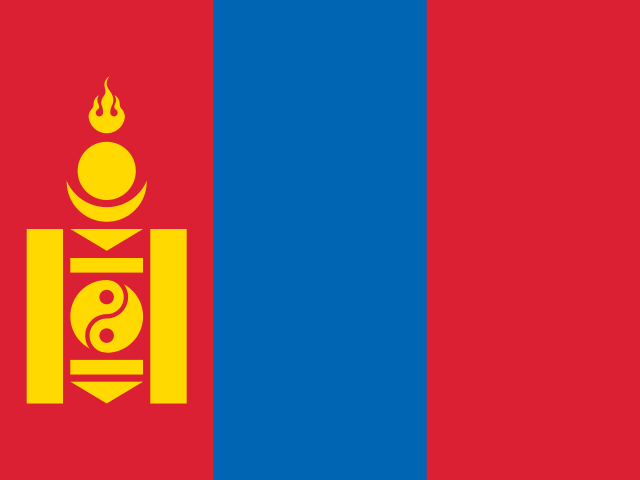
Mongolia
Mongolia is a vast, sparsely populated landlocked country dominated by open steppe, semi-desert and mountains. The Gobi Desert covers much of the south, with gravel plains, dunes and rocky massifs, while central and eastern Mongolia contain immense grasslands extending almost uninterrupted to the horizon. The north becomes greener and more mountainous, with forests and lakes influenced by the Siberian taiga, while the Altai Mountains rise along the western frontier. Mongolia has an extreme continental climate, with long, intensely cold winters, short summers and large daily temperature variations. Traditional nomadic pastoralism remains an important feature of the landscape, and the country's very low population density leaves enormous areas with little development.
Overview
Mongolia is an outstanding destination for steppe, desert and Central Asian mountain birds. The open grasslands support Demoiselle Crane, Saker Falcon and Mongolian Lark, while the Gobi holds specialties such as Pallas's Sandgrouse, Henderson's Ground Jay and Mongolian Ground Jay. Western mountains add Altai Snowcock, Lammergeier and Golden Eagle, while northern lakes and wetlands attract Whooper Swan, White-naped Crane and numerous breeding waterbirds. Mongolia is also important for the threatened Saker Falcon and several species of bustards and raptors associated with open landscapes. Birding tours are available, but independent travel outside the main routes can be difficult: distances are enormous, roads often unpaved and suitable vehicles and local guides highly valuable. The best birding generally falls between May and September, when migrants and breeding birds are present.
Top 10 target species
| Species | Annual frequency | January | February | March | April | May | June | July | August | September | October | November | December |
|---|---|---|---|---|---|---|---|---|---|---|---|---|---|
| Common Raven Corvus corax | 17.7% | 13.5% | 14.4% | 10.5% | 15.8% | 26.2% | 24.8% | 16.0% | 22.0% | 29.5% | 19.7% | 9.1% | 10.3% |
| Eurasian Tree Sparrow Passer montanus | 15.5% | 9.9% | 10.8% | 9.5% | 14.7% | 24.2% | 25.2% | 17.7% | 20.6% | 21.9% | 17.2% | 6.8% | 7.2% |
| Black Kite Milvus migrans | 13.4% | 0.0% | 0.0% | 1.8% | 17.4% | 29.0% | 34.3% | 25.1% | 29.3% | 22.9% | 1.1% | 0.1% | 0.0% |
| Eurasian Magpie Pica pica | 12.5% | 10.2% | 10.2% | 6.0% | 11.6% | 16.6% | 16.8% | 11.0% | 12.8% | 24.2% | 16.1% | 6.5% | 8.0% |
| Ruddy Shelduck Tadorna ferruginea | 12.5% | 1.8% | 2.0% | 5.6% | 16.0% | 30.1% | 30.3% | 19.0% | 15.3% | 16.6% | 9.2% | 2.1% | 1.7% |
| Red-billed Chough Pyrrhocorax pyrrhocorax | 11.1% | 6.4% | 6.7% | 8.2% | 10.7% | 15.5% | 19.6% | 9.7% | 14.3% | 17.0% | 13.0% | 5.9% | 5.7% |
| Cinereous Vulture Aegypius monachus | 10.6% | 5.7% | 9.1% | 5.6% | 7.6% | 14.9% | 19.7% | 11.7% | 15.1% | 18.7% | 11.2% | 4.0% | 4.1% |
| Horned Lark Eremophila alpestris | 10.4% | 4.8% | 7.9% | 10.3% | 10.5% | 17.1% | 19.8% | 12.8% | 9.4% | 15.9% | 11.0% | 2.3% | 2.8% |
| Carrion Crow Corvus corone | 9.8% | 8.5% | 10.1% | 6.3% | 11.9% | 14.0% | 13.9% | 9.4% | 8.7% | 10.5% | 11.0% | 6.2% | 6.9% |
| Rock Pigeon Columba livia | 8.8% | 7.4% | 8.0% | 7.6% | 10.5% | 12.5% | 12.3% | 8.3% | 8.7% | 11.1% | 10.3% | 4.1% | 4.4% |