
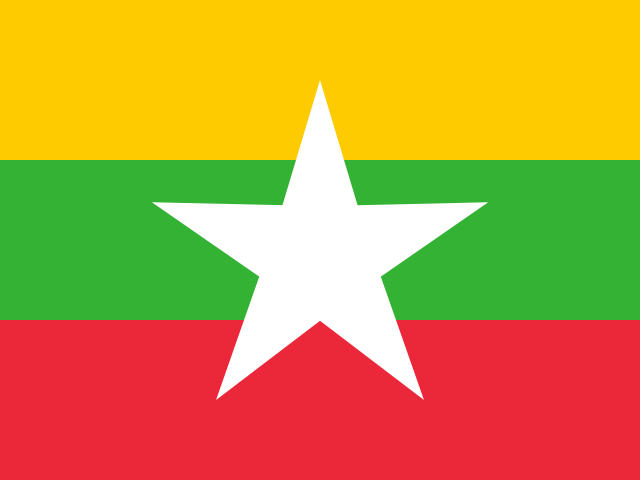
Myanmar
Myanmar is one of mainland Southeast Asia's largest countries, extending from the eastern Himalayas to the Andaman Sea. Mountain ranges border much of the country, while the broad Ayeyarwady basin forms its central lowlands and agricultural heartland. The dry interior around Bagan and Mandalay contrasts sharply with the humid evergreen forests of the south and west, while northern Myanmar contains remote subtropical and montane forests rising towards snow-covered Himalayan peaks. Extensive mangroves and wetlands occur around the Ayeyarwady Delta. The climate is strongly monsoonal, with generally hot, wet summers and a cooler dry season, although rainfall varies enormously between the central dry zone and coastal mountains.
Overview
Myanmar has a distinctive bird fauna combining Himalayan, Indochinese and Sundaic influences, with several highly sought-after endemics. The dry zone around Bagan is particularly important for White-throated Babbler, Burmese Bushlark, Hooded Treepie and Jerdon's Minivet, while Mount Victoria (Nat Ma Taung) is famous for montane species including the endemic White-browed Nuthatch. Wetlands support large numbers of waterbirds, and extensive forests hold hornbills, pittas and other Southeast Asian specialties. Myanmar historically featured on specialist birding itineraries, but the continuing armed conflict and political instability make travel highly problematic, with many regions inaccessible or unsafe and tourism infrastructure severely affected. Current official travel advice should therefore be checked before any visit. Despite its exceptional birdlife, Myanmar is presently a difficult destination for conventional international birding tourism.
Top 10 target species
| Species | Annual frequency | January | February | March | April | May | June | July | August | September | October | November | December |
|---|---|---|---|---|---|---|---|---|---|---|---|---|---|
| Spotted Dove Spilopelia chinensis | 45.0% | 42.3% | 40.5% | 43.9% | 38.6% | 40.8% | 44.1% | 52.5% | 48.9% | 52.0% | 52.9% | 44.5% | 39.6% |
| Common Myna Acridotheres tristis | 45.0% | 34.6% | 31.6% | 40.2% | 38.9% | 48.1% | 55.8% | 60.7% | 52.5% | 55.3% | 44.5% | 43.6% | 33.8% |
| Red-vented Bulbul Pycnonotus cafer | 40.0% | 36.5% | 31.1% | 41.4% | 36.8% | 41.8% | 44.6% | 48.0% | 43.4% | 44.6% | 39.7% | 37.7% | 33.9% |
| House Crow Corvus splendens | 39.3% | 33.1% | 29.2% | 31.2% | 37.2% | 45.2% | 48.2% | 46.8% | 44.4% | 47.6% | 40.0% | 40.3% | 28.4% |
| Black Drongo Dicrurus macrocercus | 35.2% | 36.3% | 29.5% | 34.4% | 31.7% | 31.5% | 36.3% | 36.2% | 35.0% | 37.4% | 40.3% | 37.7% | 36.2% |
| Eurasian Tree Sparrow Passer montanus | 33.3% | 21.0% | 23.4% | 32.7% | 28.1% | 42.1% | 48.0% | 45.0% | 39.8% | 44.1% | 32.0% | 26.2% | 17.5% |
| White-throated Kingfisher Halcyon smyrnensis | 30.1% | 27.9% | 26.4% | 29.9% | 22.9% | 28.3% | 36.3% | 35.0% | 29.2% | 34.9% | 33.3% | 30.1% | 26.8% |
| Ayeyarwady Bulbul Pycnonotus blanfordi | 30.0% | 27.1% | 23.5% | 29.7% | 20.2% | 30.0% | 33.2% | 42.7% | 37.6% | 38.5% | 25.8% | 28.5% | 23.9% |
| Rock Pigeon Columba livia | 28.8% | 20.9% | 24.0% | 20.0% | 25.9% | 32.3% | 38.2% | 34.8% | 31.1% | 40.2% | 30.6% | 28.9% | 18.6% |
| Asian Palm Swift Cypsiurus balasiensis | 27.7% | 25.2% | 24.6% | 33.8% | 23.8% | 31.1% | 31.9% | 31.3% | 24.0% | 36.7% | 25.5% | 25.1% | 19.2% |