
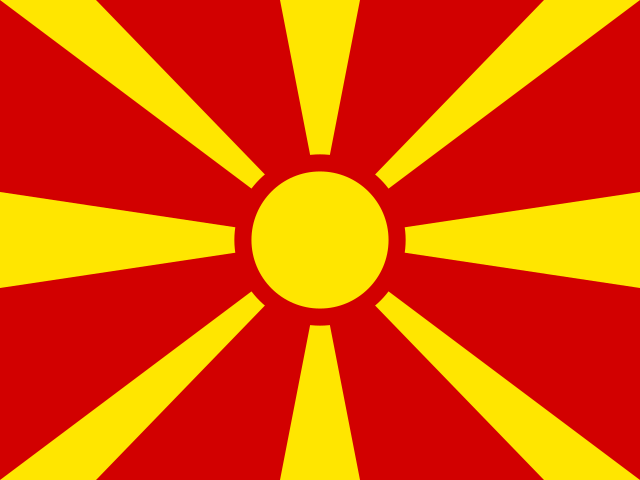
North Macedonia
North Macedonia is a mountainous Balkan country shaped by high ranges, broad valleys and large tectonic lakes. The Šar Mountains dominate the northwest, while rugged massifs, forests and upland grasslands extend across much of the interior. Lakes Ohrid, Prespa and Dojran form major freshwater ecosystems, with ancient Lake Ohrid especially notable for its exceptional biodiversity and endemism. Lower valleys combine farmland, dry grassland and Mediterranean-influenced scrub. The climate is mainly continental, with hot summers and cold winters, while southern valleys show stronger Mediterranean influence and the high mountains experience alpine conditions.
Overview
North Macedonia is particularly rewarding for raptors, Balkan mountain birds and lake wetlands. Lakes Prespa and Ohrid support Dalmatian Pelican, Pygmy Cormorant, herons and numerous migrating and wintering waterbirds. Dry hills and gorges provide habitat for Egyptian Vulture, Golden Eagle, Rock Partridge and Western Rock Nuthatch, while high mountains add Alpine Chough and other montane species. The Tikveš region is especially important for vultures and other raptors. Birding tourism remains relatively small, but the country's compact size allows mountains, dry valleys and major lakes to be combined efficiently. A car is useful for reaching more remote sites, and local guides can help locate scarce raptors.
Top 10 target species
| Species | Annual frequency | January | February | March | April | May | June | July | August | September | October | November | December |
|---|---|---|---|---|---|---|---|---|---|---|---|---|---|
| Eurasian Magpie Pica pica | 55.9% | 57.0% | 60.0% | 58.9% | 45.3% | 31.3% | 37.5% | 38.5% | 54.3% | 67.4% | 81.4% | 68.5% | 70.9% |
| Hooded Crow Corvus cornix | 53.9% | 51.3% | 62.4% | 57.5% | 40.8% | 30.0% | 36.1% | 43.3% | 50.6% | 64.5% | 77.5% | 69.2% | 63.7% |
| Great Tit Parus major | 52.2% | 45.0% | 54.8% | 57.0% | 45.1% | 39.9% | 38.2% | 33.1% | 44.6% | 58.4% | 68.3% | 75.4% | 66.1% |
| Rock Pigeon Columba livia | 47.8% | 36.6% | 47.2% | 49.4% | 38.0% | 22.2% | 27.7% | 40.2% | 52.9% | 62.3% | 71.7% | 68.9% | 56.6% |
| House Sparrow Passer domesticus | 41.1% | 22.0% | 32.7% | 35.3% | 34.1% | 35.1% | 42.2% | 51.7% | 53.2% | 50.1% | 54.5% | 45.7% | 36.2% |
| Eurasian Jackdaw Coloeus monedula | 40.6% | 29.1% | 49.2% | 38.6% | 27.2% | 20.3% | 20.3% | 27.0% | 41.7% | 56.4% | 70.1% | 59.0% | 48.0% |
| Mallard Anas platyrhynchos | 40.5% | 41.1% | 45.1% | 48.4% | 30.1% | 12.7% | 13.6% | 23.8% | 40.8% | 52.9% | 70.1% | 59.3% | 48.5% |
| Common Wood-Pigeon Columba palumbus | 37.9% | 25.4% | 43.6% | 40.7% | 33.2% | 25.1% | 32.7% | 32.1% | 37.8% | 46.5% | 60.5% | 44.2% | 33.4% |
| Eurasian Tree Sparrow Passer montanus | 36.4% | 18.1% | 33.6% | 32.1% | 24.7% | 23.5% | 27.9% | 31.1% | 37.6% | 50.4% | 64.2% | 51.0% | 43.0% |
| Eurasian Blackbird Turdus merula | 35.2% | 28.0% | 34.3% | 45.0% | 36.8% | 43.2% | 43.7% | 28.1% | 22.3% | 21.2% | 28.8% | 43.4% | 47.5% |