
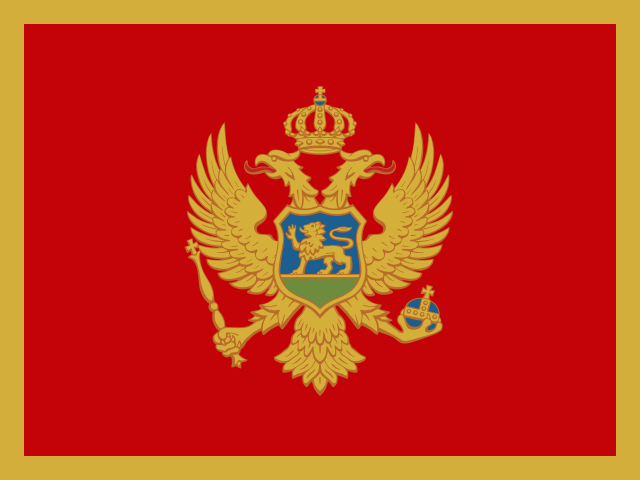
Montenegro
Montenegro is a small Balkan country with exceptionally rugged geography, rising from the Adriatic coast into the Dinaric Alps. The coastline includes the dramatic Bay of Kotor, backed by steep limestone mountains, while the interior contains deep canyons, karst plateaus, forests and high mountain ranges such as Durmitor and Prokletije. The lower Lake Skadar basin provides an extensive wetland landscape along the Albanian border. Climate changes rapidly with elevation, from Mediterranean conditions along the coast to continental and alpine climates in the mountainous interior.
Overview
Montenegro combines excellent wetland, Mediterranean and mountain birding within a compact area. Lake Skadar is the standout site, supporting Dalmatian Pelican, Pygmy Cormorant, herons, terns and large numbers of migrating and wintering waterbirds. The Ulcinj Salina and nearby coastal wetlands are important for flamingos, shorebirds and migration. In the Dinaric mountains, Rock Partridge, Golden Eagle, Alpine Chough and various montane birds occur among limestone cliffs and high grasslands, while Mediterranean scrub supports Eastern Subalpine Warbler and Blue Rock Thrush. Montenegro's small size makes it possible to combine coast, wetlands and mountains in a short trip. Birding tourism is still relatively modest, but roads, accommodation and local guides make the principal sites reasonably accessible.
Top 10 target species
| Species | Annual frequency | January | February | March | April | May | June | July | August | September | October | November | December |
|---|---|---|---|---|---|---|---|---|---|---|---|---|---|
| Great Tit Parus major | 43.5% | 57.8% | 59.1% | 53.2% | 47.3% | 40.9% | 33.4% | 31.4% | 29.7% | 39.4% | 40.3% | 48.8% | 40.8% |
| Eurasian Blackbird Turdus merula | 39.0% | 50.6% | 44.0% | 44.4% | 46.6% | 46.9% | 51.4% | 30.4% | 20.5% | 27.6% | 29.2% | 41.7% | 34.2% |
| House Sparrow Passer domesticus | 35.7% | 27.6% | 30.5% | 42.5% | 41.5% | 43.7% | 44.5% | 44.4% | 32.2% | 33.1% | 29.5% | 32.4% | 26.5% |
| European Robin Erithacus rubecula | 33.0% | 59.8% | 49.7% | 34.9% | 15.7% | 12.9% | 17.9% | 10.3% | 13.0% | 17.5% | 46.5% | 67.9% | 49.3% |
| Hooded Crow Corvus cornix | 31.4% | 36.3% | 27.7% | 34.9% | 34.7% | 33.9% | 27.5% | 27.7% | 27.9% | 26.9% | 25.8% | 41.6% | 31.3% |
| Common Chaffinch Fringilla coelebs | 31.1% | 50.9% | 38.1% | 36.1% | 27.1% | 26.4% | 35.2% | 16.1% | 20.1% | 15.2% | 25.8% | 44.0% | 37.8% |
| Yellow-legged Gull Larus michahellis | 30.8% | 30.3% | 26.1% | 35.2% | 33.3% | 33.9% | 26.4% | 36.3% | 32.5% | 33.3% | 27.9% | 34.6% | 19.7% |
| Eurasian Magpie Pica pica | 30.6% | 39.4% | 31.2% | 29.0% | 29.0% | 29.9% | 25.1% | 24.1% | 26.2% | 27.7% | 29.1% | 37.9% | 38.2% |
| Rock Pigeon Columba livia | 29.9% | 28.9% | 27.7% | 28.1% | 26.3% | 30.4% | 29.6% | 33.1% | 35.6% | 25.4% | 26.8% | 43.0% | 23.7% |
| Gray Heron Ardea cinerea | 26.5% | 23.5% | 23.9% | 24.4% | 25.5% | 25.7% | 18.3% | 22.1% | 24.6% | 31.7% | 24.6% | 39.7% | 33.9% |