
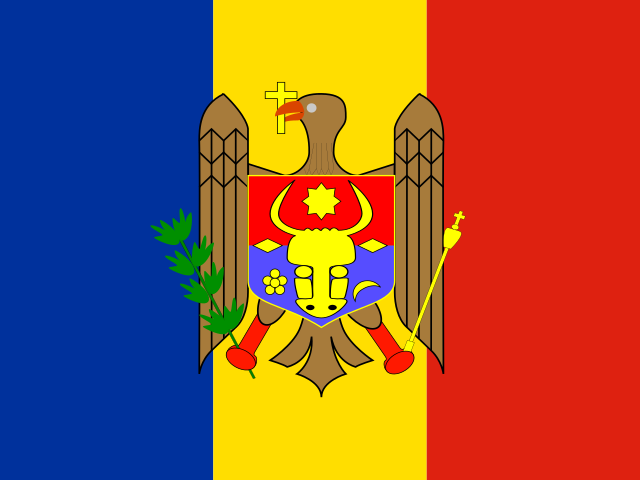
Moldova
Moldova is characterised by rolling hills, fertile plains, river valleys and extensive agricultural landscapes between Romania and Ukraine. Much of the countryside is covered by vineyards, orchards and farmland, while fragments of deciduous forest survive particularly in the central Codri uplands. The Dniester and Prut rivers form the country's principal waterways, accompanied by floodplain forests, reservoirs and wetlands. Moldova has a continental climate with warm summers, cold winters and generally moderate rainfall. Its rich chernozem soils have made agriculture and especially wine production defining features of the landscape.
Overview
Moldova offers a mixture of eastern European farmland, forest and wetland birds, although it has few major specialist targets. The Lower Prut wetlands, including Lake Beleu, are among the most important areas, attracting pelicans, herons, Pygmy Cormorants, ducks and migrating shorebirds. Agricultural landscapes support European Roller, European Bee-eater, Red-backed Shrike and various raptors, while the Codri forests add woodpeckers and woodland passerines. The Dniester valley provides another important migration corridor and wetland system. Dedicated birding tourism is limited, but Moldova's compact size makes the main habitats relatively easy to combine by road. It is best suited to birders interested in quiet eastern European countryside and productive wetlands, rather than unique endemic species.
Top 10 target species
| Species | Annual frequency | January | February | March | April | May | June | July | August | September | October | November | December |
|---|---|---|---|---|---|---|---|---|---|---|---|---|---|
| Great Tit Parus major | 57.7% | 66.5% | 70.0% | 63.1% | 62.3% | 44.6% | 37.1% | 39.6% | 41.5% | 50.3% | 74.0% | 70.4% | 72.8% |
| Mallard Anas platyrhynchos | 43.3% | 53.5% | 45.2% | 48.5% | 44.9% | 34.2% | 29.1% | 24.2% | 36.9% | 53.5% | 47.9% | 43.8% | 57.9% |
| House Sparrow Passer domesticus | 40.2% | 21.9% | 29.7% | 37.3% | 45.5% | 48.7% | 51.1% | 52.7% | 48.1% | 54.4% | 41.4% | 29.9% | 22.0% |
| Eurasian Tree Sparrow Passer montanus | 38.8% | 30.7% | 35.6% | 37.9% | 43.8% | 39.7% | 39.4% | 39.9% | 33.6% | 47.4% | 45.7% | 34.3% | 37.7% |
| Hooded Crow Corvus cornix | 38.3% | 35.9% | 38.7% | 43.6% | 38.9% | 36.7% | 30.5% | 29.8% | 32.8% | 40.5% | 47.4% | 38.6% | 46.5% |
| Eurasian Magpie Pica pica | 37.3% | 33.3% | 40.0% | 41.6% | 33.0% | 30.5% | 26.5% | 30.7% | 31.9% | 43.0% | 47.0% | 39.8% | 51.0% |
| European Starling Sturnus vulgaris | 36.9% | 18.0% | 24.3% | 39.0% | 57.1% | 65.4% | 58.9% | 37.7% | 27.4% | 37.0% | 40.5% | 19.0% | 18.0% |
| European Goldfinch Carduelis carduelis | 36.1% | 31.1% | 30.6% | 39.1% | 45.2% | 34.4% | 40.9% | 38.4% | 31.6% | 33.2% | 44.0% | 33.5% | 31.0% |
| Rook Corvus frugilegus | 34.7% | 36.7% | 47.6% | 40.2% | 29.5% | 22.8% | 16.3% | 16.3% | 20.4% | 39.4% | 53.8% | 47.8% | 45.8% |
| Gray Heron Ardea cinerea | 33.5% | 25.4% | 15.5% | 33.0% | 29.2% | 37.3% | 37.9% | 36.0% | 45.4% | 59.6% | 39.8% | 20.7% | 21.8% |