
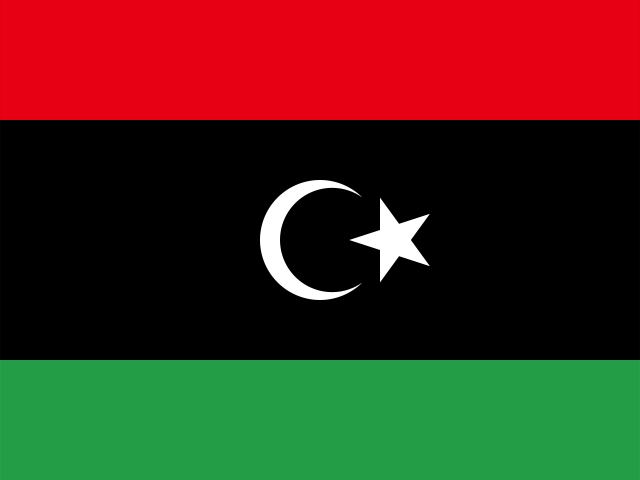
Libya
Libya is dominated by the Sahara, which covers most of the country with immense sand seas, gravel plains, rocky plateaus and isolated massifs. Most settlement lies along the Mediterranean coast, where a narrow belt has a milder climate and supports Mediterranean scrub, farmland and wetlands. The Jebel Akhdar in northeastern Libya is unusually green, with limestone hills, woodland and relatively high rainfall. Farther south, the Acacus and Tibesti regions contain spectacular desert mountains, wadis and volcanic landscapes. Rainfall is extremely scarce across most of the interior.
Overview
Libya is ornithologically underexplored but interesting for its combination of Mediterranean, Saharan and migratory birds. The coastal wetlands are important stopover and wintering areas for flamingos, herons, ducks and shorebirds, while desert habitats support sandgrouse, coursers, larks and wheatears. The Jebel Akhdar holds the country's richest Mediterranean woodland bird communities. Libya is also notable for the Libyan (Cyrenaica) subspecies of Sand Partridge and other regionally distinctive populations. Birding tourism is currently extremely limited: political instability, armed conflict, unexploded ordnance and restrictions on travel, particularly in remote desert and border areas, can make independent exploration dangerous or impossible. Current official travel advice and local security information are essential before considering a visit.
Top 10 target species
| Species | Annual frequency | January | February | March | April | May | June | July | August | September | October | November | December |
|---|---|---|---|---|---|---|---|---|---|---|---|---|---|
| House Sparrow Passer domesticus | 83.6% | 91.2% | 80.4% | 92.6% | 89.4% | 90.9% | 97.2% | 21.3% | 94.4% | 92.8% | 83.1% | 86.8% | 82.9% |
| Laughing Dove Spilopelia senegalensis | 81.5% | 86.9% | 79.9% | 93.2% | 89.3% | 91.1% | 91.2% | 15.8% | 89.9% | 94.2% | 82.9% | 83.5% | 79.9% |
| White Wagtail Motacilla alba | 44.1% | 90.6% | 81.3% | 90.4% | 26.1% | 0.8% | 0.0% | 0.0% | 0.0% | 0.9% | 61.0% | 90.1% | 88.2% |
| European Robin Erithacus rubecula | 31.2% | 58.2% | 53.1% | 46.3% | 8.5% | 0.7% | 6.4% | 0.0% | 0.0% | 5.1% | 50.2% | 85.5% | 60.9% |
| Common Chiffchaff Phylloscopus collybita | 26.2% | 34.8% | 37.1% | 48.7% | 23.5% | 12.6% | 0.5% | 0.0% | 4.5% | 19.6% | 28.0% | 57.5% | 48.1% |
| Great Gray Shrike Lanius excubitor | 25.9% | 23.8% | 16.0% | 25.4% | 21.8% | 25.5% | 24.0% | 30.8% | 41.9% | 25.3% | 29.2% | 22.4% | 24.4% |
| Barn Swallow Hirundo rustica | 22.1% | 0.0% | 3.1% | 21.6% | 47.5% | 44.4% | 17.1% | 12.5% | 0.0% | 45.3% | 67.5% | 6.0% | 0.0% |
| Black Redstart Phoenicurus ochruros | 20.0% | 41.9% | 26.3% | 26.6% | 2.6% | 0.4% | 0.0% | 0.0% | 0.0% | 0.9% | 16.1% | 62.4% | 63.2% |
| European Stonechat Saxicola rubicola | 18.9% | 45.3% | 43.8% | 13.3% | 0.5% | 1.1% | 0.0% | 0.0% | 0.0% | 0.0% | 20.8% | 52.7% | 49.6% |
| Yellow-legged Gull Larus michahellis | 17.8% | 38.1% | 24.8% | 17.8% | 7.8% | 16.3% | 28.9% | 6.3% | 12.5% | 14.5% | 12.1% | 10.7% | 23.8% |