
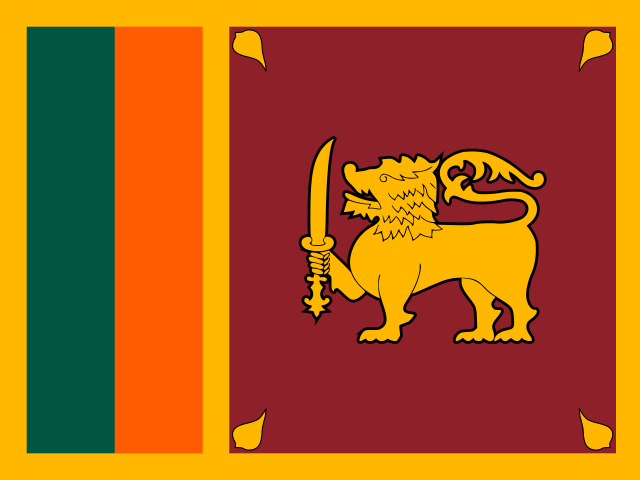
Sri Lanka
Sri Lanka is a tropical island in the Indian Ocean, with landscapes ranging from humid southwestern rainforests and central highlands to dry forests, grasslands and coastal wetlands. The mountainous interior rises above 2,500 metres and contains cool cloud forests and tea-growing regions, while a broad dry zone covers much of the north and east. Rivers radiate from the central highlands towards a coastline of lagoons, mangroves and sandy beaches. Seasonal monsoons create strong regional differences in rainfall and vegetation.
Overview
Sri Lanka is one of Asia's outstanding destinations for endemic birds, with around three dozen species found nowhere else. The rainforests of Sinharaja are essential for specialties such as Sri Lanka Blue Magpie, Red-faced Malkoha, Green-billed Coucal and Sri Lanka Spurfowl, often encountered in mixed-species flocks. Highland sites including Horton Plains and Nuwara Eliya hold Sri Lanka Whistling Thrush, Sri Lanka Wood Pigeon and Dull-blue Flycatcher. Dry-zone parks such as Yala add Malabar Pied Hornbill, Indian Peafowl and numerous raptors and waterbirds. Sri Lanka has a well-developed birding-tourism industry with specialist guides, lodges and established circuits. Its compact size allows most endemics to be targeted in a relatively short trip, making it one of tropical Asia's most accessible endemic-rich destinations.
Top 10 target species
| Species | Annual frequency | January | February | March | April | May | June | July | August | September | October | November | December |
|---|---|---|---|---|---|---|---|---|---|---|---|---|---|
| Red-vented Bulbul Pycnonotus cafer | 56.9% | 53.1% | 54.2% | 55.1% | 58.9% | 60.5% | 60.2% | 58.7% | 56.8% | 54.6% | 59.9% | 56.5% | 53.7% |
| Spotted Dove Spilopelia chinensis | 54.2% | 53.1% | 53.8% | 52.0% | 52.3% | 48.7% | 52.9% | 55.9% | 55.3% | 55.4% | 61.3% | 55.2% | 54.1% |
| Common Myna Acridotheres tristis | 49.1% | 44.0% | 44.5% | 44.4% | 49.5% | 52.1% | 53.3% | 52.9% | 51.0% | 49.8% | 54.0% | 48.1% | 45.1% |
| Rose-ringed Parakeet Psittacula krameri | 42.8% | 40.2% | 40.6% | 39.6% | 44.8% | 45.6% | 45.1% | 43.1% | 43.6% | 45.6% | 43.9% | 41.4% | 40.4% |
| White-throated Kingfisher Halcyon smyrnensis | 42.1% | 40.1% | 40.7% | 39.6% | 44.0% | 46.8% | 46.0% | 43.0% | 39.9% | 40.7% | 40.1% | 42.3% | 41.6% |
| Yellow-billed Babbler Argya affinis | 41.3% | 36.6% | 36.7% | 35.6% | 43.6% | 47.1% | 46.7% | 43.3% | 41.5% | 42.8% | 44.7% | 40.0% | 37.1% |
| House Crow Corvus splendens | 40.1% | 36.6% | 34.0% | 35.4% | 38.7% | 45.8% | 44.7% | 41.9% | 40.5% | 42.7% | 44.3% | 39.2% | 36.9% |
| Common Tailorbird Orthotomus sutorius | 38.6% | 32.3% | 32.3% | 33.3% | 39.7% | 44.9% | 44.5% | 41.1% | 40.6% | 39.6% | 45.2% | 36.6% | 32.6% |
| Brown-headed Barbet Psilopogon zeylanicus | 38.0% | 33.5% | 35.6% | 35.3% | 43.2% | 47.4% | 46.6% | 42.8% | 37.6% | 35.5% | 35.6% | 32.0% | 30.5% |
| Oriental Magpie-Robin Copsychus saularis | 34.9% | 32.2% | 34.3% | 34.9% | 38.5% | 39.6% | 37.6% | 36.5% | 32.6% | 31.6% | 36.3% | 33.6% | 31.4% |