
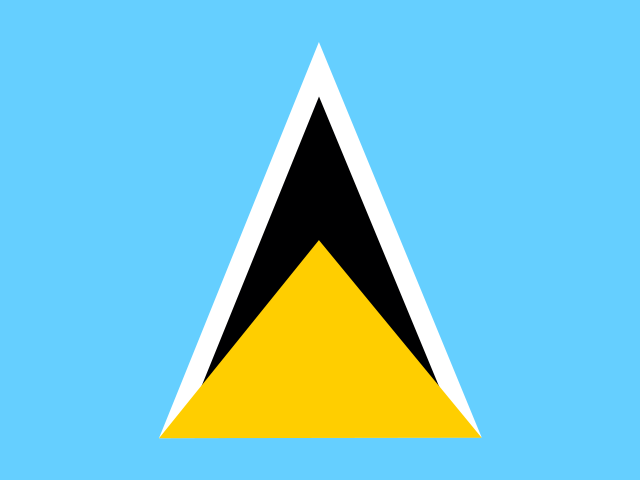
Saint Lucia
Saint Lucia is a mountainous Lesser Antillean island dominated by the volcanic Pitons and central rainforest belt. The interior rises steeply from the coast, with Mount Gimie reaching 950 metres, while the south and west contain drier valleys, plantations and coastal vegetation. The Pitons Management Area combines volcanic peaks, rainforest and marine habitats, while the island's eastern side is more exposed to the Atlantic. Rivers, waterfalls and dense forest give the interior a distinctly wetter character than many of the smaller islands farther north. Saint Lucia's compact size means that rainforest, mountains and coast can be reached within relatively short journeys, although the steep terrain makes some areas demanding to explore.
Overview
Saint Lucia is particularly valuable for island endemics, with the Saint Lucia Parrot, Saint Lucia Black Finch, Saint Lucia Oriole and Saint Lucia Warbler among the key targets. The central rainforest reserve is the main focus, especially the Millet Bird Sanctuary, which supports several endemic species along a manageable forest trail. Hummingbirds are conspicuous, including Purple-throated Carib, while wetlands and coastal areas add herons, shorebirds and migrants. The island has a small but established birding-tourism infrastructure, with local guides particularly useful for locating endemic forest birds. The dry season from December to May generally offers more stable conditions, although rainforest birding can involve steep and muddy trails.
Top 10 target species
| Species | Annual frequency | January | February | March | April | May | June | July | August | September | October | November | December |
|---|---|---|---|---|---|---|---|---|---|---|---|---|---|
| Bananaquit Coereba flaveola | 59.7% | 55.1% | 60.9% | 60.3% | 62.2% | 63.0% | 63.5% | 58.9% | 59.3% | 54.2% | 62.3% | 55.6% | 60.9% |
| Carib Grackle Quiscalus lugubris | 57.5% | 52.7% | 49.6% | 51.1% | 59.4% | 63.0% | 55.1% | 59.1% | 63.6% | 64.2% | 61.3% | 55.4% | 55.5% |
| Lesser Antillean Bullfinch Loxigilla noctis | 55.0% | 54.4% | 56.5% | 52.7% | 59.0% | 57.8% | 61.9% | 55.3% | 49.3% | 46.4% | 52.2% | 53.0% | 61.7% |
| Gray Kingbird Tyrannus dominicensis | 53.5% | 50.2% | 48.7% | 46.0% | 47.4% | 55.2% | 49.4% | 55.4% | 60.3% | 60.9% | 62.9% | 51.5% | 54.3% |
| Zenaida Dove Zenaida aurita | 47.7% | 40.0% | 45.7% | 46.3% | 52.8% | 52.7% | 44.9% | 43.6% | 56.5% | 56.7% | 47.6% | 44.7% | 41.0% |
| Antillean Crested Hummingbird Orthorhyncus cristatus | 42.8% | 42.6% | 44.7% | 43.4% | 48.1% | 42.9% | 48.2% | 41.8% | 43.2% | 28.9% | 39.6% | 42.0% | 47.7% |
| Magnificent Frigatebird Fregata magnificens | 35.6% | 30.1% | 28.7% | 32.0% | 35.5% | 40.1% | 36.4% | 38.4% | 40.1% | 45.4% | 37.8% | 35.2% | 28.0% |
| Black-faced Grassquit Melanospiza bicolor | 32.2% | 25.5% | 29.3% | 28.0% | 33.2% | 35.9% | 29.5% | 33.9% | 39.2% | 38.4% | 37.1% | 27.1% | 29.4% |
| Scaly-breasted Thrasher Allenia fusca | 31.8% | 25.5% | 28.5% | 28.9% | 36.4% | 36.6% | 40.0% | 40.2% | 37.0% | 26.9% | 30.4% | 27.1% | 24.1% |
| Scaly-naped Pigeon Patagioenas squamosa | 29.7% | 12.9% | 19.1% | 23.0% | 34.6% | 47.8% | 56.5% | 53.0% | 42.8% | 25.6% | 16.9% | 10.5% | 14.2% |