
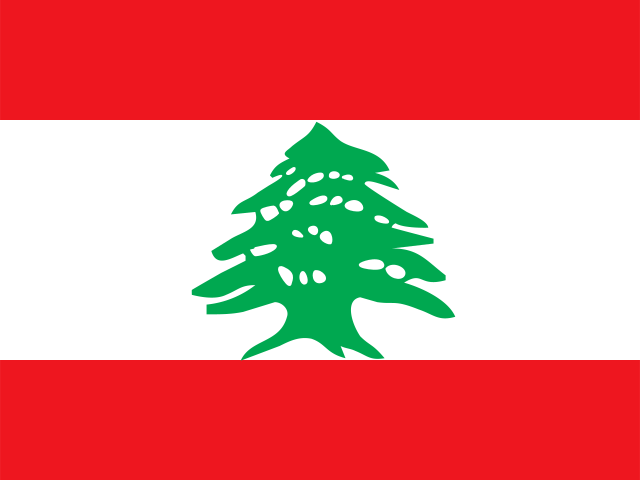
Lebanon
Lebanon is a small but topographically diverse Mediterranean country dominated by two parallel mountain chains: the Mount Lebanon range and the Anti-Lebanon Mountains, separated by the fertile Beqaa Valley. Elevations rise from a narrow Mediterranean coastline to peaks above 3,000 metres, creating sharp climatic and ecological gradients. Habitats include Mediterranean scrub, pine and oak woodland, remnants of the country's famous cedar forests, rocky mountain slopes, agricultural valleys and coastal wetlands. Winters are wet and snowy at higher elevations, while summers are generally hot and dry.
Overview
Lebanon lies on a major migration corridor between Eurasia and Africa, making passage seasons especially important. Large numbers of raptors, storks and pelicans cross the country, with sites such as Aammiq Wetland in the Beqaa Valley providing important stopover habitat for waterbirds and migrants. Mountain areas support Syrian Serin, the country's particularly notable regional specialty, alongside Western Rock Nuthatch, Chukar and various wheatears and raptors. Despite its small size, Lebanon's elevation range allows diverse habitats to be visited relatively quickly. A local bird-conservation and guiding community exists, but birding tourism is limited compared with better-established regional destinations. Security conditions and access can change rapidly, particularly near border areas, so current official travel advice should be checked when planning a visit.
Top 10 target species
| Species | Annual frequency | January | February | March | April | May | June | July | August | September | October | November | December |
|---|---|---|---|---|---|---|---|---|---|---|---|---|---|
| Eurasian Blackbird Turdus merula | 44.0% | 45.9% | 48.0% | 45.8% | 50.9% | 50.0% | 57.5% | 45.0% | 35.9% | 31.6% | 32.3% | 47.8% | 37.1% |
| House Sparrow Passer domesticus | 42.3% | 41.5% | 42.9% | 46.1% | 46.7% | 40.5% | 49.7% | 48.5% | 43.4% | 30.1% | 31.5% | 38.1% | 48.8% |
| Hooded Crow Corvus cornix | 40.0% | 42.8% | 48.0% | 43.3% | 36.6% | 35.8% | 39.6% | 37.1% | 33.0% | 35.8% | 33.6% | 48.5% | 46.2% |
| White-spectacled Bulbul Pycnonotus xanthopygos | 34.1% | 38.3% | 40.1% | 39.8% | 35.7% | 23.8% | 34.8% | 30.3% | 26.6% | 22.8% | 28.8% | 45.6% | 43.0% |
| European Greenfinch Chloris chloris | 33.9% | 30.0% | 25.6% | 35.4% | 40.0% | 36.8% | 43.3% | 36.3% | 32.7% | 26.6% | 29.1% | 41.1% | 29.5% |
| Graceful Prinia Prinia gracilis | 31.3% | 31.1% | 39.7% | 44.5% | 36.9% | 24.3% | 29.6% | 31.7% | 24.5% | 18.5% | 20.5% | 38.7% | 35.5% |
| Common Chaffinch Fringilla coelebs | 27.1% | 38.2% | 35.7% | 23.5% | 23.0% | 24.3% | 25.2% | 19.5% | 9.3% | 12.3% | 20.3% | 54.8% | 38.6% |
| Laughing Dove Spilopelia senegalensis | 26.0% | 25.4% | 31.1% | 35.7% | 31.8% | 25.6% | 24.8% | 24.7% | 18.8% | 22.2% | 17.8% | 22.3% | 31.5% |
| Sardinian Warbler Curruca melanocephala | 25.1% | 25.1% | 21.1% | 28.8% | 26.9% | 23.5% | 31.6% | 29.3% | 24.6% | 18.7% | 19.5% | 28.3% | 24.1% |
| Great Tit Parus major | 24.8% | 24.9% | 17.7% | 23.5% | 27.7% | 26.8% | 34.7% | 25.2% | 18.6% | 23.2% | 24.6% | 29.9% | 20.3% |