
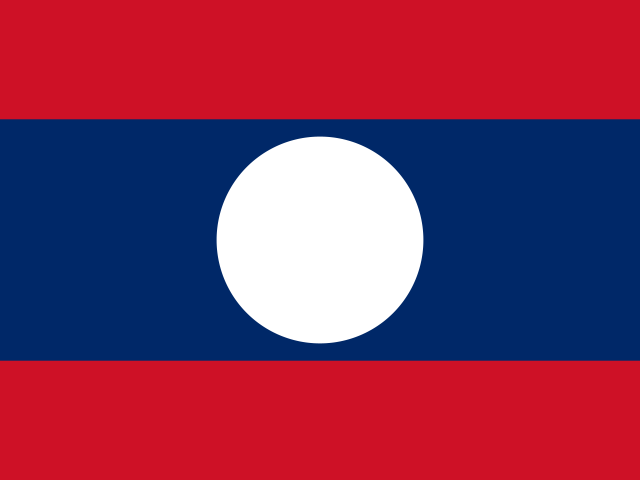
Laos
Laos is a landlocked country in mainland Southeast Asia, dominated by mountains, forested plateaus and the Mekong River. Much of the north is rugged and mountainous, with narrow valleys and extensive limestone karst, while the Annamite Range forms much of the eastern border with Vietnam. Southern Laos includes the elevated Bolaven Plateau, lowland river plains and the wetlands surrounding the Mekong's Si Phan Don region. Forests range from evergreen and montane formations to drier deciduous woodland. The climate is tropical and strongly monsoonal, with a pronounced wet season from roughly May to October and a cooler, drier period during the northern winter. Laos remains comparatively sparsely populated, with many rural and mountainous areas retaining extensive natural landscapes.
Overview
Laos is especially interesting for Indochinese forest birds and highly localised specialties. Its most famous bird is the extraordinary Bare-faced Bulbul, discovered scientifically only in 2009 and associated with the limestone karst of central Laos. The Nakai–Nam Theun region and Annamite forests support rare species such as Sooty Babbler, Red-collared Woodpecker and Crested Argus, alongside hornbills, pittas and broadbills. Northern mountains add a different assemblage of subtropical and montane species. Laos receives relatively few birding tourists compared with Thailand or Vietnam, and specialist infrastructure remains limited. Local guides are particularly valuable because productive sites can involve long road journeys, difficult forest access and limited public transport. For birders, Laos offers the appeal of little-visited forests, limestone endemics and Indochinese specialties in a comparatively undeveloped setting.
Top 10 target species
| Species | Annual frequency | January | February | March | April | May | June | July | August | September | October | November | December |
|---|---|---|---|---|---|---|---|---|---|---|---|---|---|
| Common Tailorbird Orthotomus sutorius | 47.7% | 40.5% | 33.6% | 49.6% | 48.0% | 53.6% | 50.5% | 58.0% | 59.4% | 56.8% | 45.9% | 41.6% | 34.6% |
| Eurasian Tree Sparrow Passer montanus | 42.2% | 29.9% | 28.9% | 41.4% | 42.7% | 50.8% | 51.1% | 52.5% | 56.3% | 48.9% | 42.4% | 33.0% | 29.1% |
| Scaly-breasted Munia Lonchura punctulata | 29.8% | 18.8% | 14.8% | 22.2% | 26.7% | 37.1% | 35.8% | 36.3% | 43.4% | 41.9% | 32.2% | 31.7% | 16.9% |
| Zebra Dove Geopelia striata | 29.2% | 26.4% | 19.6% | 23.0% | 22.6% | 30.7% | 30.2% | 33.3% | 40.4% | 41.7% | 31.2% | 30.0% | 21.2% |
| Greater Coucal Centropus sinensis | 28.0% | 19.4% | 24.3% | 38.0% | 37.7% | 42.2% | 40.7% | 41.2% | 30.9% | 16.2% | 14.6% | 17.3% | 13.6% |
| Common Myna Acridotheres tristis | 26.8% | 18.4% | 18.9% | 22.3% | 28.2% | 34.3% | 31.3% | 36.2% | 34.9% | 32.0% | 22.4% | 22.1% | 20.7% |
| Asian Palm Swift Cypsiurus balasiensis | 26.7% | 21.8% | 21.0% | 31.6% | 31.6% | 39.3% | 36.5% | 31.3% | 23.0% | 24.2% | 23.3% | 21.8% | 15.0% |
| Plain Prinia Prinia inornata | 23.6% | 15.1% | 13.1% | 18.8% | 25.3% | 33.8% | 28.5% | 28.1% | 33.5% | 36.3% | 19.1% | 18.8% | 12.4% |
| Brown Shrike Lanius cristatus | 22.9% | 31.6% | 21.0% | 22.5% | 28.2% | 15.7% | 0.0% | 0.3% | 2.1% | 45.5% | 45.9% | 36.5% | 25.3% |
| Great Myna Acridotheres grandis | 21.7% | 18.5% | 12.4% | 14.8% | 20.5% | 23.6% | 20.7% | 23.5% | 30.6% | 33.8% | 22.3% | 23.9% | 16.5% |