
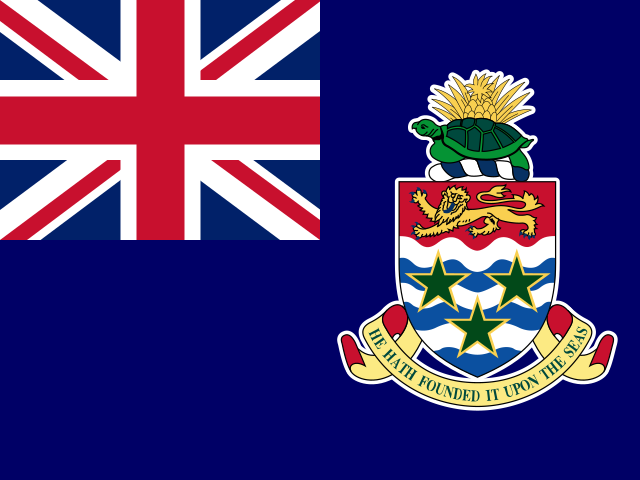
Cayman Islands
The Cayman Islands are a low-lying Caribbean archipelago south of Cuba, consisting of Grand Cayman, Cayman Brac and Little Cayman. Built largely from porous limestone, the islands have no permanent rivers and are characterised by dry woodland, scrub, mangroves, wetlands and coastal habitats. Grand Cayman is the largest and most developed island, while Cayman Brac has the highest and most rugged terrain, rising to just 46 metres. Little Cayman is particularly undeveloped, with extensive mangroves, ponds and natural coastline. The islands' position on the Cayman Ridge gives them a distinctive geological setting between the Caribbean and western Atlantic. Their relatively dry climate and well-developed tourism infrastructure make them considerably easier to explore than many smaller Caribbean islands. Protected areas such as the Mastic Reserve preserve some of the remaining native woodland.
Overview
The Cayman Islands are especially interesting for island birds, migrants and seabird colonies. Cayman Brac Parrot, restricted to Cayman Brac, is the key endemic target, with the Parrot Preserve providing its main protected habitat. Little Cayman is particularly notable for Red-footed Boobies: Booby Pond supports the largest breeding colony in the Caribbean, alongside Magnificent Frigatebirds. Wetlands on all three islands attract herons, shorebirds, ducks and North American migrants, including occasional West Indian Whistling-Ducks. Grand Cayman's Mastic Trail is useful for woodland birds, while Cayman Brac's coastal bluffs add Brown Boobies and frigatebirds. The islands are relatively easy to bird independently, with established trails, reserves and birding tours; reaching the smaller islands requires additional flights or boat connections.
Top 10 target species
| Species | Annual frequency | January | February | March | April | May | June | July | August | September | October | November | December |
|---|---|---|---|---|---|---|---|---|---|---|---|---|---|
| Northern Mockingbird Mimus polyglottos | 56.0% | 47.7% | 50.2% | 56.2% | 60.2% | 59.9% | 65.6% | 63.9% | 58.7% | 63.0% | 54.7% | 47.4% | 45.2% |
| Bananaquit Coereba flaveola | 52.6% | 46.0% | 49.4% | 55.6% | 57.8% | 53.9% | 52.9% | 55.5% | 57.7% | 60.6% | 52.7% | 44.4% | 44.9% |
| Greater Antillean Grackle Quiscalus niger | 43.8% | 30.3% | 35.3% | 47.5% | 48.5% | 51.6% | 57.0% | 61.0% | 49.5% | 46.4% | 31.1% | 34.1% | 32.7% |
| White-winged Dove Zenaida asiatica | 42.6% | 23.5% | 33.4% | 45.7% | 54.6% | 55.9% | 60.5% | 63.1% | 54.0% | 51.3% | 27.6% | 21.9% | 19.2% |
| Common Ground Dove Columbina passerina | 35.2% | 25.4% | 26.6% | 30.9% | 35.2% | 39.7% | 41.7% | 43.0% | 44.2% | 44.0% | 37.6% | 28.1% | 26.3% |
| White-crowned Pigeon Patagioenas leucocephala | 34.9% | 18.9% | 22.6% | 27.2% | 39.9% | 46.5% | 54.0% | 55.8% | 49.4% | 41.7% | 25.5% | 19.2% | 18.4% |
| Smooth-billed Ani Crotophaga ani | 33.2% | 28.2% | 26.6% | 29.9% | 31.5% | 31.9% | 36.8% | 38.5% | 37.1% | 39.8% | 35.1% | 33.7% | 29.9% |
| Common Gallinule Gallinula galeata | 32.1% | 31.4% | 30.2% | 31.5% | 33.2% | 34.5% | 35.2% | 36.7% | 33.3% | 31.0% | 23.4% | 32.4% | 31.9% |
| Mangrove Yellow Warbler Setophaga petechia | 30.5% | 19.7% | 21.1% | 26.5% | 35.8% | 44.7% | 45.1% | 44.1% | 35.4% | 36.4% | 20.3% | 17.0% | 19.8% |
| Tricolored Heron Egretta tricolor | 30.3% | 27.4% | 26.3% | 25.4% | 29.4% | 32.3% | 35.4% | 35.4% | 37.5% | 34.3% | 24.2% | 28.1% | 27.6% |