
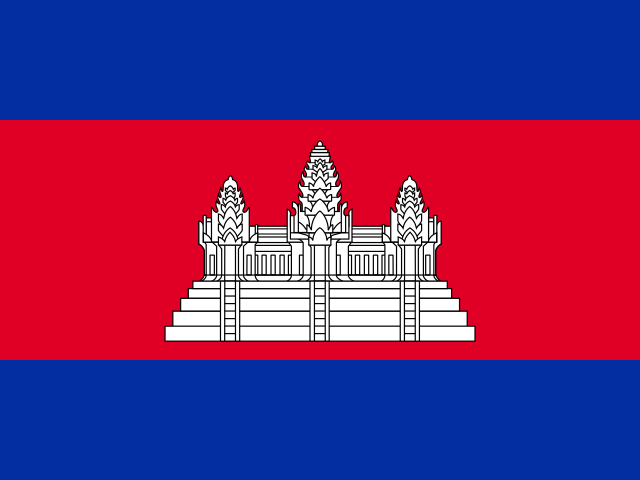
Cambodia
Cambodia is dominated by the broad lowlands of the Mekong River and Tonle Sap, surrounded by forested uplands and mountain ranges along its borders. Tonle Sap Lake is the country's defining natural feature, expanding dramatically during the monsoon as the Tonle Sap River reverses direction and floods extensive forests and wetlands. Northern and eastern Cambodia contain dry dipterocarp and evergreen forests, while the Cardamom Mountains in the southwest preserve some of mainland Southeast Asia's largest remaining forest landscapes. The climate is tropical and strongly monsoonal, with a distinct wet season from roughly May to October and a dry season during the northern winter.
Overview
Cambodia is one of Southeast Asia's most important destinations for large threatened waterbirds and dry-forest specialties. The wetlands around Tonle Sap, particularly Prek Toal, support major colonies of Greater and Lesser Adjutants, Painted Stork, Asian Openbill and Spot-billed Pelican. Northern dry forests are famous for Giant Ibis, Cambodia's national bird, as well as White-shouldered Ibis, Green Peafowl and several vultures. The grasslands around Kampong Thom hold the highly localised Bengal Florican, while the Mekong supports the scarce Mekong Wagtail. Cambodia has a growing specialist birding industry, with local guides and community-based ecotourism at several key sites. Many important areas require long drives, boats or local arrangements, but established circuits make the principal specialties relatively practical to target.
Top 10 target species
| Species | Annual frequency | January | February | March | April | May | June | July | August | September | October | November | December |
|---|---|---|---|---|---|---|---|---|---|---|---|---|---|
| Zebra Dove Geopelia striata | 53.8% | 46.8% | 41.6% | 44.5% | 46.6% | 54.0% | 58.2% | 63.3% | 62.9% | 66.3% | 59.7% | 52.3% | 49.7% |
| Common Myna Acridotheres tristis | 52.5% | 44.5% | 40.4% | 43.8% | 48.2% | 55.3% | 61.7% | 64.6% | 61.2% | 60.9% | 52.6% | 50.5% | 45.8% |
| Yellow-vented Bulbul Pycnonotus goiavier | 51.0% | 42.0% | 36.9% | 42.3% | 49.0% | 57.3% | 58.9% | 58.2% | 58.8% | 64.0% | 54.4% | 47.8% | 42.8% |
| Eurasian Tree Sparrow Passer montanus | 42.3% | 36.6% | 30.1% | 36.0% | 39.8% | 45.8% | 52.2% | 54.1% | 51.4% | 49.3% | 39.9% | 37.1% | 35.6% |
| Spotted Dove Spilopelia chinensis | 41.8% | 38.0% | 38.0% | 39.8% | 38.4% | 43.4% | 46.0% | 49.3% | 43.9% | 43.1% | 40.8% | 39.1% | 41.5% |
| White-nest Swiftlet Aerodramus fuciphagus | 39.7% | 38.6% | 35.3% | 33.4% | 35.3% | 36.0% | 34.8% | 42.1% | 44.1% | 44.6% | 44.9% | 42.7% | 45.2% |
| Common Tailorbird Orthotomus sutorius | 34.7% | 26.6% | 23.4% | 28.7% | 34.4% | 40.9% | 42.3% | 44.0% | 41.5% | 41.8% | 34.1% | 32.2% | 26.3% |
| Streak-eared Bulbul Pycnonotus conradi | 34.2% | 28.6% | 27.4% | 31.9% | 34.2% | 40.9% | 37.6% | 39.1% | 37.5% | 36.7% | 35.5% | 32.6% | 28.7% |
| Greater Coucal Centropus sinensis | 33.6% | 30.7% | 30.8% | 32.2% | 37.0% | 40.7% | 36.2% | 38.2% | 33.9% | 30.5% | 30.6% | 31.2% | 31.4% |
| Red Collared-Dove Streptopelia tranquebarica | 32.9% | 26.9% | 28.8% | 31.7% | 31.2% | 36.8% | 37.2% | 38.4% | 40.6% | 36.1% | 28.2% | 30.3% | 29.0% |