
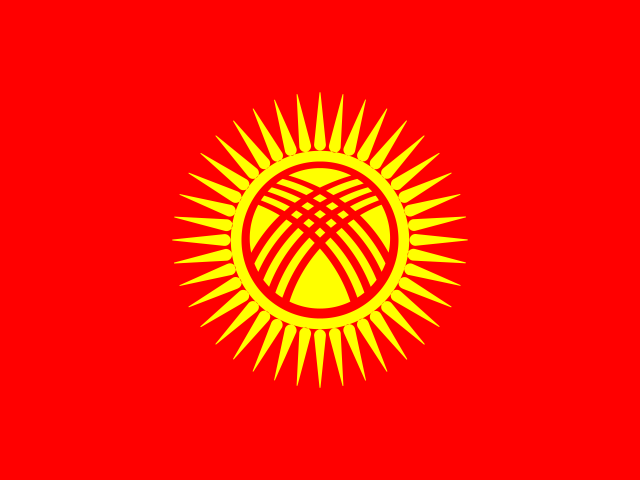
Kyrgyzstan
Kyrgyzstan is one of Central Asia's most mountainous countries, with the Tien Shan covering most of its territory. High snow-covered ranges, alpine meadows, deep valleys and extensive high-altitude plateaus dominate the landscape, while glaciers feed numerous rivers and mountain lakes. Issyk-Kul, one of the world's largest high-altitude lakes, forms a broad basin between major mountain ranges and is a defining geographical feature. Lower valleys are considerably drier, with steppe and semi-desert vegetation contrasting sharply with alpine environments above. The climate is strongly continental, with cold winters and warm summers in the valleys, while high elevations remain cool even in summer. Kyrgyzstan is sparsely populated outside the main valleys, and traditional pastoralism remains conspicuous across the mountain landscapes.
Overview
Kyrgyzstan is primarily a destination for high-altitude Central Asian birds and raptors. The Tien Shan supports sought-after species such as Himalayan Snowcock, Ibisbill, Güldenstädt's Redstart, White-winged Grosbeak and Brown Dipper, while Lammergeier, Himalayan Griffon and Golden Eagle patrol the mountains. Alpine valleys and plateaus add accentors, rosefinches and other mountain specialists, while Issyk-Kul and surrounding wetlands attract large numbers of waterbirds and migrants. Areas around Bishkek, Ala-Archa National Park and Issyk-Kul provide relatively accessible introductions to the country's birdlife, but more specialised high-altitude sites require long drives and rough mountain roads. Birding tourism is still fairly specialised, although guided tours are available and can be combined with trekking and yurt stays. Kyrgyzstan's appeal lies in spectacular mountain birding in relatively accessible Tien Shan landscapes.
Top 10 target species
| Species | Annual frequency | January | February | March | April | May | June | July | August | September | October | November | December |
|---|---|---|---|---|---|---|---|---|---|---|---|---|---|
| Eurasian Magpie Pica pica | 42.1% | 47.5% | 58.6% | 47.9% | 37.7% | 33.7% | 31.3% | 28.0% | 30.2% | 43.6% | 48.7% | 53.2% | 44.7% |
| Rock Pigeon Columba livia | 39.1% | 48.8% | 47.6% | 49.2% | 33.8% | 26.7% | 25.8% | 25.3% | 32.3% | 42.6% | 40.4% | 50.9% | 45.9% |
| Carrion Crow Corvus corone | 36.4% | 35.9% | 45.0% | 38.3% | 39.2% | 35.3% | 31.9% | 27.1% | 23.5% | 37.9% | 46.3% | 40.7% | 36.2% |
| Great Tit Parus major | 33.7% | 47.8% | 44.8% | 48.4% | 28.5% | 23.5% | 18.6% | 16.3% | 18.8% | 32.4% | 35.2% | 46.5% | 43.2% |
| Common Myna Acridotheres tristis | 32.9% | 43.4% | 29.0% | 37.3% | 36.5% | 32.0% | 31.3% | 30.1% | 31.2% | 32.5% | 27.7% | 24.6% | 39.2% |
| Eurasian Blackbird Turdus merula | 32.2% | 49.6% | 47.3% | 51.1% | 29.6% | 23.2% | 23.0% | 18.3% | 14.1% | 23.5% | 21.3% | 41.9% | 43.8% |
| Rook Corvus frugilegus | 26.7% | 43.3% | 34.3% | 33.7% | 16.8% | 16.5% | 15.5% | 13.7% | 15.2% | 21.4% | 28.3% | 39.9% | 42.0% |
| Common Chaffinch Fringilla coelebs | 21.2% | 36.6% | 33.9% | 42.6% | 11.5% | 0.2% | 0.0% | 0.1% | 0.1% | 4.3% | 37.2% | 44.8% | 42.6% |
| Eurasian Tree Sparrow Passer montanus | 21.0% | 25.1% | 24.6% | 23.2% | 14.1% | 17.4% | 18.5% | 20.2% | 23.3% | 19.0% | 23.9% | 17.2% | 25.6% |
| Hooded Crow Corvus cornix | 18.5% | 42.6% | 39.5% | 26.8% | 1.8% | 0.6% | 0.0% | 0.0% | 0.3% | 1.2% | 19.4% | 45.2% | 44.1% |