
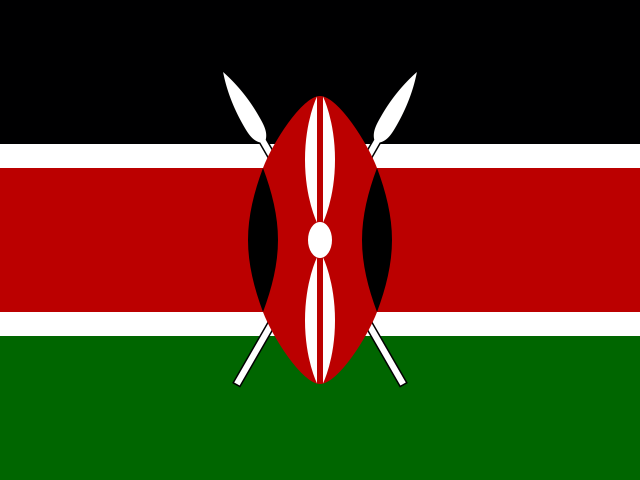
Kenya
Kenya spans an exceptional range of East African landscapes, from the Indian Ocean coast to high mountains, Rift Valley lakes and arid northern plains. The Great Rift Valley crosses the country with volcanic highlands and numerous lakes, while Mount Kenya rises above 5,000 metres with montane forest and alpine vegetation. Vast savannas dominate much of the south and east, contrasting with forests in the central highlands and coastal region. Northern Kenya becomes increasingly dry, with semi-desert, lava fields and acacia scrub. This combination of elevation, rainfall and geography creates extraordinary habitat diversity.
Overview
Kenya is one of Africa's premier birding destinations, with well over 1,000 recorded species and excellent safari infrastructure. The Rift Valley lakes, including Nakuru, Naivasha and Baringo, support spectacular concentrations of flamingos, pelicans and other waterbirds. Famous reserves such as the Maasai Mara, Amboseli and Tsavo combine abundant large mammals with bustards, secretarybirds, vultures, hornbills and raptors. Highland forests hold regional specialties including Sharpe's Longclaw and Abbott's Starling, while the Arabuko-Sokoke Forest protects highly localized birds such as Sokoke Scops Owl and Clarke's Weaver. Northern Kenya adds distinctive dry-country species including Vulturine Guineafowl and Somali Ostrich. An extensive network of guides, lodges and reserves makes Kenya particularly accessible, although remote northern areas require more logistical planning and awareness of local security conditions.
Top 10 target species
| Species | Annual frequency | January | February | March | April | May | June | July | August | September | October | November | December |
|---|---|---|---|---|---|---|---|---|---|---|---|---|---|
| Common Bulbul Pycnonotus barbatus | 39.6% | 38.4% | 37.4% | 41.7% | 40.9% | 41.2% | 38.1% | 38.9% | 40.2% | 40.2% | 40.1% | 38.6% | 39.6% |
| Superb Starling Lamprotornis superbus | 29.4% | 28.8% | 28.7% | 29.9% | 30.4% | 28.8% | 30.2% | 29.3% | 30.3% | 31.0% | 28.9% | 28.9% | 28.1% |
| Speckled Mousebird Colius striatus | 28.6% | 27.3% | 26.7% | 30.3% | 28.4% | 30.7% | 28.1% | 28.3% | 29.2% | 30.6% | 30.5% | 26.2% | 27.1% |
| Hadada Ibis Bostrychia hagedash | 27.3% | 26.7% | 25.0% | 29.4% | 28.7% | 28.3% | 26.4% | 27.3% | 26.2% | 29.1% | 29.2% | 25.8% | 25.9% |
| Ring-necked Dove Streptopelia capicola | 25.7% | 26.0% | 25.0% | 25.9% | 26.1% | 27.6% | 25.4% | 26.0% | 25.9% | 25.2% | 24.9% | 24.0% | 26.2% |
| Egyptian Goose Alopochen aegyptiaca | 24.3% | 24.4% | 23.0% | 24.8% | 23.7% | 23.0% | 24.7% | 24.1% | 25.0% | 27.2% | 24.5% | 24.0% | 23.7% |
| Fork-tailed Drongo Dicrurus adsimilis | 23.4% | 23.3% | 22.5% | 23.4% | 23.5% | 22.2% | 22.6% | 23.1% | 23.6% | 23.1% | 25.4% | 23.3% | 24.4% |
| African Pied Wagtail Motacilla aguimp | 22.4% | 21.7% | 21.0% | 22.4% | 21.8% | 22.0% | 21.1% | 22.3% | 22.9% | 24.7% | 25.0% | 21.7% | 22.2% |
| Red-eyed Dove Streptopelia semitorquata | 21.3% | 21.0% | 18.9% | 21.4% | 20.0% | 22.1% | 20.8% | 22.8% | 21.4% | 22.0% | 22.5% | 20.3% | 22.7% |
| Pied Crow Corvus albus | 20.2% | 18.3% | 15.8% | 17.6% | 18.2% | 21.6% | 20.5% | 21.8% | 23.3% | 22.9% | 22.6% | 19.4% | 20.5% |