
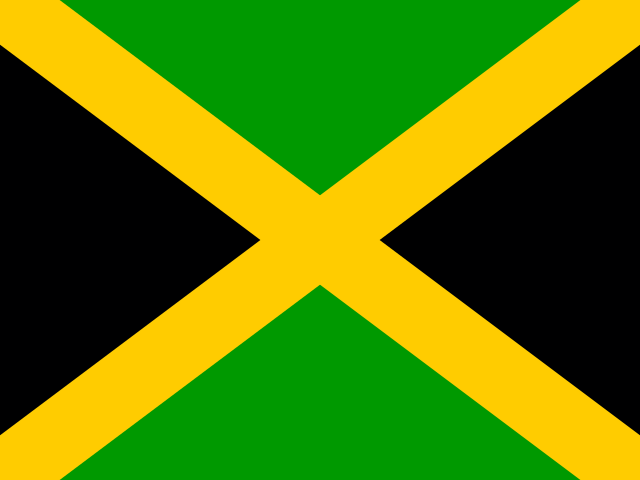
Jamaica
Jamaica is a mountainous Caribbean island with strong contrasts between humid uplands and much drier lowlands. The Blue Mountains in the east contain the island's highest peaks and extensive montane rainforest, while the Cockpit Country in the west is a distinctive karst landscape of steep limestone hills, sinkholes and dense wet forest. The south coast is considerably drier, with scrub, dry woodland and wetlands, while much of the interior remains relatively rugged despite Jamaica's dense population. This combination of mountains, limestone forest and dry coastal habitats creates substantial ecological variation over a compact area. Jamaica's tropical climate is strongly influenced by elevation, with cooler, wetter conditions in the mountains and a pronounced dry season in parts of the south. The island's long isolation has also produced an exceptionally distinctive native fauna.
Overview
Jamaica is one of the Caribbean's best destinations for endemic birds, with 28 species found nowhere else. The Blue and John Crow Mountains are the key area and reportedly the only place where all of Jamaica's endemic birds can be found, including Jamaican Tody, Jamaican Blackbird, Jamaican Owl, Jamaican Spindalis and the two Streamertails. The Cockpit Country is another major stronghold, particularly for forest endemics, while Rocklands Bird Sanctuary near Montego Bay is famous for close views of hummingbirds, especially the Red-billed Streamertail (Doctor Bird). North American migrants add significantly to the list during the winter months. Jamaica has a well-established birding tourism scene, with specialist guides, birding lodges and accessible sites, although some mountain and Cockpit Country locations are remote or involve rough roads. For a birder targeting Caribbean endemics, it is one of the most rewarding islands to visit.
Top 10 target species
| Species | Annual frequency | January | February | March | April | May | June | July | August | September | October | November | December |
|---|---|---|---|---|---|---|---|---|---|---|---|---|---|
| Bananaquit Coereba flaveola | 42.1% | 41.9% | 45.7% | 48.8% | 49.2% | 43.2% | 38.9% | 43.3% | 37.1% | 34.3% | 37.8% | 41.7% | 43.1% |
| Turkey Vulture Cathartes aura | 41.2% | 47.6% | 47.0% | 44.4% | 45.1% | 38.9% | 37.4% | 38.9% | 41.5% | 35.8% | 36.6% | 38.4% | 42.4% |
| Northern Mockingbird Mimus polyglottos | 40.1% | 37.0% | 40.9% | 39.5% | 46.6% | 42.9% | 43.2% | 39.2% | 37.9% | 35.5% | 45.0% | 36.3% | 37.1% |
| Loggerhead Kingbird Tyrannus caudifasciatus | 39.7% | 41.4% | 45.1% | 44.5% | 44.4% | 37.0% | 30.2% | 40.9% | 42.8% | 30.3% | 33.6% | 42.8% | 43.3% |
| Jamaican Woodpecker Melanerpes radiolatus | 36.6% | 32.5% | 36.4% | 41.3% | 43.3% | 43.6% | 35.5% | 43.7% | 39.2% | 30.1% | 31.3% | 31.3% | 30.9% |
| White-crowned Pigeon Patagioenas leucocephala | 33.9% | 25.7% | 30.2% | 33.8% | 42.7% | 47.2% | 42.1% | 46.1% | 34.3% | 25.2% | 23.4% | 28.4% | 27.8% |
| Red-billed Streamertail Trochilus polytmus | 31.2% | 31.8% | 31.9% | 32.3% | 33.6% | 30.8% | 23.7% | 30.4% | 31.4% | 29.1% | 33.7% | 32.7% | 32.4% |
| Zenaida Dove Zenaida aurita | 29.6% | 28.3% | 30.7% | 33.2% | 37.1% | 32.4% | 26.0% | 30.3% | 30.9% | 26.1% | 24.1% | 28.4% | 27.7% |
| Greater Antillean Grackle Quiscalus niger | 28.9% | 27.1% | 28.6% | 29.4% | 32.6% | 33.3% | 28.7% | 33.0% | 33.6% | 22.5% | 22.0% | 28.8% | 27.0% |
| White-chinned Thrush Turdus aurantius | 28.6% | 28.3% | 30.0% | 34.4% | 35.6% | 27.6% | 20.9% | 29.6% | 26.2% | 20.2% | 26.9% | 32.3% | 31.4% |