
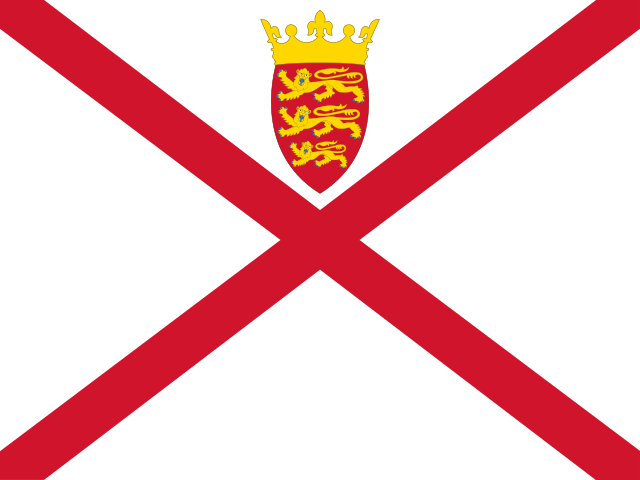
Jersey
Jersey is the largest of the Channel Islands, lying close to the Normandy coast of France. Its compact landscape combines farmland, wooded valleys, heathland, sandy bays and dramatic cliffs, particularly along the north coast. The island experiences some of Europe's largest tidal ranges, exposing extensive rocky shores, reefs and intertidal flats. A mild oceanic climate supports a mixture of British and continental European vegetation, while agriculture and settlement shape much of the interior.
Overview
Jersey is particularly interesting for coastal birds and migration. Headlands such as La Corbière and Noirmont provide good seawatching and passage migration, while wetlands including St Ouen's Pond attract ducks, waders, warblers and other migrants. Coastal cliffs and offshore rocks support Northern Fulmar, European Shag, Peregrine Falcon and breeding seabirds, while surrounding waters can produce shearwaters, skuas and gannets. Jersey's position near continental Europe means spring and autumn can bring a diverse range of migrants and occasional rarities. The island is small and easy to explore independently, with good roads and walking routes connecting most habitats.
Top 10 target species
| Species | Annual frequency | January | February | March | April | May | June | July | August | September | October | November | December |
|---|---|---|---|---|---|---|---|---|---|---|---|---|---|
| European Herring Gull Larus argentatus | 40.5% | 41.9% | 41.2% | 36.9% | 34.5% | 39.2% | 53.5% | 59.6% | 38.4% | 30.8% | 32.7% | 34.9% | 41.9% |
| Carrion Crow Corvus corone | 39.7% | 38.1% | 38.5% | 38.7% | 32.7% | 40.2% | 54.3% | 51.6% | 33.4% | 28.1% | 41.2% | 34.7% | 44.9% |
| Common Wood-Pigeon Columba palumbus | 34.7% | 34.2% | 32.9% | 34.6% | 30.6% | 38.2% | 48.8% | 47.3% | 33.6% | 25.2% | 29.0% | 29.7% | 32.5% |
| Eurasian Magpie Pica pica | 28.2% | 28.7% | 30.3% | 30.0% | 24.7% | 28.3% | 38.6% | 31.5% | 25.3% | 21.0% | 27.5% | 22.6% | 30.1% |
| European Robin Erithacus rubecula | 27.4% | 28.8% | 29.7% | 28.4% | 22.3% | 31.6% | 31.8% | 25.1% | 14.8% | 20.9% | 34.9% | 28.5% | 31.9% |
| Eurasian Blackbird Turdus merula | 25.8% | 28.3% | 30.0% | 22.3% | 23.0% | 32.8% | 44.1% | 31.6% | 13.1% | 10.0% | 23.0% | 25.1% | 26.3% |
| Eurasian Wren Troglodytes troglodytes | 24.3% | 18.9% | 19.0% | 27.2% | 23.6% | 29.8% | 39.5% | 30.1% | 18.8% | 14.4% | 26.7% | 20.8% | 23.0% |
| Eurasian Oystercatcher Haematopus ostralegus | 21.2% | 21.7% | 22.6% | 19.5% | 21.8% | 23.2% | 30.2% | 28.7% | 20.0% | 19.4% | 17.3% | 13.2% | 17.0% |
| Great Tit Parus major | 20.9% | 24.2% | 25.4% | 25.7% | 20.2% | 26.7% | 22.9% | 16.9% | 12.0% | 14.0% | 23.3% | 17.2% | 22.6% |
| Dunnock Prunella modularis | 19.5% | 20.6% | 21.1% | 23.7% | 21.6% | 23.3% | 29.5% | 21.5% | 7.2% | 9.5% | 21.9% | 17.5% | 16.7% |