
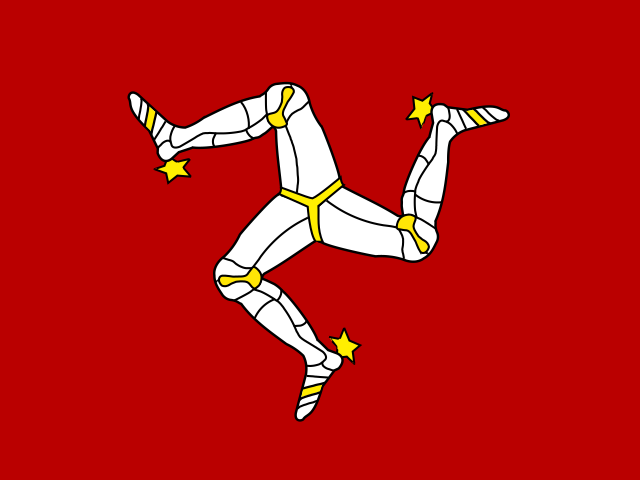
Isle of Man
The Isle of Man lies in the Irish Sea between Great Britain and Ireland, combining rugged coastline, rolling farmland, wooded valleys and open uplands. The central ridge rises to Snaefell, the island's highest point, with moorland and rough grassland covering much of the higher ground. Coastal scenery includes cliffs, rocky shores, sandy bays and small offshore islets. The island has a mild maritime climate, with cool summers, relatively mild winters and frequent wind and rain.
Overview
The Isle of Man offers varied seabird, coastal and upland birding in a compact area. The Calf of Man, off the southern tip, is particularly important for breeding seabirds and migration, with Manx Shearwater, Razorbill, Common Guillemot and Black Guillemot among the characteristic species. Coastal cliffs elsewhere support Northern Fulmar and Peregrine Falcon, while uplands hold Hen Harrier, European Golden Plover and Northern Wheatear. The island's position in the Irish Sea also brings good passage migration and occasional rarities. Birding is straightforward with good roads and walking trails, although visiting the Calf generally requires boat access and suitable weather.
Top 10 target species
| Species | Annual frequency | January | February | March | April | May | June | July | August | September | October | November | December |
|---|---|---|---|---|---|---|---|---|---|---|---|---|---|
| European Herring Gull Larus argentatus | 72.2% | 67.2% | 67.9% | 69.5% | 67.2% | 73.2% | 77.6% | 78.9% | 77.0% | 76.1% | 70.7% | 71.3% | 70.1% |
| Eurasian Jackdaw Coloeus monedula | 45.7% | 44.0% | 44.0% | 45.2% | 45.4% | 54.3% | 49.0% | 41.5% | 43.2% | 47.8% | 40.6% | 45.0% | 48.7% |
| Rook Corvus frugilegus | 37.0% | 35.7% | 34.7% | 37.2% | 39.5% | 40.3% | 38.3% | 31.2% | 31.7% | 39.3% | 35.8% | 39.3% | 40.4% |
| Eurasian Blackbird Turdus merula | 35.4% | 36.2% | 29.0% | 31.9% | 42.5% | 58.0% | 49.2% | 29.1% | 17.3% | 19.3% | 31.5% | 39.2% | 41.4% |
| European Robin Erithacus rubecula | 34.9% | 38.9% | 36.1% | 34.0% | 31.6% | 32.3% | 19.8% | 14.7% | 21.8% | 48.5% | 57.2% | 44.6% | 39.0% |
| Mallard Anas platyrhynchos | 34.8% | 31.9% | 37.4% | 40.5% | 38.9% | 37.7% | 31.4% | 29.2% | 29.3% | 30.8% | 37.2% | 37.1% | 35.7% |
| House Sparrow Passer domesticus | 34.2% | 34.2% | 28.7% | 33.1% | 35.8% | 43.0% | 44.9% | 41.6% | 29.8% | 26.8% | 25.6% | 32.9% | 34.1% |
| European Goldfinch Carduelis carduelis | 34.2% | 21.6% | 20.9% | 31.1% | 43.6% | 47.1% | 45.6% | 44.0% | 35.7% | 36.0% | 33.9% | 26.9% | 23.8% |
| Eurasian Oystercatcher Haematopus ostralegus | 34.0% | 25.8% | 32.0% | 34.9% | 33.4% | 35.9% | 39.4% | 39.8% | 36.4% | 36.3% | 35.0% | 30.2% | 28.3% |
| Great Black-backed Gull Larus marinus | 33.3% | 25.5% | 26.6% | 29.4% | 30.8% | 34.3% | 38.9% | 36.8% | 36.2% | 41.2% | 40.2% | 28.8% | 31.2% |