
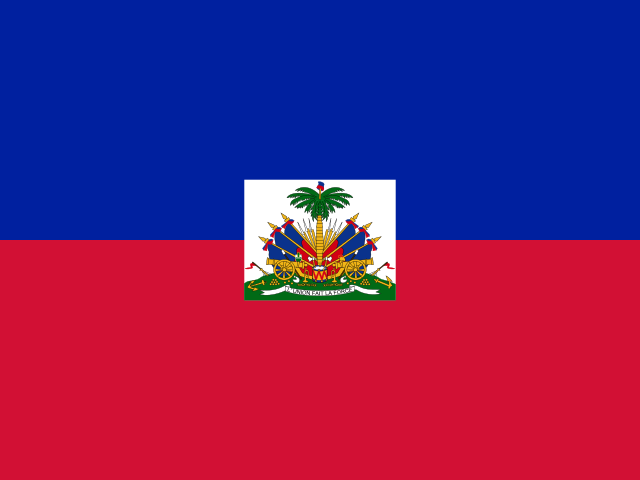
Haiti
Haiti occupies the western part of Hispaniola, with a landscape shaped by rugged mountain ranges, deeply cut valleys and a relatively narrow coastal plain. The Massif de la Selle and Massif de la Hotte contain some of the island's highest and most biologically important mountains, with humid forest surviving mainly in isolated protected areas. Much of the original vegetation has been heavily reduced, and extensive agricultural land and degraded slopes now dominate many parts of the country. The remaining forests are therefore particularly important for biodiversity and are concentrated in remote mountain areas. Haiti also includes several offshore islands and coastal wetlands, adding dry and marine habitats to the landscape.
Overview
Haiti shares Hispaniola's distinctive endemic bird fauna, making its remaining mountain forests particularly valuable. The Massif de la Selle and Massif de la Hotte hold species such as Hispaniolan Trogon, Hispaniolan Parakeet, Hispaniolan Emerald, Narrow-billed Tody and Hispaniolan Woodpecker. The remote forests of Massif de la Hotte are especially important for several restricted-range species. Haiti's birding potential is significant, but birding tourism is far less developed than in the Dominican Republic, and access to many important habitats can be difficult. Security conditions, limited infrastructure and rough mountain roads are practical considerations for visitors, making experienced local guides and careful trip planning important. For dedicated birders, Haiti can nevertheless complement a Dominican Republic trip by providing access to the western side of Hispaniola's endemic avifauna and some of the island's most threatened mountain habitats.
Top 10 target species
| Species | Annual frequency | January | February | March | April | May | June | July | August | September | October | November | December |
|---|---|---|---|---|---|---|---|---|---|---|---|---|---|
| Hispaniolan Woodpecker Melanerpes striatus | 49.4% | 48.6% | 53.4% | 52.9% | 51.0% | 54.4% | 55.2% | 43.9% | 52.0% | 50.3% | 46.3% | 42.2% | 42.3% |
| Mourning Dove Zenaida macroura | 49.1% | 40.8% | 50.0% | 51.5% | 56.6% | 58.4% | 69.9% | 55.6% | 52.1% | 55.4% | 38.4% | 24.7% | 36.4% |
| Bananaquit Coereba flaveola | 38.1% | 31.9% | 40.5% | 39.6% | 37.3% | 38.5% | 29.0% | 38.8% | 37.5% | 44.3% | 46.7% | 38.9% | 34.3% |
| Palmchat Dulus dominicus | 32.5% | 25.4% | 30.0% | 34.3% | 32.6% | 40.4% | 33.1% | 41.5% | 42.9% | 32.0% | 24.7% | 27.5% | 25.8% |
| Northern Mockingbird Mimus polyglottos | 29.2% | 30.3% | 28.4% | 32.8% | 32.8% | 36.7% | 39.7% | 20.1% | 17.2% | 27.1% | 29.6% | 28.2% | 26.9% |
| Gray Kingbird Tyrannus dominicensis | 25.1% | 24.2% | 27.8% | 27.0% | 30.1% | 28.7% | 29.1% | 24.8% | 26.4% | 25.1% | 19.1% | 15.5% | 23.0% |
| Yellow-faced Grassquit Tiaris olivaceus | 24.7% | 14.8% | 17.2% | 22.8% | 25.0% | 33.5% | 33.5% | 26.3% | 24.7% | 31.8% | 26.9% | 17.5% | 22.3% |
| Common Ground Dove Columbina passerina | 23.3% | 15.5% | 18.3% | 25.6% | 22.6% | 33.0% | 34.0% | 27.0% | 26.0% | 25.4% | 19.6% | 15.5% | 17.5% |
| Black-crowned Palm-Tanager Phaenicophilus palmarum | 21.4% | 22.4% | 25.1% | 21.4% | 21.9% | 27.1% | 29.6% | 18.9% | 12.9% | 16.4% | 18.9% | 25.2% | 17.4% |
| American Kestrel Falco sparverius | 20.3% | 18.0% | 18.8% | 19.4% | 20.9% | 23.6% | 19.9% | 24.2% | 19.8% | 19.6% | 19.4% | 17.4% | 22.4% |