
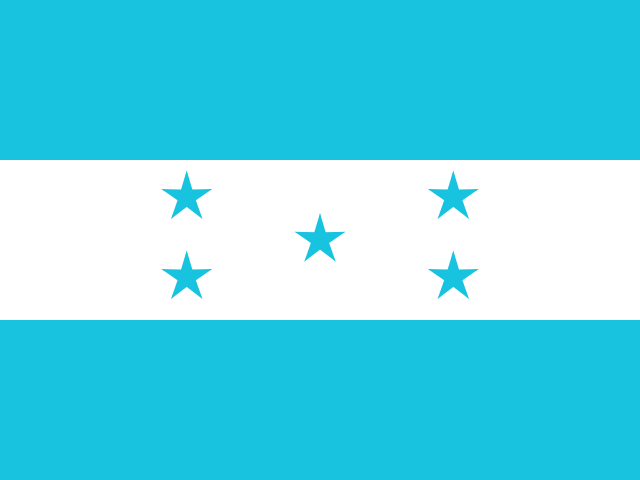
Honduras
Honduras is dominated by mountains and highland valleys, with narrow coastal lowlands along both the Caribbean and the Pacific. The Caribbean side is wetter, supporting tropical rainforest, mangroves and extensive lowland habitats, while the Pacific lowlands around the Gulf of Fonseca are warmer and seasonally drier. In the northeast, La Mosquitia is one of the country's most remote landscapes, with broad rivers, wetlands, rainforest and largely undeveloped coastal plains. Elevation creates another strong contrast, from tropical lowlands to cool pine and oak forests and cloud forest in the interior mountains. The western highlands contain some of the country's highest peaks, while the Bay Islands add a distinctly Caribbean environment offshore.
Overview
Honduras is particularly interesting for montane and Caribbean birding, with the Honduran Emerald standing out as the country's only endemic bird. Its dry-forest habitat in the interior is the focus of specialised trips, particularly around Yoro and the Gracias region. Lake Yojoa is one of the country's best-established birding areas, bringing together wetlands, forest and cloud forest within a compact region; more than 290 species have been recorded at nearby Los Naranjos. Pico Bonito National Park provides excellent Caribbean-slope rainforest and montane birding, while Cusuco National Park is notable for cloud-forest species and quetzals. The northern coast and Choluteca are also important for migrants. Honduras has a growing birding-tourism infrastructure, with established lodges, guides and visitor facilities at several major sites.
Top 10 target species
| Species | Annual frequency | January | February | March | April | May | June | July | August | September | October | November | December |
|---|---|---|---|---|---|---|---|---|---|---|---|---|---|
| Great-tailed Grackle Quiscalus mexicanus | 54.5% | 54.6% | 53.9% | 55.4% | 58.9% | 58.4% | 57.6% | 53.2% | 52.6% | 48.5% | 47.4% | 56.1% | 57.6% |
| Clay-colored Thrush Turdus grayi | 48.4% | 41.4% | 42.0% | 48.4% | 56.3% | 60.8% | 60.6% | 58.7% | 51.4% | 41.4% | 38.5% | 40.8% | 40.8% |
| Golden-fronted Woodpecker Melanerpes aurifrons | 46.6% | 42.0% | 43.7% | 49.3% | 52.9% | 52.6% | 50.4% | 48.6% | 48.1% | 43.9% | 39.7% | 42.5% | 45.2% |
| Black Vulture Coragyps atratus | 46.2% | 48.4% | 48.2% | 46.6% | 46.0% | 43.2% | 39.6% | 42.2% | 47.0% | 48.5% | 49.3% | 47.4% | 47.8% |
| White-winged Dove Zenaida asiatica | 45.4% | 43.9% | 43.9% | 48.8% | 50.8% | 51.9% | 50.2% | 46.3% | 45.2% | 39.9% | 37.9% | 42.6% | 43.3% |
| Melodious Blackbird Dives dives | 40.9% | 37.4% | 36.1% | 41.6% | 44.6% | 45.3% | 43.8% | 45.2% | 43.0% | 36.9% | 38.2% | 39.3% | 39.8% |
| Turkey Vulture Cathartes aura | 36.4% | 41.2% | 39.9% | 37.8% | 38.1% | 32.1% | 29.9% | 31.5% | 33.7% | 37.0% | 37.5% | 37.9% | 39.6% |
| Great Kiskadee Pitangus sulphuratus | 28.7% | 27.9% | 29.3% | 29.9% | 27.9% | 29.2% | 28.1% | 29.9% | 30.1% | 27.8% | 27.0% | 28.3% | 28.7% |
| Tropical Kingbird Tyrannus melancholicus | 28.1% | 29.3% | 28.4% | 26.1% | 24.8% | 26.3% | 26.8% | 28.6% | 30.6% | 29.2% | 26.9% | 29.8% | 30.3% |
| Social Flycatcher Myiozetetes similis | 26.6% | 26.2% | 27.2% | 27.3% | 25.7% | 26.3% | 27.3% | 26.4% | 26.4% | 26.1% | 25.2% | 27.6% | 27.7% |