
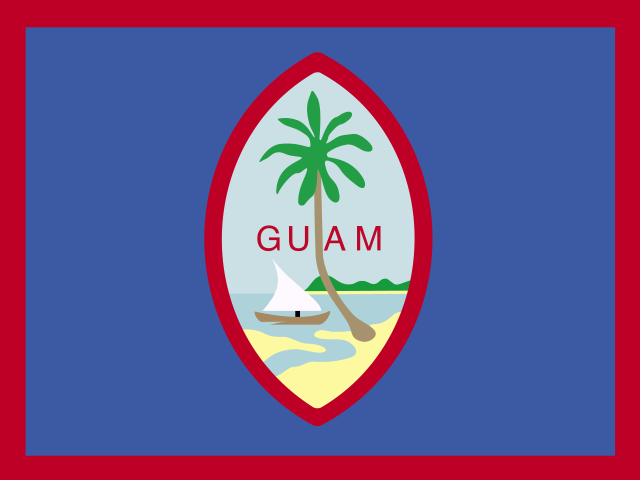
Guam
Guam is the largest and southernmost of the Mariana Islands, a U.S. territory in the western Pacific. The northern half is dominated by a raised limestone plateau, while the south is older and volcanic, with rolling hills, river valleys and the island's highest peaks. Native limestone forest, savanna, wetlands and mangroves survive alongside extensive urban and military development. Guam has a warm, humid tropical climate with a pronounced rainy season and is regularly affected by typhoons. Its position near the Mariana Trench places it within a geologically active part of the Pacific. Despite its relatively small size, Guam is densely populated and has substantially more infrastructure than most neighbouring Micronesian islands.
Overview
Guam is unusual among Pacific islands because its native bird fauna has been devastated by the introduced Brown Treesnake. Several species have disappeared from the wild on Guam, including the Guam Kingfisher (Sihek) and Guam Rail, although both survive through conservation programmes and the rail has been re-established on predator-free islands. Consequently, Guam offers fewer native forest birds than the nearby Northern Marianas. Remaining species include Mariana Swiftlet, Micronesian Starling and Mariana Fruit Dove, while wetlands and coastlines attract shorebirds, herons and seabirds. Ritidian Point in the Guam National Wildlife Refuge protects important limestone forest and coastal habitat. Guam is straightforward to explore thanks to good roads and extensive tourism infrastructure, but for specialist birders its greatest interest lies in island conservation and the dramatic ecological effects of invasive species, rather than a large endemic list.
Top 10 target species
| Species | Annual frequency | January | February | March | April | May | June | July | August | September | October | November | December |
|---|---|---|---|---|---|---|---|---|---|---|---|---|---|
| Eurasian Tree Sparrow Passer montanus | 43.2% | 44.5% | 48.9% | 48.6% | 42.7% | 48.2% | 45.0% | 48.3% | 44.0% | 34.0% | 39.2% | 37.0% | 37.7% |
| Pacific Reef-Heron Egretta sacra | 32.3% | 29.7% | 29.5% | 30.1% | 29.5% | 29.4% | 29.3% | 31.3% | 36.6% | 33.4% | 38.8% | 32.8% | 36.8% |
| Philippine Collared-Dove Streptopelia dusumieri | 30.9% | 32.9% | 28.9% | 29.3% | 27.2% | 30.7% | 24.0% | 39.4% | 34.2% | 29.9% | 26.9% | 34.0% | 32.7% |
| Pacific Golden-Plover Pluvialis fulva | 28.0% | 36.0% | 33.7% | 43.7% | 33.3% | 4.1% | 1.6% | 0.3% | 11.4% | 44.0% | 40.2% | 44.2% | 44.0% |
| Yellow Bittern Botaurus sinensis | 26.9% | 31.9% | 28.5% | 28.1% | 20.0% | 28.2% | 21.3% | 25.8% | 25.5% | 22.1% | 25.1% | 30.6% | 36.3% |
| Black Drongo Dicrurus macrocercus | 22.9% | 22.3% | 21.6% | 23.8% | 24.6% | 22.0% | 24.1% | 30.2% | 22.2% | 20.0% | 20.9% | 22.6% | 20.2% |
| Eurasian Whimbrel Numenius phaeopus | 18.0% | 20.5% | 16.2% | 21.9% | 17.7% | 8.9% | 7.1% | 6.1% | 10.2% | 30.1% | 28.0% | 28.0% | 21.4% |
| Gray-tailed Tattler Tringa brevipes | 17.9% | 20.4% | 18.4% | 18.1% | 18.0% | 13.3% | 9.6% | 10.5% | 17.4% | 21.1% | 23.7% | 24.2% | 20.6% |
| Ruddy Turnstone Arenaria interpres | 16.2% | 18.6% | 15.6% | 16.5% | 13.2% | 8.7% | 4.4% | 4.7% | 15.7% | 24.6% | 25.8% | 23.9% | 23.3% |
| Blue-billed White-Tern Gygis candida | 15.2% | 19.2% | 18.4% | 16.4% | 16.9% | 20.3% | 17.3% | 11.9% | 12.8% | 10.4% | 11.6% | 12.5% | 15.2% |