
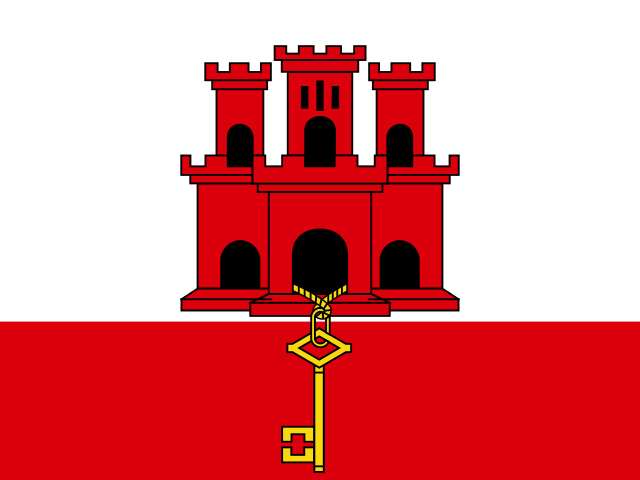
Gibraltar
Gibraltar is a small British territory at the southern tip of the Iberian Peninsula, dominated by the dramatic limestone Rock of Gibraltar, which rises steeply above the Strait of Gibraltar. Its compact landscape combines cliffs, Mediterranean scrub, urban areas and a narrow coastline. The Upper Rock preserves most of the territory's natural vegetation and is also famous for its population of Barbary macaques. Gibraltar has a Mediterranean climate with hot, dry summers and mild winters, strongly influenced by the surrounding sea and frequent winds through the strait.
Overview
Gibraltar is internationally famous for raptor migration between Europe and Africa. The narrow Strait of Gibraltar funnels huge numbers of soaring birds across the sea, particularly Black Kites, European Honey Buzzards, Booted and Short-toed Snake Eagles, and White Storks. Spring and autumn can produce spectacular visible migration, with Europa Point and the Upper Rock among the main observation areas. Seabirds, including Cory's and Balearic Shearwaters, also pass through the strait. Gibraltar is extremely easy to explore independently due to its tiny size, although the best migration movements depend strongly on wind direction and weather conditions. Its principal attraction is unquestionably the opportunity to watch mass migration between two continents.
Top 10 target species
| Species | Annual frequency | January | February | March | April | May | June | July | August | September | October | November | December |
|---|---|---|---|---|---|---|---|---|---|---|---|---|---|
| Yellow-legged Gull Larus michahellis | 55.3% | 54.6% | 44.3% | 53.4% | 53.1% | 52.8% | 69.9% | 57.8% | 61.6% | 56.3% | 52.6% | 52.2% | 54.4% |
| Eurasian Blackbird Turdus merula | 35.7% | 41.4% | 30.0% | 41.8% | 53.2% | 44.9% | 34.1% | 16.9% | 22.2% | 37.1% | 39.7% | 36.0% | 31.7% |
| Sardinian Warbler Curruca melanocephala | 35.4% | 41.6% | 30.8% | 44.2% | 49.0% | 34.5% | 24.8% | 14.5% | 25.9% | 41.0% | 47.5% | 43.0% | 28.5% |
| House Sparrow Passer domesticus | 30.1% | 33.0% | 23.5% | 27.6% | 38.5% | 41.6% | 39.4% | 27.1% | 22.3% | 24.3% | 19.3% | 27.7% | 37.4% |
| Northern Gannet Morus bassanus | 25.3% | 38.9% | 47.8% | 31.5% | 13.7% | 8.7% | 11.7% | 16.6% | 16.4% | 17.4% | 24.6% | 29.5% | 47.1% |
| Rock Pigeon Columba livia | 22.4% | 36.6% | 17.6% | 18.3% | 23.1% | 25.0% | 27.5% | 21.5% | 13.3% | 18.8% | 17.3% | 24.0% | 25.9% |
| Eurasian Blackcap Sylvia atricapilla | 21.9% | 30.8% | 23.1% | 26.0% | 29.4% | 19.2% | 21.7% | 7.1% | 9.4% | 19.9% | 29.0% | 26.5% | 20.4% |
| Black Redstart Phoenicurus ochruros | 21.2% | 50.1% | 35.3% | 34.2% | 0.9% | 0.0% | 0.6% | 0.1% | 0.0% | 0.4% | 21.6% | 58.6% | 52.1% |
| Black-headed Gull Chroicocephalus ridibundus | 19.3% | 28.7% | 40.7% | 21.1% | 2.7% | 2.3% | 5.1% | 16.4% | 19.1% | 15.9% | 15.1% | 22.9% | 42.0% |
| European Shag Gulosus aristotelis | 18.9% | 21.6% | 30.5% | 19.7% | 11.8% | 17.8% | 15.7% | 25.0% | 19.8% | 11.2% | 10.9% | 16.7% | 26.7% |