
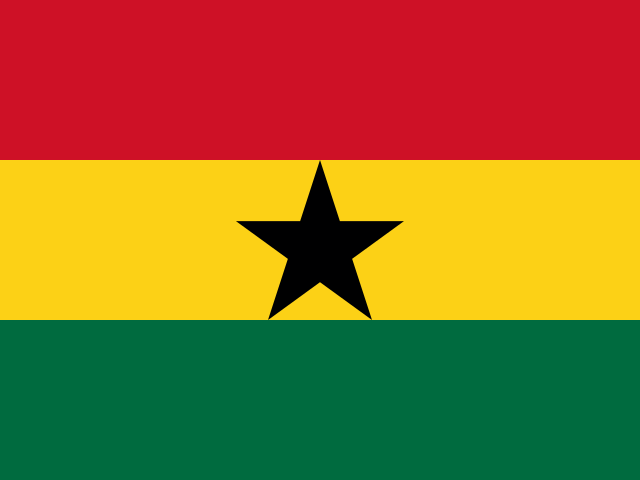
Ghana
Ghana stretches from the Gulf of Guinea through humid tropical forests to the drier Guinea savannas of the north. The south and southwest contain the country's richest remaining rainforest, while central Ghana forms a transition of woodland and agricultural landscapes. Lake Volta, one of the world's largest artificial lakes by surface area, dominates the east, and the Volta Basin and coastal lagoons provide extensive freshwater and wetland habitats.
Overview
Nigeria combines West African rainforest, Guinea savanna and Sahel bird communities, with several particularly important sites. Okomu National Park and remaining southern forests support species such as Grey-necked Rockfowl, Yellow-casqued Hornbill and Black-casqued Hornbill, while the Jos Plateau is notable for the endemic Jos Plateau Indigobird and restricted-range Rock Firefinch. In the southeast, the Obudu Plateau adds montane species associated with the Cameroon Highlands. Nigeria has considerable bird diversity but is not an easy birding destination: specialist tourism infrastructure is limited, habitat loss is significant, and security conditions restrict travel in parts of the country. Local knowledge and experienced guides are particularly valuable when planning visits.
Top 10 target species
| Species | Annual frequency | January | February | March | April | May | June | July | August | September | October | November | December |
|---|---|---|---|---|---|---|---|---|---|---|---|---|---|
| Common Bulbul Pycnonotus barbatus | 45.3% | 40.5% | 44.4% | 43.0% | 40.7% | 47.6% | 51.1% | 51.1% | 48.8% | 46.9% | 44.6% | 41.4% | 44.2% |
| Pied Crow Corvus albus | 43.5% | 35.9% | 39.3% | 39.2% | 38.7% | 54.2% | 44.3% | 52.1% | 50.7% | 48.5% | 41.8% | 38.9% | 38.8% |
| Laughing Dove Spilopelia senegalensis | 35.1% | 26.3% | 28.9% | 31.1% | 27.9% | 38.6% | 44.7% | 45.8% | 43.1% | 38.7% | 35.1% | 29.9% | 30.7% |
| Red-eyed Dove Streptopelia semitorquata | 34.5% | 32.3% | 30.6% | 24.7% | 27.7% | 31.8% | 36.5% | 43.8% | 43.2% | 41.9% | 33.6% | 31.3% | 36.4% |
| Black Kite Milvus migrans | 30.2% | 36.7% | 40.6% | 42.4% | 38.6% | 43.1% | 19.2% | 2.0% | 1.5% | 20.4% | 37.5% | 39.4% | 41.2% |
| West African Pied Hornbill Lophoceros semifasciatus | 28.6% | 29.8% | 29.7% | 26.3% | 26.9% | 25.5% | 20.1% | 29.9% | 32.1% | 33.5% | 28.9% | 29.7% | 30.5% |
| Western Cattle-Egret Ardea ibis | 27.9% | 25.6% | 28.6% | 30.4% | 26.3% | 30.1% | 30.1% | 28.1% | 27.3% | 27.4% | 24.4% | 28.2% | 28.1% |
| Western Plantain-eater Crinifer piscator | 24.4% | 21.1% | 20.9% | 21.6% | 20.0% | 25.6% | 35.1% | 27.8% | 28.4% | 27.6% | 23.6% | 20.3% | 20.9% |
| Bronze Mannikin Spermestes cucullata | 23.9% | 17.7% | 18.1% | 18.8% | 16.3% | 26.8% | 29.7% | 30.3% | 30.6% | 29.8% | 25.8% | 21.8% | 21.6% |
| Northern Gray-headed Sparrow Passer griseus | 22.8% | 14.1% | 15.1% | 17.5% | 16.7% | 22.6% | 30.2% | 35.1% | 31.6% | 31.1% | 24.7% | 18.1% | 16.7% |