
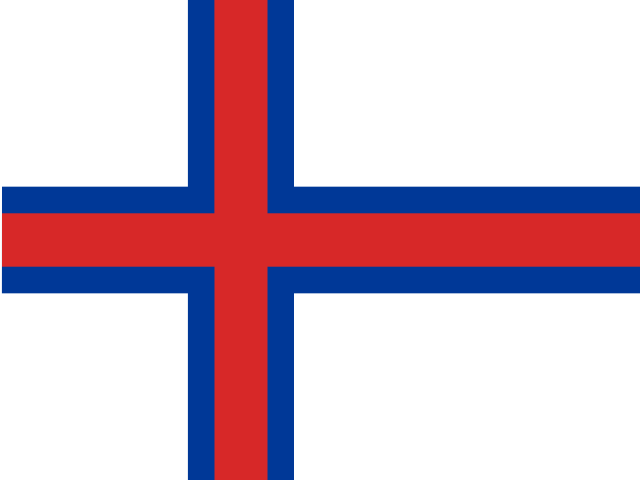
Faroe Islands
The Faroe Islands are a remote North Atlantic archipelago of 18 mountainous volcanic islands between Iceland and Scotland. Their dramatic landscape is dominated by steep sea cliffs, narrow fjords, grassy slopes and treeless uplands, with settlements clustered along sheltered coasts. The islands have a cool oceanic climate, with mild winters, cool summers and frequent rain, fog and strong winds. Almost no natural woodland occurs, and traditional sheep grazing has strongly shaped the open grassland landscape. Tunnels, bridges and ferries connect much of the archipelago despite its rugged terrain.
Overview
The Faroes are best known for spectacular North Atlantic seabird colonies. Cliffs and offshore stacks support Atlantic Puffin, Northern Fulmar, Black-legged Kittiwake, Common Guillemot, Razorbill and Northern Gannet, while uplands hold European Golden Plover, Eurasian Oystercatcher and Whimbrel. Mykines is the most famous birding destination, with easily observed puffins and a major gannet colony on nearby Mykineshólmur. The islands can also attract interesting migrants and occasional rarities, particularly in autumn. Birding independently is generally straightforward, but weather, steep terrain and ferry or helicopter schedules can complicate access to remote islands. Some seabird areas have seasonal access restrictions to protect breeding colonies.
Top 10 target species
| Species | Annual frequency | January | February | March | April | May | June | July | August | September | October | November | December |
|---|---|---|---|---|---|---|---|---|---|---|---|---|---|
| European Starling Sturnus vulgaris | 60.1% | 72.1% | 63.1% | 52.4% | 60.8% | 61.1% | 52.7% | 36.7% | 45.4% | 54.5% | 71.8% | 77.1% | 73.3% |
| European Herring Gull Larus argentatus | 58.1% | 82.4% | 77.5% | 63.4% | 58.3% | 44.0% | 41.6% | 32.0% | 46.7% | 51.7% | 57.8% | 67.7% | 74.6% |
| Hooded Crow Corvus cornix | 52.6% | 67.8% | 63.9% | 52.3% | 51.6% | 41.6% | 39.4% | 24.8% | 39.7% | 48.4% | 61.7% | 66.1% | 73.4% |
| Common Eider Somateria mollissima | 44.6% | 59.0% | 49.0% | 49.6% | 40.8% | 41.2% | 38.2% | 36.1% | 42.6% | 43.1% | 44.3% | 42.3% | 49.1% |
| Rock Pigeon Columba livia | 44.4% | 62.0% | 50.7% | 36.0% | 40.8% | 35.1% | 34.4% | 27.3% | 36.8% | 43.8% | 52.3% | 55.7% | 58.2% |
| Mallard Anas platyrhynchos | 44.3% | 59.3% | 59.0% | 52.8% | 48.0% | 44.0% | 28.6% | 13.9% | 21.8% | 34.1% | 48.2% | 63.3% | 58.8% |
| Great Black-backed Gull Larus marinus | 37.1% | 49.2% | 42.3% | 42.6% | 34.9% | 27.7% | 26.4% | 22.6% | 34.1% | 38.7% | 33.8% | 45.4% | 47.7% |
| Northern Fulmar Fulmarus glacialis | 36.4% | 25.2% | 36.0% | 31.3% | 38.5% | 37.0% | 49.8% | 47.0% | 57.9% | 46.5% | 14.0% | 23.5% | 30.5% |
| Eurasian Oystercatcher Haematopus ostralegus | 33.4% | 10.2% | 17.1% | 52.6% | 58.9% | 56.4% | 58.7% | 50.6% | 45.4% | 22.0% | 11.7% | 10.8% | 6.8% |
| House Sparrow Passer domesticus | 29.9% | 31.5% | 25.3% | 22.1% | 30.5% | 28.4% | 27.8% | 22.0% | 25.4% | 31.2% | 43.9% | 43.5% | 27.9% |