
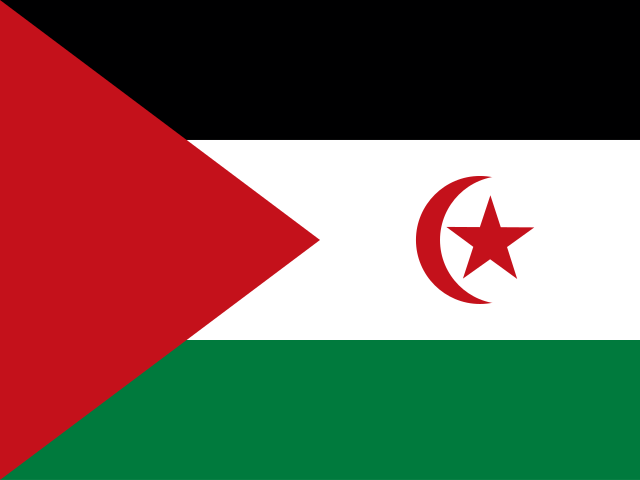
Western Sahara
Western Sahara is a disputed territory on the Atlantic edge of the Sahara, largely controlled by Morocco, with the remainder administered by the Sahrawi Arab Democratic Republic. Most of the landscape consists of extremely arid rocky plains, sand dunes and desert plateaus, with almost no permanent surface water. The long Atlantic coastline adds cliffs, beaches, lagoons and extensive tidal flats, where the cool Canary Current moderates temperatures and produces frequent coastal fog. Vegetation is sparse except around wadis, oases and wetter coastal sites.
Overview
Western Sahara offers distinctive Saharan and Atlantic coastal birding. Desert habitats support Greater Hoopoe-Lark, Bar-tailed Lark, Cream-coloured Courser, Black-crowned Sparrow-Lark, Desert Sparrow and sandgrouse, while wadis and isolated vegetation can concentrate migrants. Dakhla Bay is the territory's standout birding area, with extensive tidal flats attracting flamingos, spoonbills, gulls, terns and large numbers of shorebirds; Royal Tern and Audouin's Gull are characteristic coastal species. The Dakhla area is relatively accessible and has substantial tourism infrastructure, although specialist birding services are limited. Travel away from established roads requires greater care: the territory's unresolved political status, military zones and landmines, especially around the Moroccan-controlled berm and remote inland areas, make some regions unsafe or inaccessible.
Top 10 target species
| Species | Annual frequency | January | February | March | April | May | June | July | August | September | October | November | December |
|---|---|---|---|---|---|---|---|---|---|---|---|---|---|
| Barn Swallow Hirundo rustica | 18.7% | 24.9% | 30.9% | 29.9% | 24.7% | 11.9% | 18.3% | 10.8% | 33.3% | 22.5% | 0.7% | 5.0% | 11.0% |
| Greater Flamingo Phoenicopterus roseus | 18.4% | 9.4% | 12.4% | 12.7% | 7.0% | 9.2% | 1.3% | 26.3% | 60.4% | 39.6% | 7.5% | 19.2% | 16.3% |
| Lesser Black-backed Gull Larus fuscus | 17.7% | 21.5% | 24.2% | 26.2% | 18.4% | 7.9% | 5.1% | 3.6% | 20.8% | 15.4% | 7.5% | 31.0% | 30.2% |
| Greater Hoopoe-Lark Alaemon alaudipes | 16.3% | 27.0% | 24.2% | 26.9% | 15.2% | 14.7% | 11.4% | 8.6% | 0.0% | 11.7% | 13.1% | 14.6% | 28.2% |
| Little Egret Egretta garzetta | 15.8% | 11.5% | 12.5% | 15.5% | 11.2% | 5.3% | 1.3% | 12.1% | 52.1% | 33.9% | 2.0% | 14.1% | 17.6% |
| Caspian Tern Hydroprogne caspia | 15.7% | 14.4% | 18.0% | 21.3% | 15.6% | 5.3% | 11.7% | 10.8% | 25.0% | 14.1% | 4.1% | 24.1% | 24.4% |
| Great Gray Shrike Lanius excubitor | 15.6% | 32.1% | 24.1% | 30.3% | 16.5% | 11.3% | 8.9% | 0.1% | 8.3% | 19.4% | 5.6% | 7.3% | 23.1% |
| House Sparrow Passer domesticus | 15.1% | 15.8% | 19.7% | 22.4% | 14.4% | 3.4% | 11.8% | 9.2% | 14.6% | 18.9% | 14.5% | 14.3% | 22.2% |
| Eurasian Collared-Dove Streptopelia decaocto | 15.0% | 25.0% | 21.0% | 24.4% | 19.0% | 6.0% | 3.9% | 3.6% | 8.3% | 21.3% | 6.6% | 16.4% | 23.9% |
| Gray Heron Ardea cinerea | 13.4% | 12.4% | 14.9% | 13.9% | 8.6% | 1.3% | 0.0% | 9.2% | 20.8% | 29.5% | 10.1% | 19.1% | 21.2% |