
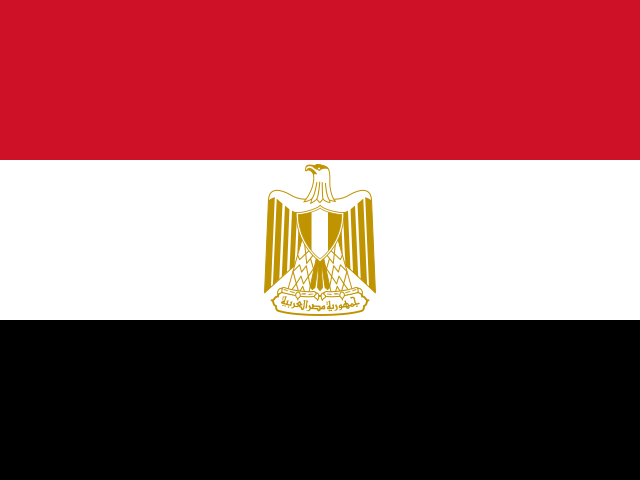
Egypt
Egypt is dominated by the Sahara Desert, with most of its population and fertile land concentrated along the Nile Valley and Nile Delta. West of the river stretches the vast Western Desert with dunes, rocky plateaus and isolated oases, while the Sinai Peninsula combines desert plains with rugged mountains rising above 2,600 metres. Egypt's Mediterranean and Red Sea coastlines add lagoons, saltmarshes, mangroves and coral-fringed shores. The climate is overwhelmingly hot and arid, moderated somewhat along the Mediterranean coast.
Overview
Egypt occupies a crucial position on the Eurasia–Africa migration flyway, particularly for soaring birds avoiding long sea crossings. The Gulf of Suez and Red Sea coast can produce spectacular movements of storks, eagles, buzzards and other raptors, while the Nile Delta and northern lakes host huge numbers of waterbirds and migrants. Lake Nasser is notable for African species reaching their northern limits, including African Pied Wagtail and Yellow-billed Stork, while Sinai supports desert specialties such as Sinai Rosefinch, Sand Partridge and Hooded Wheatear. Egypt has good general tourism infrastructure but relatively limited specialist birding infrastructure. Some desert, border and military areas have restricted access or permit requirements, making local knowledge valuable when planning birding routes.
Top 10 target species
| Species | Annual frequency | January | February | March | April | May | June | July | August | September | October | November | December |
|---|---|---|---|---|---|---|---|---|---|---|---|---|---|
| Laughing Dove Spilopelia senegalensis | 54.3% | 57.0% | 55.7% | 48.6% | 45.2% | 51.4% | 65.8% | 64.1% | 57.7% | 46.5% | 52.3% | 49.7% | 58.2% |
| House Sparrow Passer domesticus | 51.1% | 53.6% | 54.1% | 48.7% | 44.0% | 50.8% | 65.2% | 56.0% | 51.4% | 39.5% | 47.6% | 49.2% | 53.6% |
| Hooded Crow Corvus cornix | 48.7% | 59.2% | 51.3% | 46.5% | 38.3% | 41.9% | 55.1% | 48.7% | 47.3% | 39.5% | 45.8% | 51.9% | 59.2% |
| Rock Pigeon Columba livia | 44.0% | 43.8% | 42.2% | 43.6% | 40.0% | 41.6% | 51.6% | 42.6% | 43.9% | 39.7% | 44.4% | 47.0% | 48.0% |
| Barn Swallow Hirundo rustica | 43.3% | 39.3% | 38.9% | 48.7% | 58.9% | 56.2% | 38.2% | 40.2% | 33.6% | 41.1% | 45.5% | 37.0% | 42.3% |
| Little Egret Egretta garzetta | 31.6% | 35.3% | 29.0% | 22.9% | 24.0% | 27.3% | 32.9% | 32.5% | 32.0% | 30.7% | 34.2% | 37.9% | 40.5% |
| Western Cattle-Egret Ardea ibis | 30.7% | 37.2% | 30.2% | 25.5% | 29.0% | 29.7% | 35.2% | 32.7% | 28.0% | 29.1% | 26.1% | 30.2% | 35.4% |
| Spur-winged Lapwing Vanellus spinosus | 28.1% | 31.6% | 26.7% | 23.6% | 24.6% | 27.0% | 27.4% | 32.0% | 27.7% | 26.5% | 27.9% | 29.8% | 32.5% |
| Common Hoopoe Upupa epops | 26.6% | 24.5% | 24.7% | 27.2% | 22.8% | 23.2% | 33.6% | 28.3% | 29.3% | 27.9% | 24.4% | 27.2% | 26.8% |
| Pied Kingfisher Ceryle rudis | 24.6% | 34.2% | 25.2% | 20.0% | 16.7% | 20.2% | 23.1% | 25.7% | 20.3% | 20.1% | 25.2% | 31.3% | 33.6% |