
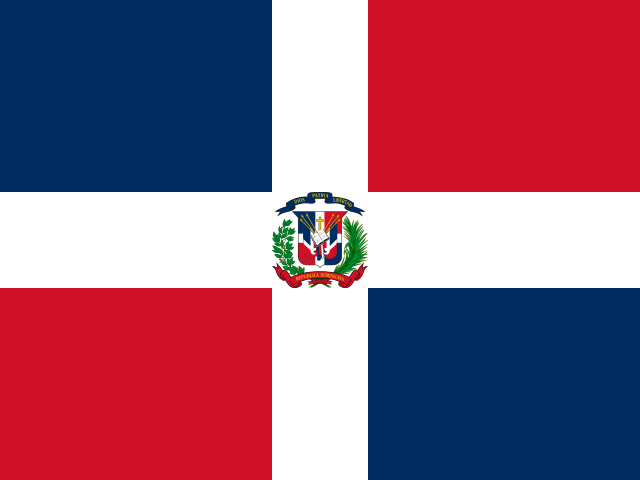
Dominican Republic
The Dominican Republic occupies the eastern part of Hispaniola, with a remarkably varied landscape for a Caribbean country. The Cordillera Central contains the island's highest mountains, while the southwest combines dry forests, limestone landscapes, coastal lagoons and the striking Lake Enriquillo, the Caribbean's largest lake. The Sierra de Bahoruco rises sharply from the dry southwest into pine forests, humid montane forest and cloud forest, creating strong ecological contrasts over relatively short distances. The northern and eastern parts of the country are generally more humid, with extensive agricultural areas and tropical lowland vegetation. Offshore islands and coastal wetlands add further habitats. The country's most distinctive geographical feature is this combination of high mountains and unusually dry landscapes within a tropical Caribbean setting.
Overview
The Dominican Republic is one of the Caribbean's best destinations for Hispaniolan endemic birds. The outstanding area is Sierra de Bahoruco, where roughly 30 of Hispaniola's endemic species can be found, including Hispaniolan Trogon, Broad-billed Tody, Hispaniolan Crossbill, Western Chat-Tanager and Antillean Siskin. The critically endangered Ridgway's Hawk and Bay-breasted Cuckoo are among the more sought-after species, while the mountains also provide habitat for Black-capped Petrel. Constanza and Valle Nuevo offer a different high-elevation community, while Salinas de Baní is useful for shorebirds and winter migrants. The southwest is the main focus for serious endemic-oriented trips; some Bahoruco sites involve rough roads and 4×4 access, making a local guide particularly useful.
Top 10 target species
| Species | Annual frequency | January | February | March | April | May | June | July | August | September | October | November | December |
|---|---|---|---|---|---|---|---|---|---|---|---|---|---|
| Hispaniolan Woodpecker Melanerpes striatus | 58.7% | 55.0% | 55.9% | 53.6% | 55.6% | 59.6% | 61.2% | 64.4% | 60.3% | 64.3% | 61.3% | 58.1% | 55.7% |
| Palmchat Dulus dominicus | 50.7% | 45.4% | 41.3% | 43.4% | 49.2% | 54.6% | 56.0% | 57.6% | 55.8% | 59.5% | 52.3% | 47.5% | 45.6% |
| Gray Kingbird Tyrannus dominicensis | 48.9% | 47.4% | 41.6% | 45.3% | 47.8% | 51.5% | 53.4% | 54.3% | 49.8% | 50.6% | 48.1% | 48.2% | 48.3% |
| Bananaquit Coereba flaveola | 46.0% | 46.8% | 48.2% | 44.0% | 40.4% | 45.2% | 38.6% | 46.3% | 48.6% | 52.7% | 51.4% | 46.6% | 42.9% |
| Antillean Palm Swift Tachornis phoenicobia | 45.6% | 43.5% | 39.6% | 42.2% | 42.9% | 48.8% | 51.6% | 54.8% | 54.4% | 53.3% | 41.4% | 36.7% | 37.7% |
| Northern Mockingbird Mimus polyglottos | 41.8% | 42.4% | 37.8% | 39.0% | 38.3% | 44.6% | 40.5% | 39.9% | 38.5% | 49.2% | 47.5% | 41.7% | 42.2% |
| Mourning Dove Zenaida macroura | 31.2% | 28.9% | 28.1% | 33.5% | 34.4% | 38.3% | 32.6% | 36.4% | 34.0% | 33.9% | 28.5% | 21.6% | 24.6% |
| Greater Antillean Grackle Quiscalus niger | 27.1% | 24.7% | 23.2% | 25.5% | 27.1% | 28.4% | 30.5% | 31.9% | 26.7% | 25.4% | 26.9% | 29.6% | 25.2% |
| Hispaniolan Mango Anthracothorax dominicus | 24.8% | 23.1% | 23.1% | 23.8% | 23.1% | 28.3% | 23.7% | 26.2% | 23.7% | 26.3% | 28.6% | 23.7% | 23.8% |
| White-winged Dove Zenaida asiatica | 24.6% | 17.1% | 21.3% | 25.7% | 27.3% | 35.6% | 32.9% | 32.7% | 27.5% | 26.6% | 21.2% | 14.5% | 12.2% |