
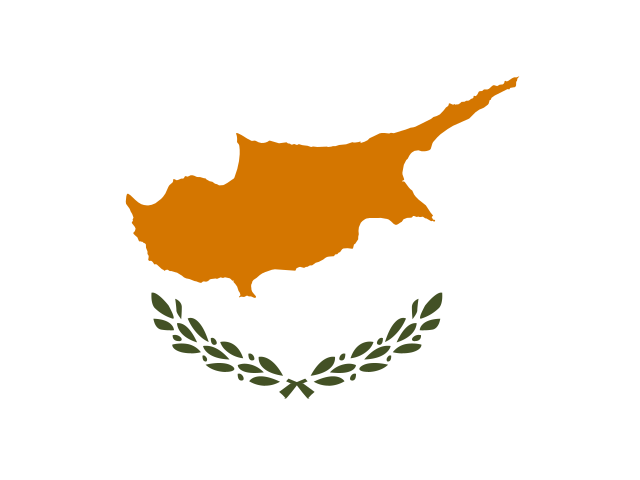
Cyprus
Cyprus is a large eastern Mediterranean island with landscapes ranging from the forested Troodos Mountains to dry lowlands, agricultural plains, rocky coastlines and salt lakes. The central Mesaoria Plain separates the Troodos from the smaller Kyrenia Range in the north, while extensive pine forests survive at higher elevations. Coastal habitats include beaches, cliffs, wetlands and Mediterranean scrub. Cyprus has hot, dry summers and mild, wetter winters, with cooler conditions and occasional heavy snowfall in the highest mountains. Its position at the crossroads of Europe, Asia and Africa has strongly influenced both its natural environment and long human history.
Overview
Cyprus is especially rewarding for endemics and migration, lying on a major route between Europe and Africa. Its signature birds are the endemic Cyprus Warbler and Cyprus Wheatear, both readily sought during the breeding season. Akrotiri Salt Lake, Larnaca Salt Lake and Paphos Headland are major migration sites, attracting flamingos, herons, shorebirds, raptors and large numbers of passerines. The Troodos Mountains add forest species, including the distinctive endemic subspecies of Eurasian Jay and Coal Tit. Spring and autumn are particularly productive, when migration can produce impressive variety and occasional rarities. Cyprus has good roads, plentiful accommodation and an active birding community, making independent birding straightforward. Some areas, particularly military zones and parts of the island's buffer zone, have restricted access.
Top 10 target species
| Species | Annual frequency | January | February | March | April | May | June | July | August | September | October | November | December |
|---|---|---|---|---|---|---|---|---|---|---|---|---|---|
| Hooded Crow Corvus cornix | 32.9% | 31.7% | 33.0% | 41.4% | 41.1% | 33.1% | 33.3% | 26.2% | 27.3% | 27.2% | 36.4% | 32.5% | 32.0% |
| Barn Swallow Hirundo rustica | 28.6% | 0.9% | 20.4% | 50.7% | 51.3% | 44.7% | 48.6% | 42.0% | 34.7% | 25.0% | 21.1% | 3.2% | 1.2% |
| Sardinian Warbler Curruca melanocephala | 28.4% | 28.3% | 32.2% | 37.0% | 35.3% | 27.7% | 22.2% | 17.7% | 22.5% | 25.6% | 29.8% | 30.0% | 32.2% |
| Eurasian Kestrel Falco tinnunculus | 27.5% | 26.4% | 27.3% | 33.1% | 31.7% | 24.5% | 28.8% | 18.9% | 20.9% | 26.7% | 33.7% | 28.5% | 28.9% |
| Common Wood-Pigeon Columba palumbus | 27.1% | 20.9% | 23.3% | 30.3% | 33.8% | 32.2% | 33.4% | 31.8% | 28.2% | 23.9% | 27.0% | 20.8% | 19.7% |
| House Sparrow Passer domesticus | 26.3% | 18.8% | 23.1% | 34.4% | 40.3% | 31.6% | 32.3% | 26.2% | 20.7% | 23.1% | 24.3% | 20.5% | 20.8% |
| Crested Lark Galerida cristata | 21.0% | 14.5% | 21.6% | 32.9% | 31.9% | 20.9% | 19.7% | 15.3% | 16.4% | 23.3% | 23.5% | 18.1% | 14.2% |
| European Stonechat Saxicola rubicola | 20.5% | 43.1% | 44.6% | 29.0% | 0.6% | 0.0% | 0.0% | 0.0% | 0.0% | 0.1% | 28.4% | 51.9% | 48.3% |
| European Goldfinch Carduelis carduelis | 20.2% | 21.7% | 23.1% | 25.9% | 24.2% | 20.2% | 20.0% | 17.2% | 13.4% | 12.8% | 18.8% | 23.1% | 22.4% |
| Great Tit Parus major | 18.0% | 18.6% | 20.6% | 23.7% | 24.4% | 17.2% | 12.5% | 12.0% | 13.5% | 14.2% | 19.4% | 19.9% | 19.4% |